


Satisfaction of Khorasan Razavi Sample Farmers From Saffron Burning is a mistranslated headline from a 2019 report about farmers using Iran’s saffron commodity exchange. Nothing was being burned. The subject was the saffron bourse: a regulated market where eligible lots could be stored, documented and traded.
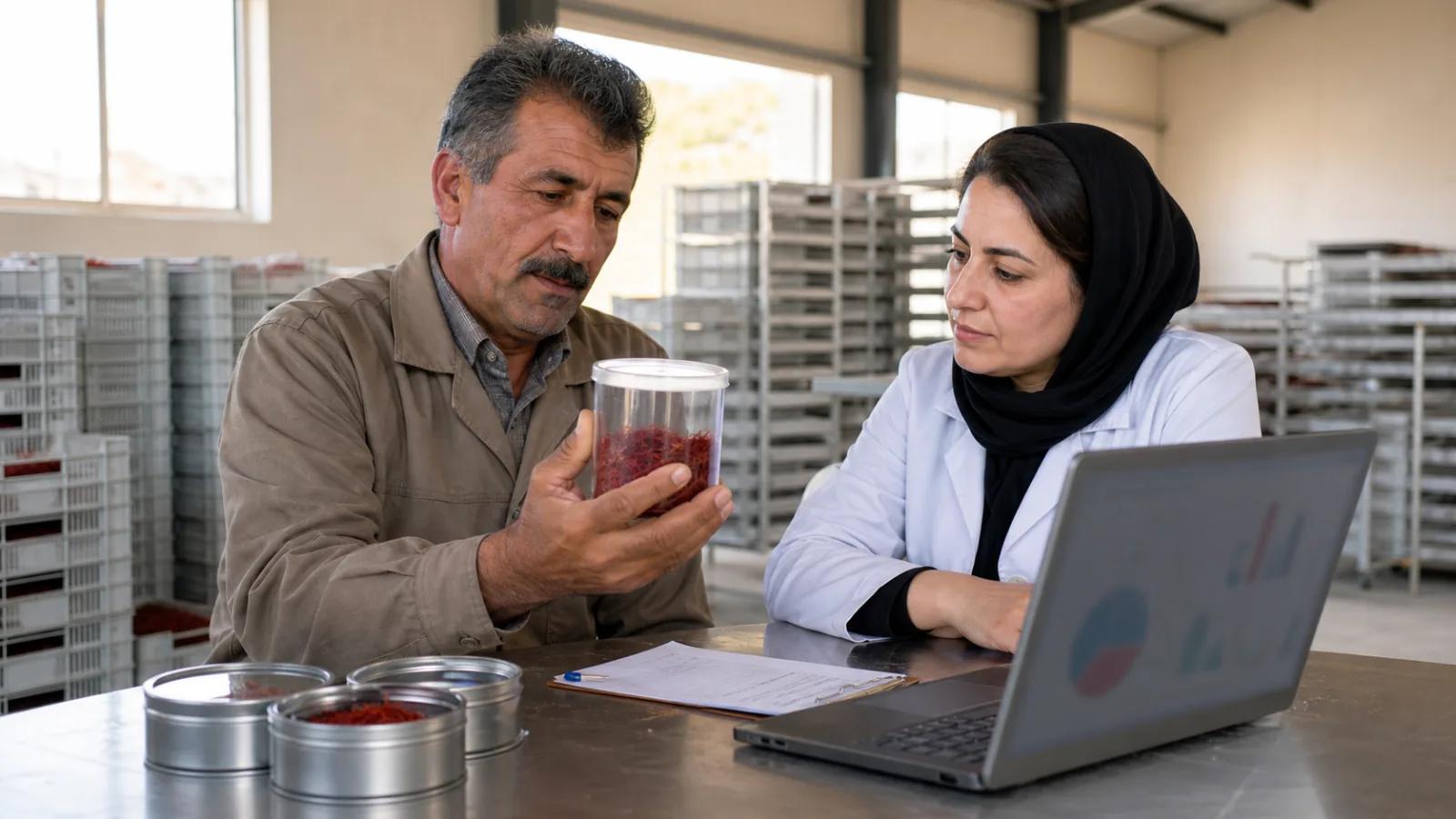
The original report quoted Hamid Banaei, then a member of Iran’s parliament, praising the exchange and its new saffron futures and options. He argued that a clearer marketplace could help growers see prices, reduce dependence on informal dealing and retain more of the value created by their crop. Those are useful aims, but an exchange does not guarantee every farmer a higher price or eliminate every intermediary.
Why Khorasan farmers were interested in the saffron exchange
Khorasan Razavi and South Khorasan sit at the heart of Iranian saffron production. A recent FAO account puts Iran’s share at roughly 85–90% of world production and describes saffron as an important livelihood for small farms in both provinces. For growers, the price received after weeks of careful harvesting and hand separation matters as much as the size of the crop.
Banaei said sample farmers attending an exchange event appeared pleased with the opportunity to offer saffron through the market. The report’s larger point was that farmers wanted a sale route with visible rules, recognized grades and less uncertainty about who would buy their product.
That does not mean every middleman is unnecessary. Warehousing, testing, aggregation, finance, packaging and transport are real services. The question is whether their costs and terms are transparent, and whether the grower can compare them with another route to market.
The reported 36-kilogram harvest needs context
The historical article describes one sample farmer producing 36 kilograms of dried saffron per hectare, compared with a previous average of 3–4 kilograms. It then links the result to renewed confidence created by exchange trading.
The figure is preserved because it was central to the original report, but no farm record, plot size, crop age, irrigation plan or independent measurement accompanied it. It should therefore be read as an attributed account, not a normal yield benchmark. More importantly, a trading platform cannot directly create biological yield. Soil, corm health, planting density, field age, water timing, nutrition, disease pressure, harvest speed and drying practice all affect the amount and quality recovered.
A better expected selling price may encourage a farmer to invest in those practices. That is an economic incentive, not proof that the exchange caused the reported harvest.
How exchange-traded saffron works
Physical saffron does not become interchangeable merely because it enters a market. The lot has to match the exchange’s rules for an accepted warehouse, product type, grade, weight and documentation. In Iran’s warehouse-receipt system, approved saffron is deposited, assessed and represented by a tradable certificate. The buyer trades the documented lot rather than relying only on a seller’s description.
This can improve price discovery because offers and completed trades are more visible. It can also make quality differences easier to describe. It does not establish one “real price” for all saffron: crop year, thread style, laboratory results, package, payment terms, volume and export services can still justify different prices.
Our practical guide to saffron traded on the commodity exchange explains the warehouse-receipt route and the checks a grower or buyer should make before treating a quoted price as comparable.
Futures and options manage price risk; they do not insure the crop
The 2019 report says futures and options could “insure” a farmer’s sale. Hedging is the more accurate term. A futures position can offset some loss from an adverse price move, while an option can give its buyer a contractual right at a stated price in return for a premium. Neither protects the field against poor yield, contamination, theft or a lot failing the contract specification.
Official CFTC education on agricultural futures also makes clear that standardized contracts have fixed quantities, qualities, delivery points and dates. Positions can require margin, and many are offset before delivery. A grower considering an Iranian saffron contract needs the current local contract specification and advice from an authorized market professional; a general article cannot determine whether a particular hedge fits that grower’s crop and cash flow.
Before relying on a hedge, a farmer should understand:
- which saffron grade and approved warehouse the contract recognizes;
- the contract size, expiry, delivery and settlement rules;
- warehouse, testing, brokerage and transaction costs;
- premium or margin requirements and the consequence of an adverse move;
- whether enough buyers and sellers are present to enter or exit at a fair price.
What determines whether farmers actually benefit
Transparent trading is valuable only when growers can use it. A small producer may need a cooperative or aggregator because one harvest is below the contract size. The time between warehouse delivery and payment matters when labour must be paid immediately. A distant approved warehouse can make transport and handling costs decisive.
Quality rules also have to be understood before harvest. If growers know how moisture, foreign matter, colour strength and thread form affect acceptance, the exchange can reward better handling. If a lot is rejected after the farmer has already paid for transport and storage, formal trading may be less attractive than a local cash buyer.
The original report also connected the exchange with branding, exports and rural employment. A documented lot can support traceability, but a certificate is not an export brand by itself. Buyers still need consistent processing, safe packaging, accurate origin information, dependable shipment and a supplier who resolves complaints. Those services create jobs beyond cultivation without pretending that every task can be removed from the chain.
A fair reading of the farmers’ satisfaction
The farmers’ reported enthusiasm makes sense. In 2019, a more visible saffron market offered hope that careful production could be recognized and that growers would have another selling choice. Banaei also offered parliamentary support if rules needed revision to help agricultural commodities trade effectively.
The durable test is practical rather than ceremonial: can a farmer understand the specification, deliver an eligible lot, compare all costs, receive payment on workable terms and manage risk without taking on obligations they do not understand? When those conditions are met, exchange trading can be a useful part of the saffron market. When they are not, the promise of a transparent price may remain out of reach for the people who produced the crop.
Sources
- The historical statements attributed to Hamid Banaei and sample farmers in the original 2019 version of this post.
- Iranian Agriculture News Agency: saffron warehouse-receipt trading.
- FAO: innovation and quality integrity in Iran’s saffron value chain.
- U.S. Commodity Futures Trading Commission: how futures markets and agricultural hedging work (general education, not Iranian contract advice).

![Exporting Saffron to Turkey + Price Guide [Complete 0 to 100]](https://img.rowhanisaffron.com/20260827003933/saffron-export-turkey-quality-inspection.webp)



