


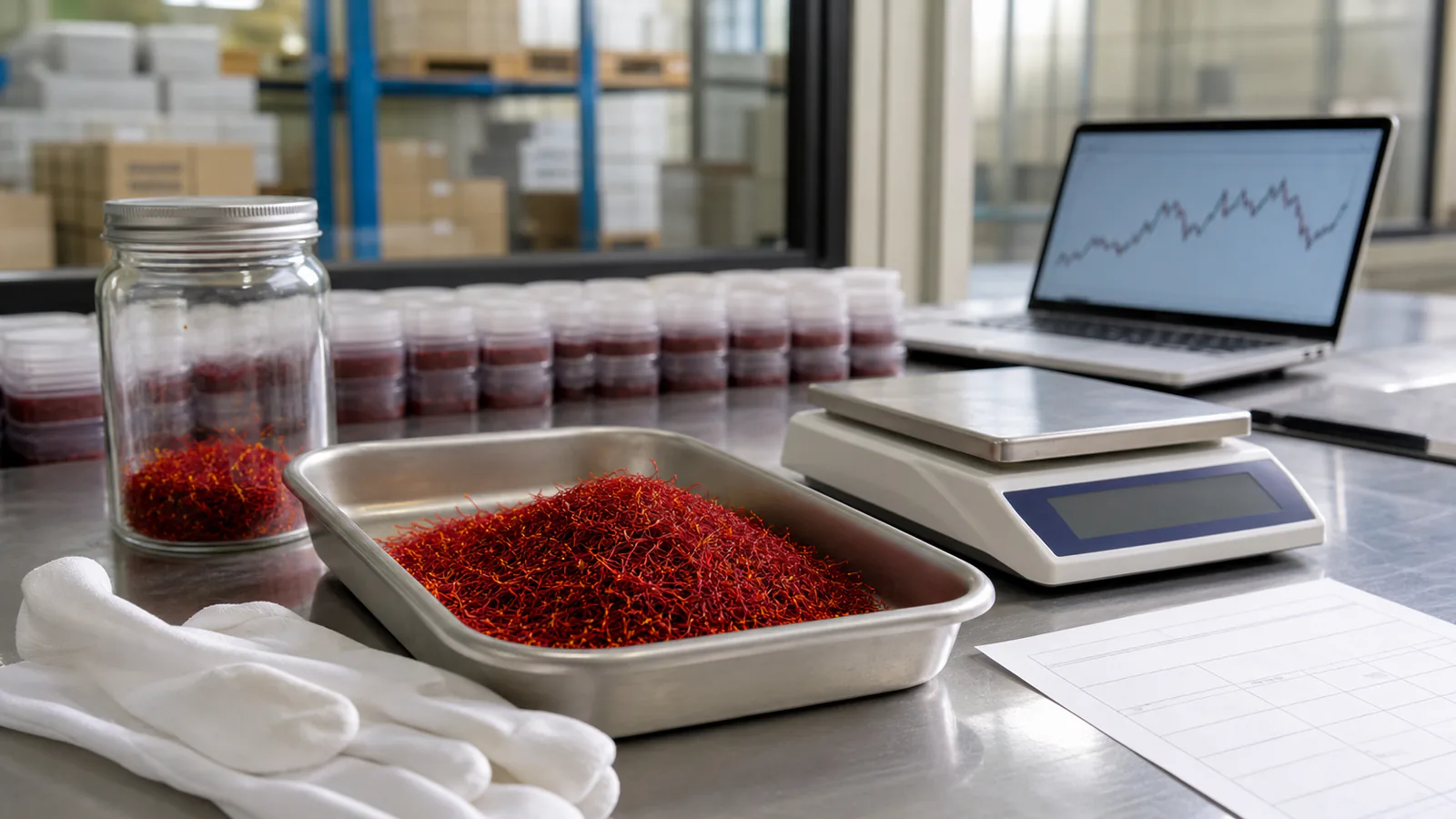
Saffron is traded on the Iran Mercantile Exchange to turn a variable physical crop into a standardised, storable and tradable commodity. Approved warehouses inspect eligible saffron and issue commodity deposit certificates. Those certificates can be traded, used for delivery and connected to other financial instruments.
The exchange can make price formation and quality rules more visible. It cannot, by itself, guarantee a fair outcome for every farmer, build an international brand or remove all fraud and intermediaries from the saffron trade.
Why saffron suits an exchange market
Saffron has several characteristics that make an organised market useful. It is high in value relative to its weight, can be stored when handled correctly, and can be divided into standard units. At the same time, prices move sharply and quality is not uniform.
Iran has historically produced most of the world’s saffron, yet much of the value after harvest has depended on grading, storage, finance, packaging, distribution and access to foreign buyers. The 2016 argument for exchange trading was therefore less about growing more and more about strengthening the commercial part of the chain.
How a saffron commodity certificate works
- A producer or owner delivers an eligible grade of saffron to an exchange-approved warehouse.
- The warehouse samples, weighs and evaluates the lot against the applicable specification.
- If accepted, the warehouse records the commodity and a deposit certificate represents the approved quantity.
- The certificate can be offered through authorised market channels without moving the physical saffron for each trade.
- A holder who meets the applicable quantity, fee and timing rules can request physical delivery.
The contract, warehouse and expiry rules matter. A certificate is not simply a digital photograph of any saffron bag. It represents a defined commodity held under a particular warehouse arrangement.
What standardisation contributes
A public price is useful only when buyers understand what it prices. Warehouse admission connects the trade with named grades, sampling and measurable conditions. That can reduce disputes caused by one seller quoting a premium grade while another quotes a weaker product under the same general word “saffron.”
Standardisation can also discourage some forms of substitution, but it does not make the wider market fraud-free. Testing is limited to the rules and sample applied to the warehouse lot. Retail packs, informal transactions and exports outside that chain still require their own controls and traceability.
Price discovery and transparency
An exchange brings bids and offers into a recorded venue. Instead of a price known only inside a small chain of traders, participants can see transactions for a specified certificate. This can provide a reference point for farmers, processors, merchants and buyers.
The reference is not a universal saffron price. Different grades, harvest years, warehouses, delivery costs, currencies and export conditions can produce different values. A thin market can also be volatile. Transparency improves information; it does not remove supply-and-demand risk.
The saffron derivative market
A saffron derivative market adds contracts whose value relates to the underlying commodity or certificates. Futures can allow a participant to lock in a future purchase or sale price, while commodity funds offer indirect financial exposure. These tools may support risk management and financing, but they also introduce leverage, liquidity, timing and basis risk.
They are not the same as buying saffron for cooking or taking delivery for export. A grower, warehouse operator, processor, trader and financial investor enter the market with different objectives. Any participant needs the current contract specification and applicable regulatory advice, not a historical blog post.
A 2017 report from Iran’s Agricultural News Agency records the official launch rationale: certificates for a stronger cash market and financing, followed by futures, options and commodity-fund development for risk management.
Possible benefits for producers
- A visible reference price: a farmer can compare a local offer with recorded trades for a defined grade.
- Stored value: an accepted lot can remain in a warehouse while its certificate is traded.
- Quality incentive: published admission rules can reward preparation that meets the specification.
- Financing potential: eligible certificates may support approved financing arrangements.
- Risk tools: suitable commercial participants may use derivatives to manage future price exposure.
Access is not automatic. Small producers may face sampling, transport, storage, brokerage, documentation and minimum-delivery requirements. Cooperatives and service providers can help, but their costs and incentives also need scrutiny.
The competitive concerns behind the 2016 proposal
The original analysis contrasted Iran’s large production base with stronger branding and market access by Afghanistan and Spain. It cited Afghanistan’s 2013 taste-and-quality award, Spain’s role in packing and re-exporting imported saffron, and investment in Afghan cultivation as warnings that production volume alone did not secure market leadership.
It also listed domestic risks: high production costs, weak genetic records, inconsistent sanitary or organic practice, volatile prices, misuse of Iranian identity, unhealthy competition and a fragmented export chain. Proposed responses included an independent saffron organisation, crop-income insurance, soil improvement, stronger research priorities, HACCP-based management, contract purchasing, pharmaceutical research and better promotion.
Those ideas cover production, processing and trade—the “sustainability triangle” described in the original article. Exchange trading addresses only part of that triangle. It cannot substitute for plant-health work, food safety, credible certification, market development or direct relationships with international buyers.
How to read the old production figures
The 2016 article reported 261 tonnes of production, more than 92 percent of global output, and exports of 139 tonnes worth US$419 million for the Iranian year 1391. Its reference to “78 hectares” appears to have lost the word “thousand” in translation and should not be repeated as a precise area without the underlying dataset.
It also compared Canadian wheat, Kazakh grain, Indonesian palm oil, Chinese medicinal plants and agricultural exchanges in the Americas. Those examples expressed a policy argument; they do not establish a World Trade Organization rule granting price-control rights when a country supplies 58 percent of a product. No such claim should guide a current trading decision.
What has happened since
Saffron certificates and financial products did develop beyond the tentative trades described in 2016. A March 2026 market report, citing Iran Mercantile Exchange activity, recorded continued trading in saffron commodity deposit certificates and saffron-based commodity funds. That confirms an operating market, not that every original policy goal has been achieved.
Success should be measured with evidence: participation across farms and regions, warehouse accessibility, grading consistency, trading depth, the relationship between certificate and farm-gate prices, delivery performance, export uptake and the share of final value reaching producers.
Why saffron is traded on the Commodity Exchange
The short answer is price discovery, standardisation, storage, financing and risk management. These are useful commercial tools for a crop with high value and volatile prices. Their benefit depends on sound warehouse rules, meaningful participation and transparent costs.
The exchange is infrastructure, not a complete saffron strategy. Iran’s wider position still depends on cultivation, clean processing, traceable quality, honest branding and buyers who value the finished product.

![Exporting Saffron to Turkey + Price Guide [Complete 0 to 100]](https://img.rowhanisaffron.com/20260827003933/saffron-export-turkey-quality-inspection.webp)



