


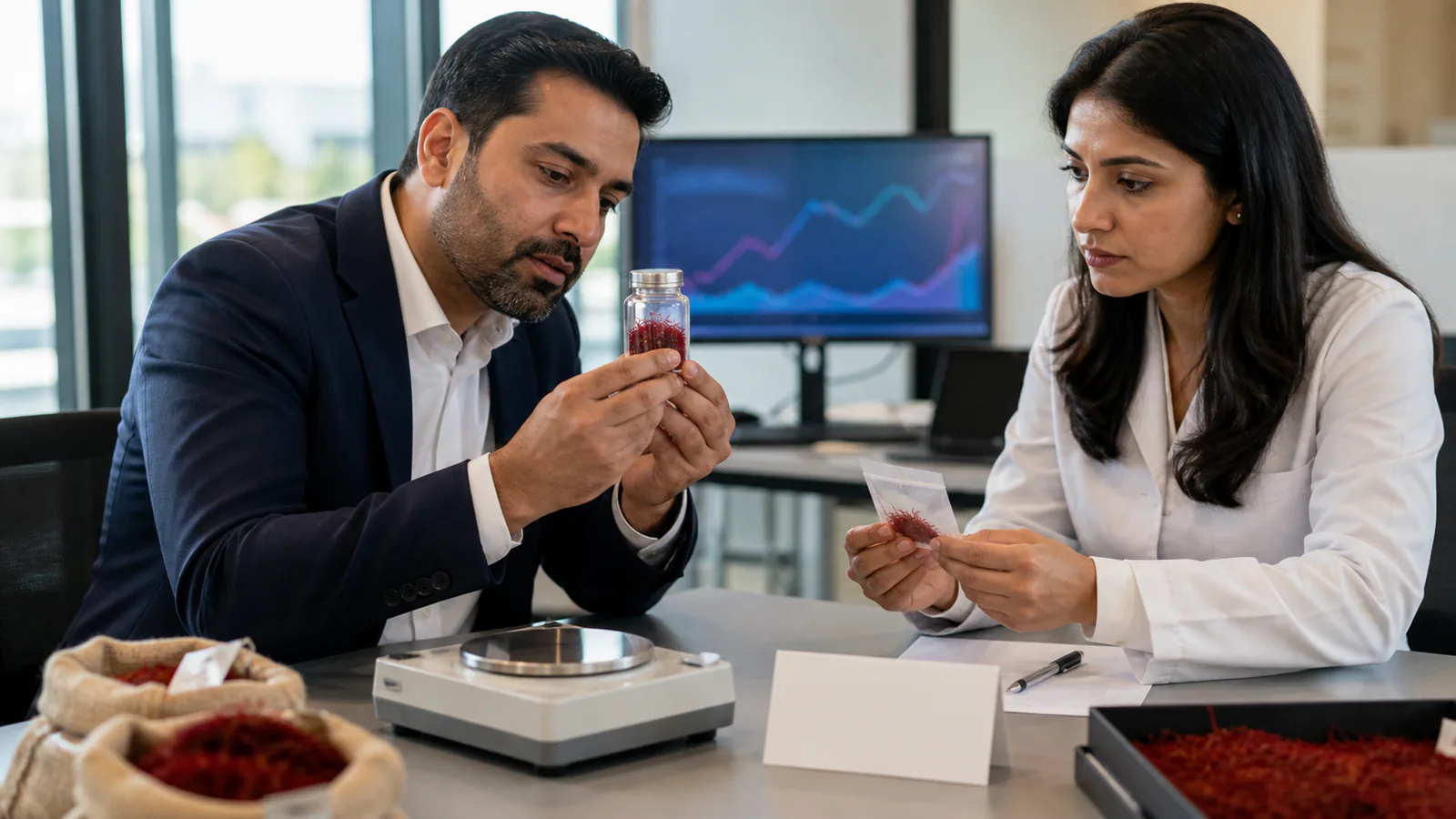
Saffron is traded on the Commodity Exchange is the title of a 2016 report about plans to move more Iranian saffron business onto the Iran Mercantile Exchange. Agriculture officials argued that an organised market could improve price transparency, standardisation, access to finance and confidence among growers, suppliers and international buyers.
The source describes a policy meeting and a proposed transition, not a live trading screen or a current contract specification. Anyone intending to trade needs the exchange’s present rules, approved brokers, product notices and settlement terms. This article explains what the officials were trying to achieve and separates physical saffron trade from the saffron derivative market.
What officials proposed at the meeting
According to the Iranian Students News Agency (ISNA), Hassan Khadangi, then director general of a Ministry of Agriculture bureau covering vegetables, ornamental and medicinal plants, said the ministry had long considered supplying saffron through the Agricultural Commodity Exchange. He asked exchange managers, brokers, suppliers and buyers to help develop trading.
Khadangi presented saffron as a strategic crop with unusual global importance. His goal was an organised venue where bids and offers could meet under stated rules rather than a promise that every saffron sale should occur in one place.
The production and export figures need careful units
The report gives a cultivated area of “78 hectares,” production above 261 tonnes and a share above 92% of world saffron. Seventy-eight hectares cannot plausibly produce 261 tonnes of dried saffron. The area almost certainly lost a thousands separator or word in translation, but this page does not have enough evidence to replace it with a guessed number.
It also says that in year 91 Iran exported “more than 139 saffron” and earned the equivalent of $419 million. The missing unit after 139 was probably a weight, and “91” appears to be an abbreviated Iranian-calendar year, but neither should be silently completed. The figures are preserved as the meeting’s reported context, not presented as a clean current dataset.
How a commodity exchange can improve price discovery
Khadangi believed that transparent supply and demand on the exchange would reveal a more realistic price and direct more benefit to growers and suppliers. An exchange can publish bids, offers and completed trades under a common specification. That gives participants a reference point that may be clearer than isolated private quotations.
It does not guarantee a high price. A transparent market can move down as well as up, and the price only represents the grade, delivery place, contract size and timing specified. A grower also needs access to grading, storage, finance and an eligible broker before an exchange price becomes practically available.
Physical saffron trade and derivatives are different
A physical or spot transaction exchanges saffron for payment according to agreed quality and delivery terms. A derivative is a contract whose value comes from an underlying commodity or reference price. Futures can help a commercial participant manage price risk, but they also create margin, liquidity and settlement obligations.
The World Federation of Exchanges explains that commodity-derivatives venues connect contracts to real-world supply, storage, delivery and consumption. It also distinguishes physically settled contracts, where the underlying goods are delivered, from cash-settled contracts, where the price difference is paid.
For readers searching saffron derivative market, that distinction is the starting point. The 2016 meeting discussed placing saffron within an organised commodity-market structure. It does not, by itself, identify which saffron futures, options, warehouse receipts or spot contracts are available today.
Who is the saffron exchange owner?
The search phrase saffron exchange owner can suggest that saffron itself has a separate exchange owned by one trader. That is not what this report describes. It refers to the Iran Mercantile Exchange as a trading venue and to the Ministry of Agriculture as a policy participant. Farmers, suppliers and buyers would remain owners of their goods or contractual positions according to the applicable rules.
Corporate ownership, governance and broker authorisation can change. A prospective participant should use the exchange’s current official corporate disclosures and the relevant securities regulator rather than infer ownership from a historical news article or from the person quoted in it.
Why standards were essential to the proposal
Mohammad Reza, whose family name is rendered as “Sacred” in the translated source, represented the horticulture function of the Khorasan Razavi Agriculture Organization. He listed saffron-production standards among the main requirements for exchange trading.
That requirement is fundamental. Buyers cannot bid meaningfully if one lot’s grade, moisture, foreign matter, colour strength, pack and origin are not comparable with another’s. A warehouse or delivery system also needs sampling rules, approved testing, lot identity and procedures for a dispute. Standardisation does not make every lot identical; it makes the differences visible.
The expected benefits went beyond price
The speaker’s list of potential benefits included price transparency, fewer unnecessary intermediaries, fraud prevention, Iranian saffron branding, a stronger place in global trade, investment and financial-market development, more orderly money flows and a more efficient distribution network.
Each benefit depends on execution. Fewer intermediaries are helpful only if essential grading, storage, packing and distribution services remain available. A listed product does not prevent fraud unless identity and custody are checked. Branding improves when the delivered lot consistently matches its description, not merely because it appears on an exchange.
Competitors, volatility and weak branding drove urgency
The meeting cited new and established competitors, sharp price swings, products sold under the name of Iranian saffron, unhealthy competition among traders, missing genetic registration and the absence of a strong international Iranian brand. China and Afghanistan were named as competitors with lower production costs.
Officials feared that rising Iranian production costs and a weak market strategy could surrender influence despite Iran’s large production share. Their answer was not only more output. They wanted more control over standards, pricing information, marketing and distribution.
The billion-dollar goal was conditional
The translated report contains a contradictory sentence about whether saffron exports could exceed one billion dollars. The following sentence makes clear that any such ambition depended on higher yield and production and on better organisation of domestic and overseas markets through the exchange. It should be read as an aspirational scenario, not a forecast achieved by listing saffron.
The same speaker claimed that World Trade Organization rules gave a country producing and supplying 58% of a product a right to an international exchange and influence over production policy, pricing, marketing and monitoring. The report cites no WTO agreement or provision for that assertion. It must not be treated as an established WTO rule.
Education and incentives were part of the decision
Both officials recognised that suppliers, buyers and brokers needed information and reasons to participate. At the end of the meeting, the participants decided that the Khorasan agriculture organisation would coordinate cultural or educational activity with the exchange and use available incentives to organise saffron suppliers.
This addressed a practical obstacle. A modern trading mechanism cannot work if growers do not understand grade requirements, delivery processes, fees, payment timing and price risk. Nor can it work without enough genuine buyers and brokers to create liquidity.
What a saffron exchange does not solve by itself
An exchange is market infrastructure, not a cure for every weakness in the saffron trade. It cannot by itself increase field yield, lower production costs, build an international brand or guarantee exports. It can support those goals when the product specification, warehouses, laboratories, brokers and settlement process are credible.
The transition from traditional saffron trade to a modern organised market was described at the meeting as difficult and time-consuming. That is a more realistic conclusion than the source’s strongest promises. Good infrastructure changes behaviour gradually, as participants learn that the published rules and delivered goods can be trusted.
How to read saffron exchange and trade information
A reader researching a saffron exchange or saffron trade should identify the instrument before comparing any price. Ask whether the quote concerns physical saffron, a warehouse receipt, a futures contract or another derivative. Then check the grade, contract size, currency, delivery month, settlement method, warehouse or delivery point and timestamp.
This historical article explains why Iranian officials wanted those mechanisms. It is not a current invitation to invest and does not provide a broker, contract symbol or live price. The lasting principle is straightforward: transparent trading helps only when everyone understands what is being traded and the lot or contract can be verified.

![Exporting Saffron to Turkey + Price Guide [Complete 0 to 100]](https://img.rowhanisaffron.com/20260827003933/saffron-export-turkey-quality-inspection.webp)



