


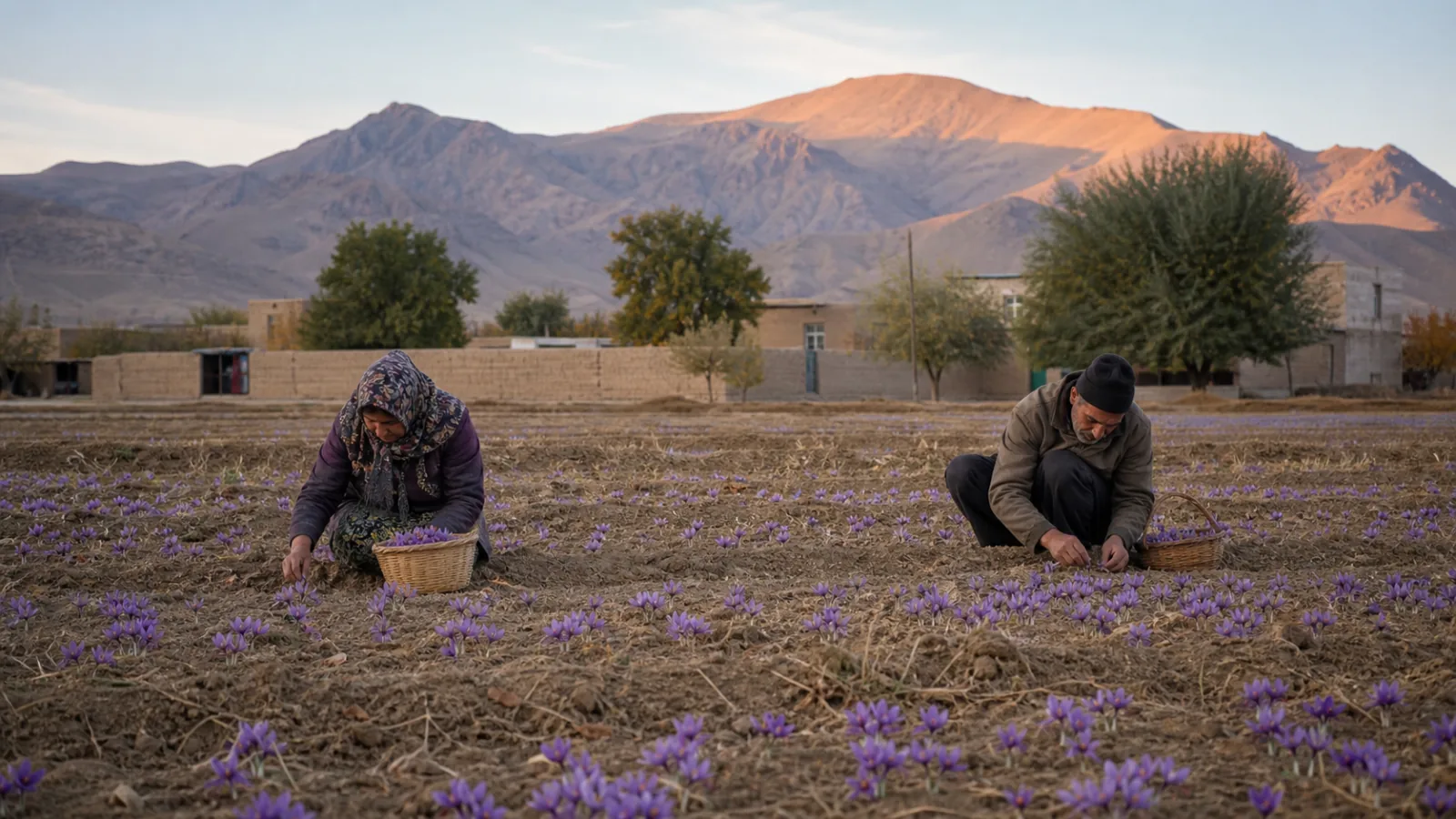
The people of Seno village are tied to saffron in ways that extend far beyond a few weeks of harvest. Around this village near Gonabad in Razavi Khorasan, the crop shapes the working year, household income, shared water management and the autumn landscape. During flowering, rows of small violet blooms spread across fields at the foot of the mountains; inside homes and workshops, families separate the red stigmas while the flowers are still fresh.
Seno, also romanized as Sanu, lies about 22 kilometres from Gonabad. It became the pilot village for the qanat-based saffron farming system that FAO recognized as a Globally Important Agricultural Heritage System in 2018. That recognition belongs to the wider Gonabad system, not to a commercial brand or a claim that Seno is the only “saffron village.”
Why Seno is known as a saffron village
A 2019 local account attributed to Mohammad Nabizadeh, then Seno’s village administrator, said more than 90% of residents depended on saffron for at least part of their livelihood. It described about 500 hectares of saffron fields in Seno and approximately 700 hectares across Seno, Moshiriz, Khanik and Sarasiab sharing water associated with the Seno spring and irrigation network.
The same account reported an average annual harvest of roughly 200 tonnes of saffron flowers from Seno’s fields. That wording matters. Fresh flowers include petals and other material removed during processing; the figure is not 200 tonnes of dried saffron threads. It is a historical local estimate rather than a current crop forecast, and acreage and harvests can change with water, weather and field condition.
What remains clear is the crop’s scale within village life. Saffron needs intense labour in a short window. Flowers are generally picked early, before warmth causes them to open fully, and the stigmas must then be separated and dried carefully. Families arrange other work around those days because delay can reduce quality.
What the saffron village looks like during harvest
People searching for saffron village photos usually expect a carpet of purple. The reality is more intimate. Saffron plants are low to the ground, and each flower is small. The colour becomes dramatic when many blooms open together across narrow plots, with trees, earthen field edges and the Kamar Zard mountain landscape behind them.
Harvest scenes also include work that a wide landscape photograph misses: baskets filling one flower at a time, hands separating three stigmas from each bloom, trays prepared for drying and neighbours moving between fields and homes. The valuable red threads are only a small fraction of the fresh flower, which explains both their price and the pressure of the harvest period.
Visitors should remember that these are working farms, not decorative flower beds. Permission matters before entering a plot or photographing people. Walking between rows can compact soil or damage flowers, and a grower may have only a few cool morning hours to collect that day’s crop.
Qanats connect water, farming and community
Gonabad has limited surface water. Qanats carry groundwater through gently sloping underground channels, using gravity rather than continuous pumping. FAO’s heritage designation recognizes the way this water system, local knowledge and crop diversity support livelihoods in an arid and semi-arid region.
Saffron fits that landscape because its growing cycle does not match the heavy summer demand of many crops. That does not make it a water-free plant. Farmers still have to allocate scarce irrigation at the right stages, maintain channels and adapt to drought. A qanat survives only when the community also maintains the physical system and the rules for sharing its flow.
The heritage value is therefore larger than one product. It includes the relationships among underground water, terraced or small fields, family labour, local timing and knowledge passed between generations.
The village market and where Seno saffron goes
The 2019 account said Seno’s seasonal saffron-flower market had operated for more than 50 years. Much of the crop was sold in bulk, with saffron moving through nearby centres including Gonabad, Ferdows, Qaenat and Torbat-e Heydarieh.
Bulk trade gives growers a quick route to buyers, but it can also leave the village name invisible once lots are combined or repacked elsewhere. The original report noted limited local processing, packaging and branding, as well as a need for more practical farmer training.
A useful local value chain would not simply put the word Seno on a box. It would make the claim traceable. That means documenting the grower or collection point, crop year, thread style, net weight, storage conditions and any laboratory result tied to the same lot. Small producers may benefit from shared testing and packing facilities if their ownership, fees and quality rules are clear.
Quality cannot be proved by village name alone
Nabizadeh described Seno saffron as higher quality than produce from other places, reflecting local confidence in the crop. Origin can influence growing conditions and skill, but a geographic name by itself does not prove the grade of an individual package.
Quality depends on the harvested material and what happens next: how quickly stigmas are separated, drying temperature and time, moisture control, cleanliness, storage and protection from adulteration. A buyer should assess the actual lot and its evidence rather than treat any town name as a substitute for testing.
For a closer look at the regional system, our guide to Gonabad’s globally recognized saffron heritage explains how place, production practice and verifiable quality should be considered together.
What Seno’s saffron heritage needs next
Recognition can draw attention to a landscape, but it does not automatically solve weak farm-gate prices or fund maintenance. Seno’s long-term resilience depends on viable returns for growers, reliable water governance, field and post-harvest training, realistic routes to market and opportunities for younger residents to build skilled work around the crop.
That may include careful agricultural tourism, the village saffron museum, traceable small-batch packing or shared processing. Each project should protect the working landscape rather than turn it into a stage set. The reason Seno matters is that saffron is still part of daily life there. Its purple fields are beautiful; the knowledge and labour behind them are the deeper story.
Sources
- The statements attributed to Mohammad Nabizadeh in the original 2019 version of this post; acreage, flower tonnage, market age and trade routes are retained as historical local estimates.
- FAO: Qanat-based Saffron Farming System in Gonabad.
- Iranian Agriculture News Agency / Ministry of Agriculture: Seno as the pilot village for the FAO registration.

![Exporting Saffron to Turkey + Price Guide [Complete 0 to 100]](https://img.rowhanisaffron.com/20260827003933/saffron-export-turkey-quality-inspection.webp)



