


Sarayan, the second-largest producer of saffron in Khurasan, was the description used by local agricultural officials in a 2019 report. The ranking referred to Sarayan County’s place within South Khorasan Province, where Qaenat had the larger cultivated area. It should not be read as a claim that Sarayan was second across all three modern Khorasan provinces or that the position can never change.
The report attributed 2,624 hectares of bearing and non-bearing saffron fields and an estimated ten tonnes of dried production to Sarayan. Those figures describe that reporting period. More recent published accounts place Sarayan among South Khorasan’s largest saffron counties, but acreage and harvest change from year to year, so current purchasing or investment decisions need current agricultural data.
Where Sarayan fits in South Khorasan saffron production
Sarayan is in South Khorasan, an arid province where saffron supports many small farming households. The crop’s autumn flowering cycle and high value per unit of weight suit land where water is limited, although saffron still needs correctly timed irrigation and sound soil management.
The historical numbers imply an average of about 3.8 kilograms of dried saffron per hectare if the entire 2,624 hectares produced in the same season. The original statement, however, explicitly combined bearing and non-bearing fields. Dividing total production by all planted land therefore gives only a rough indicator, not a measured farm yield.
Field age is one reason for the difference. Newly planted corms may not deliver the same crop as an established field, and productivity can rise and later decline as a planting matures. Weather, temperature, soil, corm health, irrigation timing and management also affect the result. A county ranking cannot tell a buyer the quality of one lot or a grower what one field should produce.
Why the movement of saffron corms concerned local officials
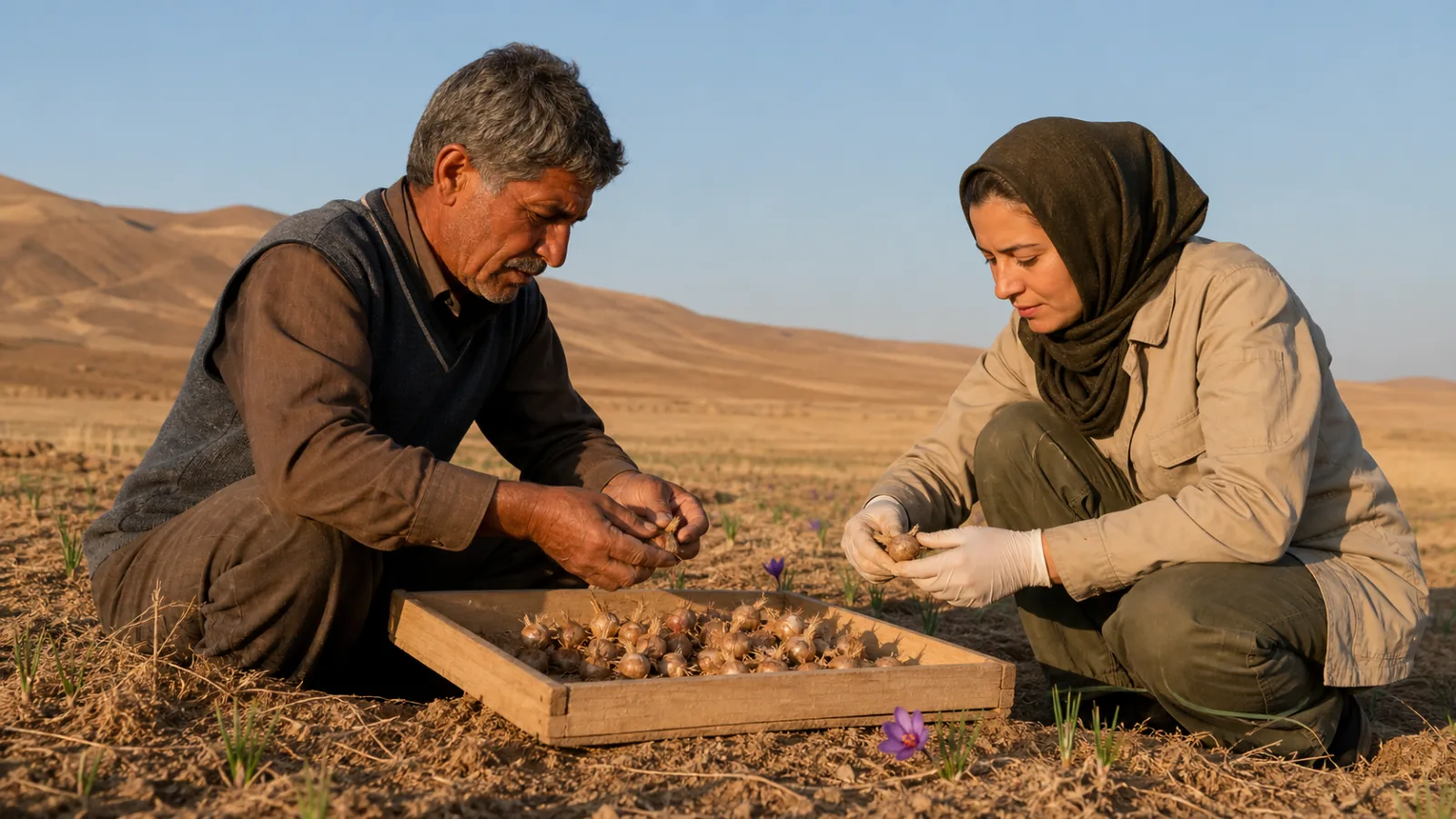
The original report used the translated phrase “saffron onion.” The planting material is more accurately called a corm: a compact underground stem that produces leaves, flowers and daughter corms. Because cultivated saffron is normally propagated through corms rather than seed, moving planting material can establish production in another field or region.
Mousa Soleimani, then head of the local Agriculture Jihad office, argued that uncontrolled movement out of Sarayan could weaken local employment and help production expand elsewhere. The report framed this as a threat to Iran’s export position. That concern needs proportion. Knowledge, climate, labour, post-harvest skill and market access cannot be packed into a sack of corms, and no region is entitled to a permanent monopoly. Still, locally adapted, healthy planting stock is an agricultural asset.
There is also a plant-health reason for oversight. Corms can carry soil and organisms between fields. EPPO lists several pests for which Crocus sativus is a host, and research records corm-rot problems involving fungi and mites. A permit and inspection system can therefore serve a practical purpose when it checks origin, health and the destination’s rules rather than merely restricting lawful trade.
How Sarayan’s corm permit process was described
According to Soleimani’s 2019 account, applicants first approached the local Agriculture Jihad office and were referred to the agricultural engineering system. Plant-protection experts then inspected the proposed material before a transport permit could be issued for movement to another area.
That is an archival description, not a current application guide. Offices, forms, quarantine requirements and cross-border rules may have changed. Anyone moving saffron corms should confirm the present requirements with the competent plant-protection and customs authorities before digging, selling or shipping them.
A responsible corm transaction should identify:
- the field and producer from which the material came;
- the lifting date, corm size range and intended planting use;
- visible injury, rot, pest or excessive soil contamination;
- inspection or phytosanitary documents required at the destination;
- packing, ventilation and transport conditions that limit damage.
Production volume is not the same as market value
The phrase “largest producer of saffron” usually describes tonnes or hectares. Grower income depends on more: usable yield, labour cost, drying losses, grade, price, access to buyers and how much processing or packaging stays in the region.
Expanding acreage without enough healthy corms, water, harvest labour or reliable sales can reduce returns. Protecting every corm from leaving is not a complete development policy either. Sarayan retains more value when growers can renew fields with inspected planting material, dry saffron consistently, pool testing and traceability where useful, and negotiate with buyers using comparable specifications.
Our overview of saffron production in South Khorasan Province places county-level reports in the wider provincial value chain.
What buyers should take from Sarayan’s reputation
Sarayan is a significant saffron origin, not a guaranteed grade. A credible offer should still state the crop year, thread style, net weight, storage conditions and evidence for any laboratory claim. The sample and certificate must represent the same lot that will be delivered.
The 2019 ranking is valuable as a snapshot of a community with substantial land and expertise invested in saffron. Its lasting lesson is not the ordinal number. It is that production depends on healthy planting stock, capable growers and a local chain able to turn a fragile flower into a consistent, traceable spice.
Sources
- The 2019 statements attributed to Mousa Soleimani in the original version of this post; its ranking, acreage, output and permit procedure are retained as historical claims.
- Agrosystems, Geosciences & Environment: climate and management factors influencing saffron yield.
- EPPO Global Database: pests associated with Crocus sativus.
- FAO AGRIS record: saffron corm rot and field-management research in Iran.

![Exporting Saffron to Turkey + Price Guide [Complete 0 to 100]](https://img.rowhanisaffron.com/20260827003933/saffron-export-turkey-quality-inspection.webp)



