


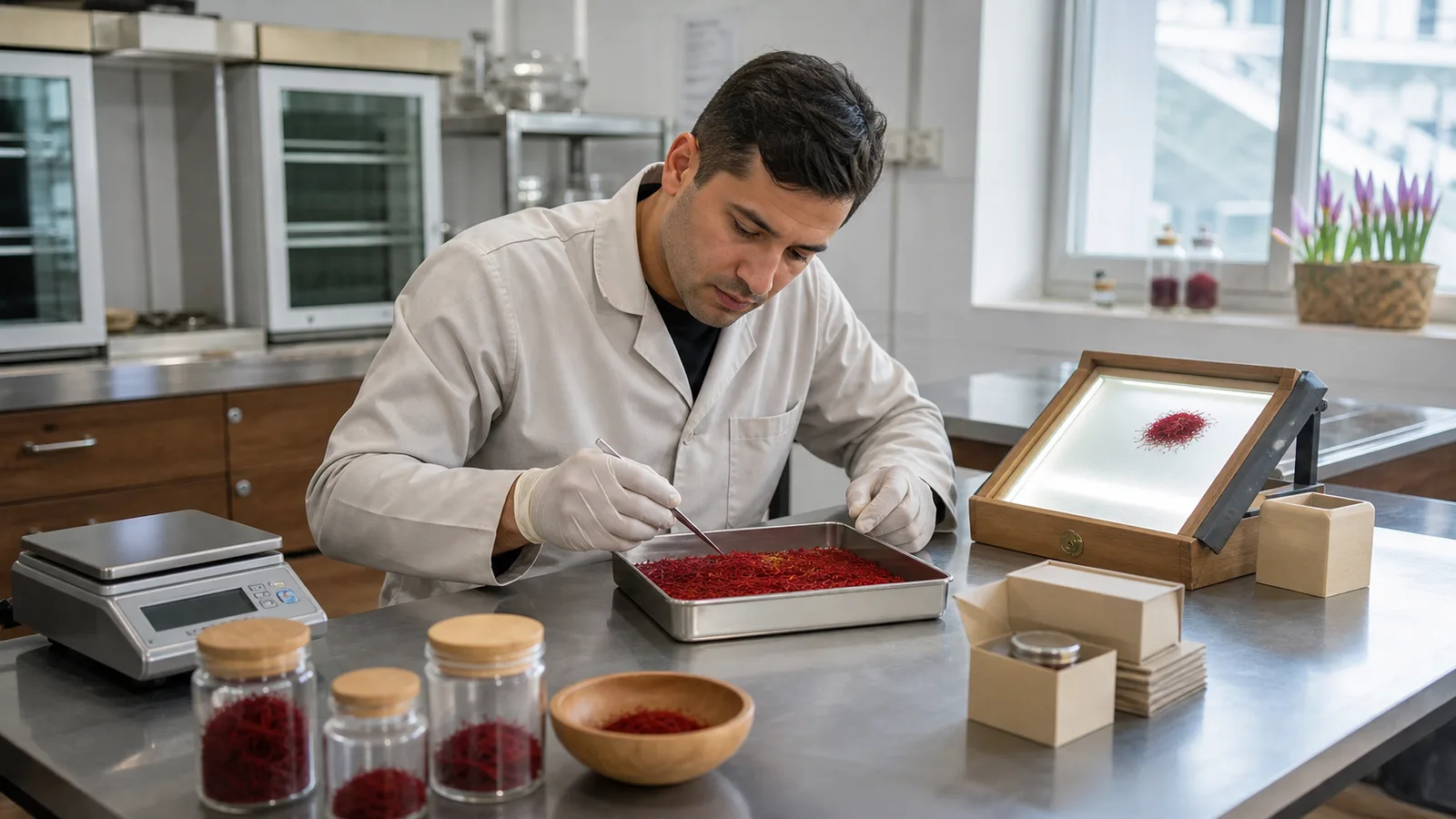
In Iran no work has been done on saffron processing was the stark assessment recorded in the original version of this article. It should be read as a historical criticism of how much Iranian saffron was sold with limited added value, not as a literal description of the industry today.
The older report called for Iran to move beyond selling raw threads and develop tested food, cosmetic and pharmaceutical products. That argument still matters. The claims attached to it, however, need a clearer evidence boundary: laboratory potential is not the same as an approved medicine, and processing includes far more than making capsules or creams.
What the original interview said
The article attributed the comments to Abdullah Mulla Filabi, described as a member of the scientific board at the Institute of Food Science and Technology in the Khorasan region. The English transliteration of the name varies within the old text, so this page retains the displayed name without claiming that it is the definitive spelling.
He argued that saffron processing in Iran had not advanced far enough and contrasted traditional saffron consumption with higher-value products abroad. The examples included a saffron capsule, saffron oil, a spray and a cream said to be used in Spain for irritated children’s gums and skin cracks. The original page did not identify the products, manufacturers, regulatory approvals or source of the Spanish example, so that anecdote cannot be treated as verified medical evidence.
The report also said the institute possessed technical knowledge but lacked what the machine-translated text called “a new honey” for mass production. In context, that phrase appears to refer to an investor or financing, although the surviving English text is too damaged to establish the original wording. The broader point is clear: research knowledge does not become a safe commercial product without capital, validated manufacturing, quality control and a lawful route to market.
What saffron processing actually includes
Processing begins long before anyone develops an extract. Once flowers are picked, their stigmas must be separated, dried and handled under controlled conditions. Moisture, heat, light, storage and contamination can change the aroma, colour and flavour that buyers expect.
A complete value chain can include:
- clean separation and hygienic drying after harvest;
- sorting, grading and laboratory checks for identity and quality;
- protection against adulteration, moisture and contamination;
- batch records and traceability from producer to package;
- packaging that protects the threads while giving buyers accurate information;
- measured culinary products, extracts and ready-to-use food formats; and
- research into cosmetics, medicines or materials under the rules for those product categories.
These stages do not have equal risk. A pre-measured culinary sachet and a capsule marketed for depression require very different evidence and regulatory oversight. Calling both of them “processed saffron” can hide that distinction.
Safranal is important, but it is not the whole spice
The old interview described safranal as saffron’s effective ingredient. Safranal is a volatile compound closely associated with saffron aroma, but saffron is chemically more complex. Crocins contribute much of its colour, picrocrocin contributes bitterness, and other constituents vary with origin and handling.
Safranal and other saffron compounds have been studied in cells and animals for several biological effects. Reviews of possible pharmaceutical applications also warn that much of this evidence is preclinical. A result in a cell culture or animal model does not establish that a safranal capsule prevents or treats cancer in people. The earlier article’s unqualified “anticancer” wording therefore went beyond the evidence it supplied.
Developing a medicine from a plant compound would require a defined ingredient, consistent dose, toxicology work, interaction testing, controlled human trials and regulatory review. The aroma of saffron or the presence of safranal alone is not proof of a therapeutic product.
What the depression research can and cannot show
The original article also called saffron’s antidepressant properties proven. Randomised trials and meta-analyses have reported promising results for standardised saffron preparations in adults with mild to moderate depression. That is stronger evidence than a laboratory experiment, but it does not make every spice, tea or capsule interchangeable with the preparations studied.
Trials differ in extract, dose, duration, participants and comparison treatment, and many are small. A commercial product still needs accurate composition, safety information and manufacturing consistency. Someone experiencing depression should not stop prescribed treatment or replace professional care with saffron on the strength of a general blog claim.
This is precisely why careful processing matters. If researchers want to test a saffron preparation, they must be able to reproduce it. Unknown origin, variable drying or an undeclared mixture makes both scientific interpretation and consumer protection harder.
Iranian saffron processing has moved beyond the old absolute
Current evidence makes the headline’s absolute statement unsuitable as a present-day fact. The UN Food and Agriculture Organization has documented modern processing and packaging units in the Mashhad area and ongoing work with Iranian institutions on post-harvest practices, authenticity, quality control and traceability.
FAO and Iran have also worked on a saffron supply-chain project covering food authenticity and transparent testing. More recent value-chain guidance discusses ready-to-use formats such as instant dissolved saffron, pre-dosed packages and dispensing systems. These initiatives do not prove that every processing problem has been solved. They do show that “no work” is no longer a credible description of the whole sector.
The more useful question is where processing creates genuine value. A new format should protect saffron’s identity and quality, solve a customer problem and support a truthful claim. Novelty alone is not enough.
From research idea to a trustworthy product
The old report said research centres in Iran were seeking medicinal products from saffron. That ambition belongs at the beginning of a development process, not at the end: a promising idea still has to pass composition, safety, efficacy, manufacturing and regulatory checks.
A team developing a saffron food, cosmetic or health product should be able to answer several practical questions:
- Which saffron material is being used: stigma, petal, extract or isolated compound?
- How is its identity, purity and concentration measured from batch to batch?
- What happens to key compounds during drying, extraction, storage and transport?
- Does the packaging protect the product and state exactly what it contains?
- Is the promised benefit supported at the evidence level required for that claim?
- Which food, cosmetic, supplement, medicine or medical-device rules apply?
- Can the producer make it consistently at a price the intended customer can afford?
Our guide to saffron packaging explains why protection and clear presentation are part of the product rather than an afterthought. Authentication and traceability are equally important because extra processing cannot compensate for adulterated or poorly handled raw material.
The cost and access problem
The old interview worried that saffron’s high input cost would make pharmaceutical and personal-care products affordable only to wealthy buyers. That risk depends on more than the price of the spice. Extraction yield, dosage, testing, regulated facilities, packaging, distribution and production scale all affect the final price.
A product that uses a small, standardised quantity may not be dominated by raw-saffron cost. Conversely, an elaborate product with weak evidence can be expensive without offering useful value. Commercial planning should therefore start with the customer need and the evidence required, then determine whether saffron is technically and economically suitable.
Value addition should also benefit the people who grow and handle saffron. Transparent sourcing, better post-harvest practices and reliable quality can help producers compete on more than volume. Products that obscure origin or make exaggerated medical promises may earn attention briefly, but they weaken trust in the larger saffron market.
A better reading of the original claim
The historical statement was not really that Iranians had never dried, graded, packaged or researched saffron. It was a complaint about the gap between Iran’s leading role in cultivation and the limited share of value captured through branded, standardised and research-led products at that time.
That concern remains worth discussing, while the absolute wording and unsupported medical claims do not. Strong saffron processing in Iran means protecting quality after harvest, proving authenticity, designing genuinely useful formats and matching every product claim to the evidence behind it. It is a value-chain task, not simply a race to put saffron into a capsule, cream, oil or spray.
Sources
- FAO: Iran project to enhance saffron authenticity and traceability.
- FAO: saffron harvesting, processing and packaging practices in Mashhad.
- FAO: innovation and quality integrity in Iran’s saffron value chain.
- Critical review of saffron and its constituents in pharmaceutical research.
- Meta-analysis of saffron trials for mild to moderate depression.

![Exporting Saffron to Turkey + Price Guide [Complete 0 to 100]](https://img.rowhanisaffron.com/20260827003933/saffron-export-turkey-quality-inspection.webp)



