


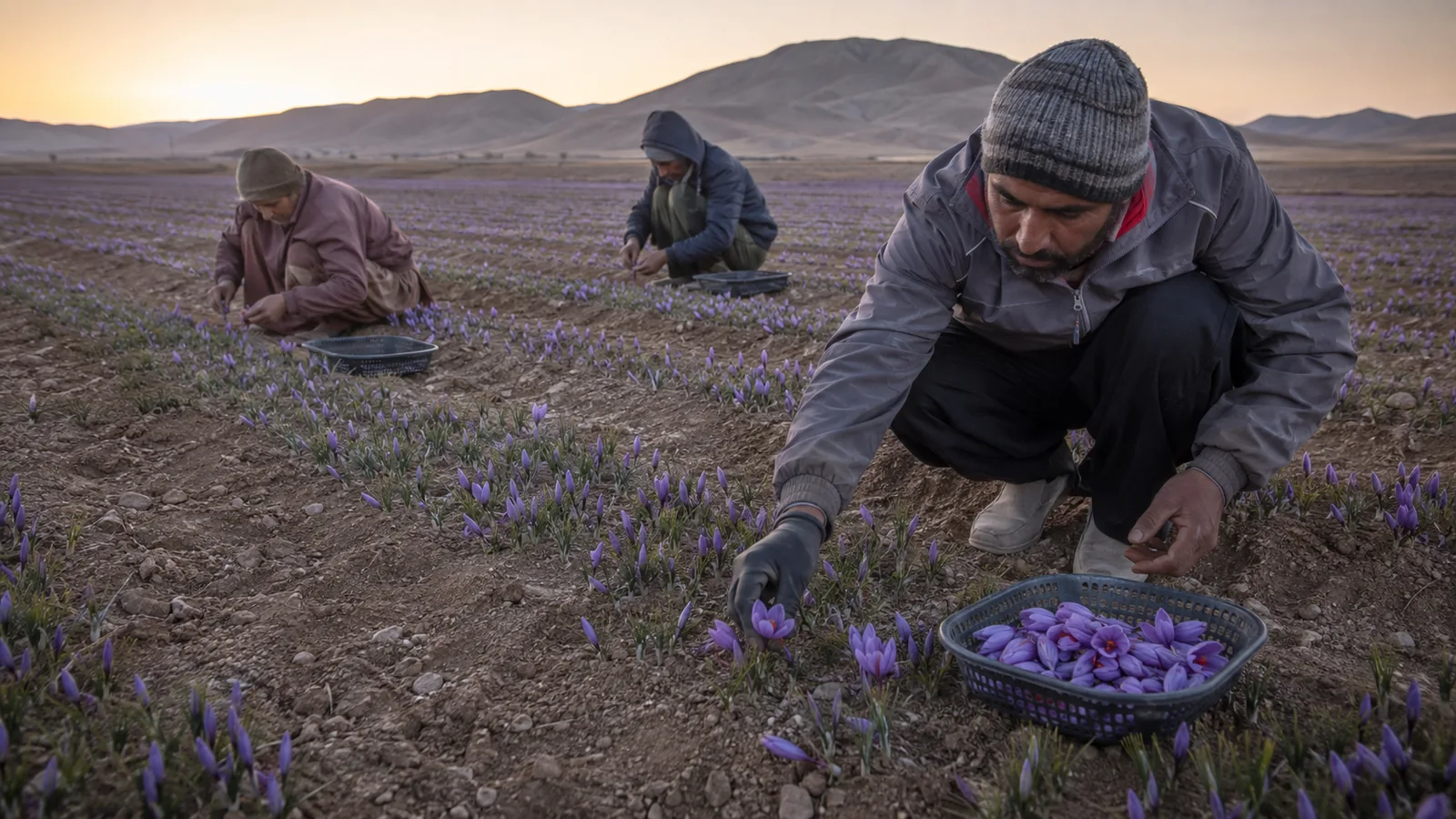
North Khorasan saffron harvest begins in autumn as the purple flowers open across Farouj, Shirvan, Esfarayen and other parts of the province. The season is brief and labour-intensive: flowers must be picked, moved carefully, separated and dried while they are still in good condition.
The original North Khorasan harvest forecast
The first version of this report attributed its figures to Safdar Safdari, then head of horticultural affairs at the North Khorasan Agriculture Organization. It recorded:
- a forecast of 29 tonnes of dried saffron;
- 4,800 hectares under cultivation;
- about 4,600 saffron producers;
- third place among Iranian provinces and a reported 9% national share;
- Farouj producing 74% of the provincial crop, followed by Shirvan and Esfarayen.
These figures remain here because they are central to the original news report and the page’s established search footprint. They are not labelled as current 2026 statistics, however, because the original copy did not state the agricultural year. Harvest area, production and provincial share need a date to be meaningful.
A dated comparison shows why the year matters
A report from Iran’s Agricultural News Agency (IANA), dated 28 October 2021, said harvest was under way on 4,350 hectares and forecast 22 tonnes for that season. It also identified Farouj as the province’s largest cultivation area and reported average yield above 6.2 kg per hectare.
The 2021 figures do not disprove the later 4,800-hectare and 29-tonne report; they show that the area and forecast changed between reporting periods. They also show why a search for Iran saffron harvest news should lead to dates and named sources, not a collection of floating numbers.
When is the saffron harvest season in Khorasan?
In North Khorasan, flowering generally begins during autumn, with the exact start shifting by location, altitude, temperature and irrigation timing. A field may be quiet one morning and busy with open flowers soon after. Growers watch the crop rather than rely on one fixed calendar date.
People searching for the Iran saffron harvest season in Khorasan in October or November should check a local announcement for the particular year and county. North Khorasan and Razavi Khorasan are separate provinces, and their fields do not all flower on the same day.
What happens when the first flowers open
Picking
Crews usually work during the cool part of the day and collect flowers before they remain open in stronger light for long. Clean, shallow containers prevent the lower flowers from being crushed under a deep load. Soil, stones and plant debris should stay out of the batch.
Transport and flower separation
Picked flowers are taken promptly to a clean working area. There, workers separate the red stigmas from the rest of the flower. The familiar saffron thread consists of the stigma; petals and yellow stamens are not equivalent spice.
Drying
Fresh stigmas contain too much moisture for storage. They need controlled drying with clean equipment, even loading and enough airflow. Excess heat can damage quality, while incomplete drying can shorten storage life. Each day’s lot should remain identifiable through drying and packing.
Why labour is the harvest bottleneck
The original report estimated that more than 10 to 15 workers per hectare could be required at peak harvest. Treat that as a report-specific estimate rather than a fixed staffing rule: crew needs depend on flower density, terrain, picking hours, transport distance and whether the same workers also separate stigmas.
The important point is unchanged. A short flowering peak concentrates a large amount of hand work into a few mornings. Delays are difficult to recover later, so labour, containers, transport and the separation room should be arranged before the first substantial bloom.
Can saffron harvesting be mechanised?
Safdari’s remarks called for mechanisation and said a local company was developing equipment. Machines may help with transport, field preparation, sorting or parts of flower handling, but the original article did not identify the machine or publish trial results. It is therefore too early to claim that it replaced careful hand picking.
Any machine should be judged by measurable results: flowers collected per hour, damage rate, soil contamination, missed flowers, labour saved and the quality of the dried stigma. A fast process that bruises or contaminates the crop is not an improvement.
Farouj’s market during harvest
Market access matters because fresh flowers lose condition quickly. The 2021 IANA report described a 1,000-square-metre rural saffron market in Farouj with 35 stalls, opened during the flower season so growers could present product to buyers. Prices were described as being set through supply and demand.
A seasonal market is most useful when weighing is transparent, lots stay separate, price units are clear and payment terms are known before product changes hands. It should also provide a quick route from flowers to hygienic separation and drying.
The TANA event and processing capacity
The original news item said a local event referred to as TANA focused on saffron corm production, grower training, packaging and reducing sales of unprocessed product. It also reported eight processing and complementary units serving medicinal plants in the province.
Those goals address a real gap between field output and market value. Packaging alone is not enough, though. Processing capacity needs clean workflows, documented lots, suitable drying and storage, testing where required, and buyers who recognize the resulting quality evidence. Our guide to North Khorasan cultivation and production challenges follows that chain from corm selection to sale.
Medicinal plants and drought adaptation
The earlier report described saffron within a provincial medicinal-plant area of roughly 10,500 hectares and said the saffron area had grown from 1,238 to 4,800 hectares over a decade. These are again historical report figures rather than live totals.
Saffron’s irrigation season can fit dry regions better than some summer crops, but it is not immune to drought. Growers still need moisture at the right stages and must protect the winter and spring leaf period that supports replacement corms.
Exports and North Khorasan’s place in Iran
The source article recorded 42 kg exported in its previous year to markets including the Persian Gulf region, the United Arab Emirates and Italy. It did not identify customs data or the year, so the amount is retained only as an attributed historical detail.
For wider context, the UN Food and Agriculture Organization reported in 2025 that Iran produced about 85–90% of the world’s saffron. North Khorasan contributes to that position, but a province benefits most when origin, handling and quality remain traceable after the crop leaves the field.
Saffron harvest festivals in Khorasan
A saffron harvest festival can bring visitors, buyers and local producers together, but it should not be confused with the start of commercial harvest across an entire province. Event dates are set by organisers; flowering dates are set by the crop and weather.
If you are looking for a saffron harvest festival in Khorasan, Iran, confirm the year, province and host county before travelling. A festival in Razavi Khorasan is not automatically a North Khorasan event. For a farm visit, ask whether visitors may enter fields, what footwear is appropriate and whether photography or picking is permitted.
What a strong harvest season looks like
A production forecast attracts attention, but the result is decided in thousands of small handling choices. Prepared crews, clean containers, prompt separation, controlled drying and honest lot records protect the work done in the field.
The start of saffron harvest in North Khorasan is therefore more than a date on the calendar. It begins a tightly connected process from Farouj, Shirvan and Esfarayen farms to processors and buyers. When reports keep their dates and units clear, that process is easier for growers, customers and readers to understand.

![Exporting Saffron to Turkey + Price Guide [Complete 0 to 100]](https://img.rowhanisaffron.com/20260827003933/saffron-export-turkey-quality-inspection.webp)



