Saffron Cultivation Challenges in North Khorasan begin in the field but do not end there. Corm health, planting density, water, labour at harvest, fast flower handling and access to a fair market all influence whether a grower turns a promising crop into saleable saffron.
What the earlier North Khorasan report said
The original article described Farooj as a leading production area and identified Shirvan as an important centre of agricultural expertise. It forecast 29 tonnes of saffron flowers “this year,” claimed 14,900 hectares were under saffron and proposed a dedicated flower market in Farooj.
Those figures were not accompanied by a reporting year, source or definition, so they must not be presented as current provincial statistics. Flower weight is also different from the weight of dried saffron stigmas. The useful part of the report is its description of the work itself: harvesting is manual, labour is concentrated into a short flowering window, and growers need better links between production, handling and sale.
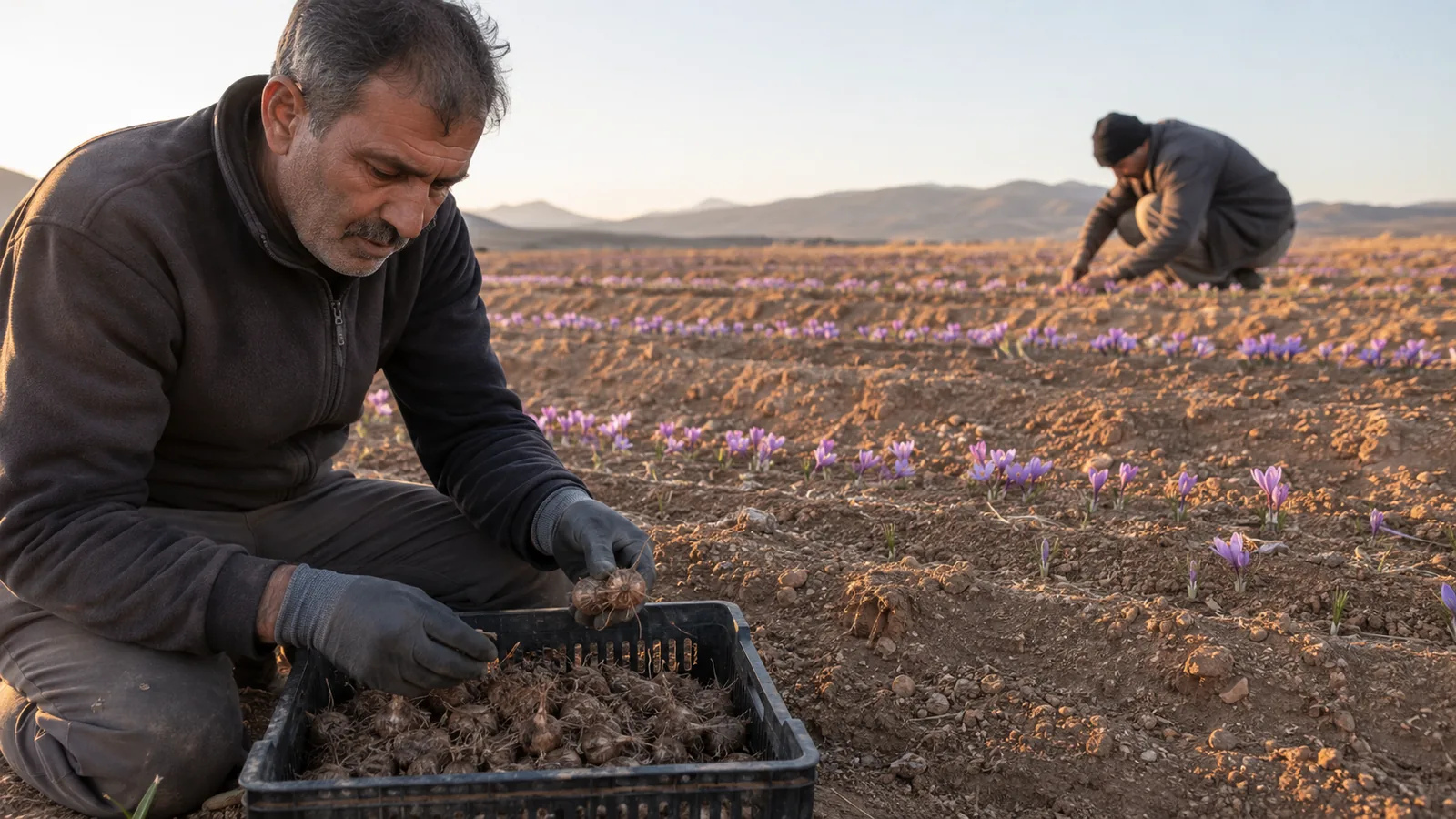
Saffron agriculture in Shirvan County, North Khorasan, Iran
Shirvan sits within a wider North Khorasan farming landscape of dry summers, cold periods and limited water. Saffron can suit semi-arid conditions, but “low water use” does not mean “no water management.” The timing and amount of irrigation affect establishment, flowering and the development of replacement corms.
Research indexed by FAO’s AGRIS database is especially relevant here. A three-season field experiment conducted about 10 kilometres from Shirvan compared different corm densities and nutrient treatments under Northern Khorasan conditions. The North Khorasan corm-density study found that flower and corm responses changed with both density and manure treatment.
That is valuable evidence, but it is not a universal prescription. Results from an experimental field should be adapted to soil tests, corm size, field age, machinery, disease history and local water conditions before a commercial grower copies a treatment.
Challenge 1: selecting and protecting saffron corms
Crocus sativus is propagated through corms rather than seed. A planting lot therefore carries both the next crop’s stored reserves and any physical damage or disease already present. Growers should reject soft, mouldy, badly cut or suspicious corms and keep lots traceable to their source.
The old article recommended “disinfected bulbs weighing at least eight grams.” Size can influence flowering, but a single minimum is not a complete buying standard, and disinfection is not a one-product remedy. A sound plan combines appropriate corm size with correct identification, dry ventilated storage, careful handling and locally approved disease-management advice. Our saffron corm guide explains what to inspect before planting.
Challenge 2: choosing planting density
The earlier claim that an ideal cultivation density was “25 kg per hectare” is not usable guidance. It is far below realistic commercial planting quantities and does not say whether it refers to corm mass, fertilizer or something else.
Density may be expressed as corms per square metre, spacing between corms or total corm mass per hectare. These measures are not interchangeable unless average corm weight is known. The Shirvan experiment tested 50, 100 and 150 corms per square metre; higher density increased several flower and corm measures during that trial. It also changed daughter-corm production, so the best economic choice depends on the intended life of the field and the cost of planting material.
Record row spacing, within-row spacing, depth, corm count and average corm weight. Without those records, a grower cannot tell whether a change in yield came from density, planting material or another part of the season.
Challenge 3: irrigation at the right time
Timely irrigation was one of the original report’s sensible concerns, but timing must follow the crop stage and local conditions. Water needs differ between establishment, flower emergence, winter leaf growth and spring corm development. Soil texture and recent rain determine how long moisture remains available.
Waterlogging can encourage corm problems; severe shortage can restrict growth. A field schedule should therefore be based on soil moisture and local extension advice, not a fixed calendar copied from another province. Distribution matters too: uneven flow creates wet and dry strips that make both yield and diagnosis harder to interpret.
Challenge 4: nutrition without guesswork
More fertilizer is not automatically better. Organic matter, nitrogen, phosphorus and potassium interact with the existing soil and with irrigation. Begin with a representative soil test, document what is applied and compare treated sections over more than one harvest where possible.
The Northern Khorasan study reported stronger results from some higher-density and cow-manure combinations, but those amounts belonged to a particular experimental soil and period. Raw manure can introduce weeds, contamination and uneven nutrients. Use mature, well-managed material and follow local agronomic and food-safety requirements.
Challenge 5: the short, labour-intensive harvest
Saffron flowers do not wait for a convenient workforce. During peak bloom, fields may need repeated picking, and the stigmas then have to be separated and dried promptly. A shortage on only a few busy mornings can affect handling quality across much of the crop.
Farooj’s proposed flower marketplace should be judged against this time pressure. A useful market would need clean handling, rapid intake, transparent weighing, clear ownership and a route to processing before flowers deteriorate. A building alone does not solve the problem if transport, labour, grading and payment are slow.
Growers can reduce risk by estimating labour before bloom, organizing collection containers, setting a separation space and agreeing how flowers will be weighed and transferred. Mechanisation may help with some field or handling tasks, but delicate picking and stigma separation still require careful quality control.
Challenge 6: drying, storage and quality evidence
Khorasan saffron production is often discussed in tonnes and hectares, yet value is decided at lot level. Threads can lose quality after a good harvest through slow separation, dirty surfaces, excessive drying heat, residual moisture or unsuitable storage.
Each lot should stay identifiable from field and picking date through drying and packing. Basic records—fresh flower weight, dry stigma weight, drying conditions, final moisture assessment and storage location—help locate problems. Laboratory testing and traceability give buyers stronger evidence than a regional name alone.
FAO and Iran’s Ministry of Agriculture-Jahad made the same connection in a 2025 programme on quality integrity across the saffron value chain, covering production, post-harvest handling, safety, traceability and marketing.
Challenge 7: pricing, intermediaries and exports
The old article blamed weak oversight, smuggling and middlemen for low farmer returns, and said Iranian saffron was sometimes rebranded abroad. These concerns require evidence in each case; removing every intermediary is not a practical policy by itself. Aggregation, testing, finance, packing and export compliance are real services. The important questions are whether costs are transparent, farmers can compare offers and origin remains traceable.
For saffron production in Khorasan, Iran to earn a stronger position, quality claims must survive the journey to the buyer. Clear lot identity, reliable testing, honest origin information and consistent delivery do more for reputation than unsupported superlatives.
A practical improvement plan for growers
- Map each plot, its age, soil result and irrigation method.
- Buy traceable, healthy corms and record size and quantity.
- Choose spacing with an agronomist using local evidence rather than an unexplained kg/ha figure.
- Prepare labour, containers and a clean separation area before flowering.
- Measure fresh flowers and dried stigma by lot.
- Control drying and storage instead of judging quality by colour alone.
- Compare written offers on the same grade, weight and payment terms.
North Khorasan’s opportunity
Agriculture in Shirvan County, North Khorasan, Iran has more to gain from measured field improvement than from an unsupported production forecast. Farooj’s market access, Shirvan’s research base and the province’s farming knowledge can complement one another when records and quality evidence travel with the crop.
The central challenge is coordination. Healthy corms cannot compensate for poor harvest handling, and careful drying cannot repair unclear ownership or delayed payment. Treating cultivation, processing and sale as one connected system gives growers a more credible path to higher yield, better quality and fairer returns.