


Iran saffron production in 2024 was measured in hundreds of tonnes, not 470,000 tonnes. That figure in the previous version of this page was a serious unit error. A Ministry of Agriculture official forecast roughly 400 tonnes for the Iranian year ending in March 2025; it was a forecast, not a confirmed final harvest.
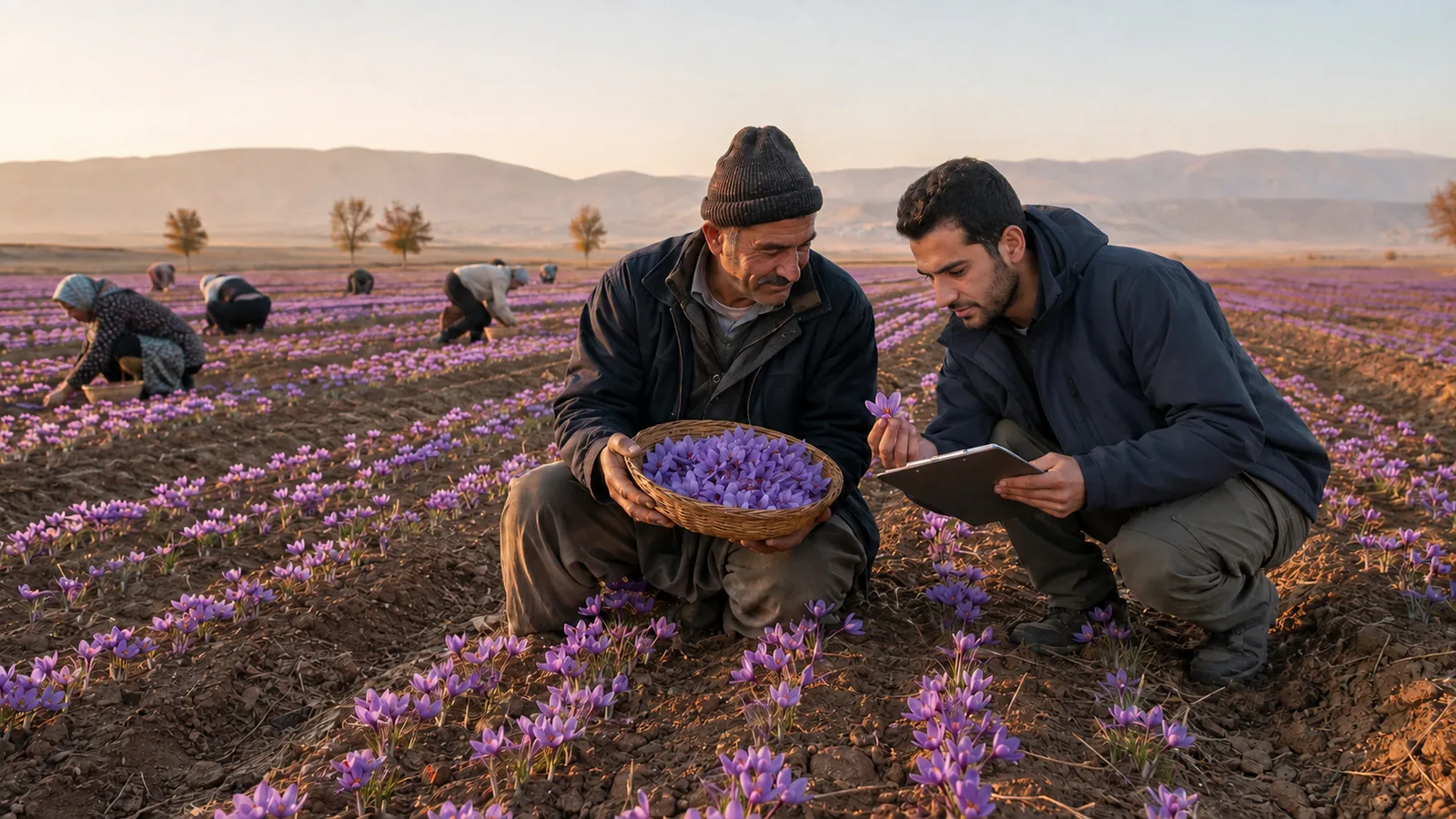
Details of saffron production in 2024
The clearest dated estimate published during the 2024 harvest came from Hossein Zeynali, director of the Agriculture Ministry’s medicinal-plants national plan. On 27 October 2024, he said Iran’s output was expected to reach about 400 tonnes in the Iranian calendar year ending in late March 2025.
The wording is important. “Expected to reach” identifies a forecast issued while the crop year was still underway. It should not be rewritten as 400 tonnes actually harvested, and it does not describe the calendar year from January through December.
Why 470,000 tonnes was wrong
The old article attributed “470,000 tons” to the head of the Agricultural Commission of the Iranian Chamber of Commerce. At that scale, the claim is incompatible with every credible account of the world saffron market. Contemporary reports discussed a range near 450–470 tonnes, making a confusion between tonnes and kilograms likely: 470 tonnes equals 470,000 kilograms.
We could not recover the original commission statement to prove which unit it used, so this article does not silently replace one unsupported exact figure with another. The defensible 2024 reference is Zeynali’s approximately 400-tonne forecast, with its date and reporting period attached. The stray “21” that previously appeared before the first heading was a copy error and carried no statistical meaning.
What was known before the 2024 forecast
In July 2024, Zeynali said more than 238 tonnes had been produced from 21 March 2023 to 19 March 2024. That was the previous Iranian year, 1402. It provides useful context for the later recovery forecast, but the two numbers should not be presented as measurements of the same period.
FAO’s current description is about share rather than tonnage. In September 2025, the organization said Iran produces more than 90% of the world’s saffron. That supports Iran’s dominant position; it does not validate the old 470,000-ton claim.
Where Iran’s saffron was grown
The October forecast put the national saffron area at 127,000 hectares across 23 provinces. It said more than 93% of production came from the three Khorasan provinces: Khorasan Razavi, South Khorasan and North Khorasan. These are forecast-period figures attributed to the ministry official, not a new land survey by this website.
National acreage also does not tell a grower what one field will yield. Age and size of corms, field age, soil, irrigation, nutrition, weather, disease and harvest handling all matter. Averages can hide large differences between an established field in Khorasan and a new plot elsewhere.
Production, exports and market share are different measures
Production is the dry saffron harvested. Export weight is the amount recorded as leaving the country. Export value is the declared monetary value of those shipments. The numbers diverge because part of a crop may be used domestically, stored, sold in a later period or moved outside recorded channels.
A country can therefore produce most of the world’s saffron without receiving the same share of global retail revenue. Processing, pack size, brand ownership, distribution and re-export all affect where later value is recorded. For longer-run context, our saffron production statistics guide keeps annual figures and their periods separate.
Iran saffron export value in 2024
The most widely reported near-2024 total covered Iranian year 1402, from 21 March 2023 to 19 March 2024. Rouhollah Latifi of the Central Organization of Rural Cooperatives said Iran exported 221 tonnes worth $207,786,281 to 55 countries during that period. Because it is not a calendar-2024 total, it should not be labelled simply “Iran saffron export value 2024” without the dates.
For the first two months of the next Iranian year, from 21 March to 22 May 2024, Zeynali reported more than 25 tonnes worth over $22 million exported to 37 countries. China, the United Arab Emirates, Spain, Afghanistan and Italy were named as the five leading destinations for that short period. A two-month flow should not be multiplied by six and presented as an annual result; saffron exports are seasonal.
Calendar-2024 importer reports shown by the World Bank’s WITS presentation of UN Comtrade also record significant trade from Iran to the European Union, Spain and China. Those rows cannot simply be summed because the EU aggregate overlaps its member countries. For the same reason, an apparently precise total built from that page would be misleading.
Readers who reached this page while looking for Iran saffron export news 2025 should keep that distinction in view: 2024 importer data, an Iranian-year 2024 forecast and a later news publication date do not describe one common period.
Food security and agricultural inflation
The original article placed saffron beside wider concerns about food security and inflation in agricultural products. Saffron is a high-value crop and a rural livelihood, but it is not a staple food. Its role in food security is mainly through farm income, resilient production systems and the ability of households to sustain their livelihoods.
Costs still matter. Labour, water, fertilizer, packaging, finance and transport can change what remains for a grower or exporter. A higher export price does not necessarily improve the farm return if those costs rise faster.
The old container-cost example was not a current quote
The former text said container shipping had risen from $150–$200 to $2,000 per container. It did not name a route, container size, date, carrier or whether the amount covered the full shipment or only one charge. Freight prices cannot be compared responsibly without those details, so the numbers are retained as a historical statement rather than a present shipping benchmark.
Saffron’s high value and low physical weight also mean it does not always move like a bulk agricultural commodity. Air cargo, courier, groupage and sea freight serve different shipment sizes. The best choice depends on lawful routing, insurance, temperature and moisture protection, customs time and the buyer’s delivery requirement.
Rail links and cargo aircraft were proposals
The earlier article mentioned a rail connection to western China through Kazakhstan and possible arrangements with Russian airlines to lease cargo planes. Those ideas belong to the logistics discussion, but the page supplied no project name, service timetable, contract or evidence that either option carried saffron.
A future logistics claim should name the origin and destination, operator, transit time, frequency, customs procedure and cost basis. Until those details exist, a proposed route is not proof of faster or cheaper saffron exports.
Overseas cultivation is not the same as exporting saffron
The old report also described overseas farming as a Ministry of Agriculture development strategy. It named Afghanistan and Iraq, while noting security concerns, and suggested that parts of South America and Africa might offer climates and investment conditions worth studying.
That is a much broader policy question than domestic saffron production. A viable project would require lawful access to land and corms, water and soil assessment, phytosanitary compliance, local labour and harvest capacity, protection of genetic resources, secure finance and a buyer. The absence of infrastructure since a 2016 regulation cannot be solved by climate suitability alone.
What could improve production without inflating the numbers
Useful improvement begins with measured field performance. Modern cultivation techniques can help when they address an identified constraint rather than promise a universal yield. Facilities are valuable when they protect drying, storage, testing and traceability. International collaboration can support research or market access, but each arrangement needs clear ownership of data, plant material and commercial rights. The intended outcome is a stronger sector benefiting farmers and the national economy, but those benefits have to be demonstrated rather than assumed.
- Record productive area separately from newly planted or non-bearing land.
- Report dry stigma yield in kilograms per hectare and state the sampling method.
- Track weather and irrigation alongside yield instead of attributing every change to one cause.
- Keep harvest estimates, final production and customs exports in separate series.
- Compare transport quotations on the same route, service and date.
- Use processing and packaging data to measure retained value, not just shipment weight.
How to read Iran saffron production figures
Start with the year system and the unit. Ask whether the number is a forecast or a final result, whether it covers dry saffron or flowers, and whether the area is planted or productive. Then check the named institution and the date of the statement.
For 2024, the safest concise account is this: officials reported more than 238 tonnes for the Iranian year ending in March 2024 and later forecast about 400 tonnes for the year ending in March 2025. Iran remained the dominant producer, centered overwhelmingly in the Khorasan provinces. The former 470,000-ton figure was a unit error and should not be repeated.

![Exporting Saffron to Turkey + Price Guide [Complete 0 to 100]](https://img.rowhanisaffron.com/20260827003933/saffron-export-turkey-quality-inspection.webp)



