


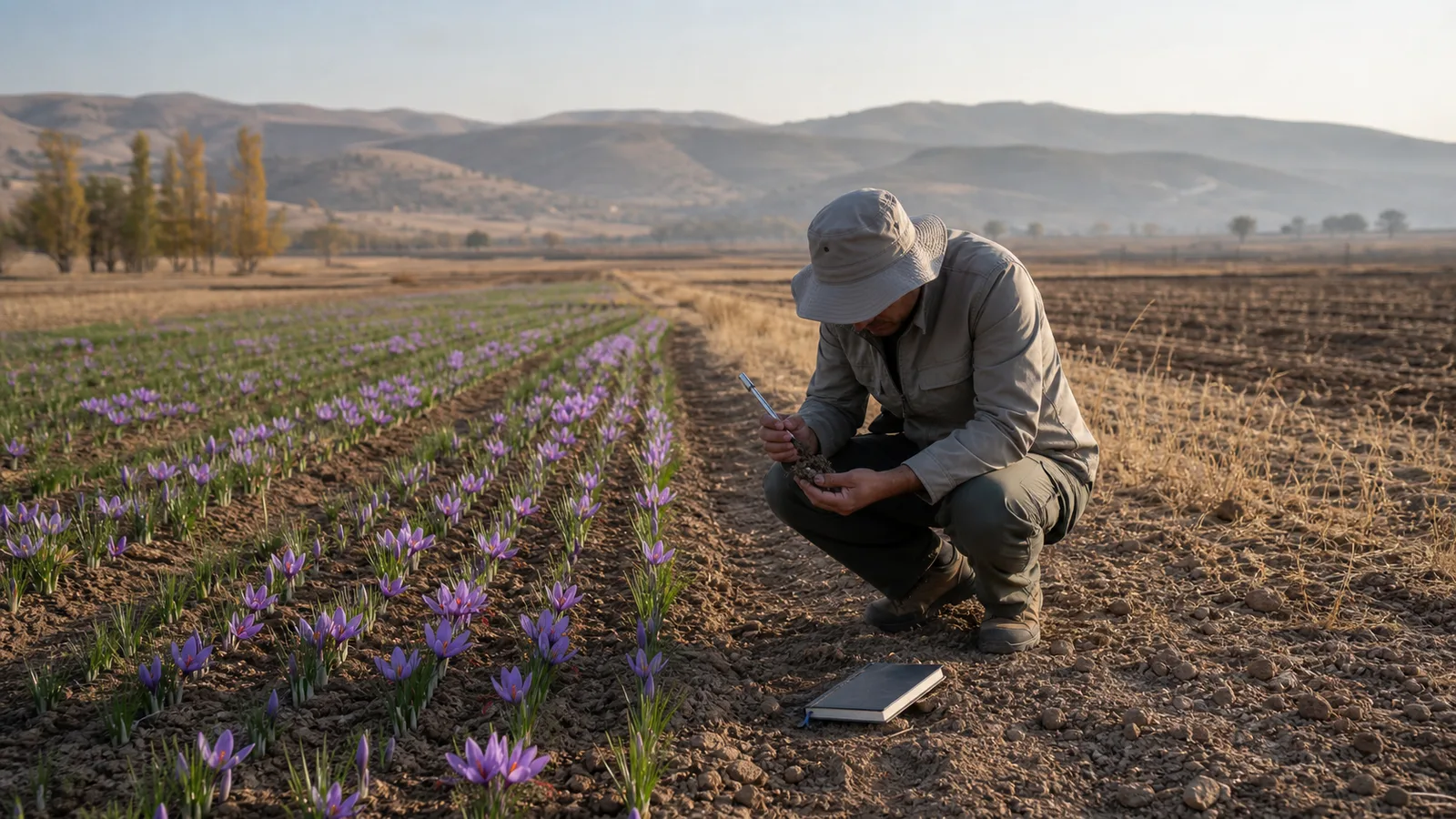
Is the range of saffron cultivation decreasing? The answer depends on what “range” means. Total planted area can expand while the land that is reliably suitable becomes more limited. A province may add saffron fields, yet individual farms can still lose yield or abandon production because water, soil, temperature, labour or market conditions no longer support the crop.
This distinction was missing from a 2017 report about an agricultural conference in Karaj, Iran. The speaker warned that the geography suitable for saffron, pistachio and date-palm cultivation was becoming narrower. His wider argument was that climate pressure and marketing problems could not be solved by planting more land alone; growers needed practical research, innovation and a stronger link between science and farm decisions.
What the original 2017 report said
The meeting took place at the Imam Khomeini agricultural research centre in Karaj and focused on date-palm cultivation. An Iranian agricultural official—whose name was rendered as “Alexander Zand” in the old English translation—spoke to researchers, guests and reporters about problems shared across high-value crops.
He separated natural pressures from problems people can influence. Heat, climate and limited water were presented as physical constraints. Weak product sales, poor transfer of research and insufficient investment in innovation were management and market constraints. His proposed response was a knowledge-based agricultural system in which research reached farmers and private companies could receive organised support.
The report also attributed two production shares to the speaker: 13% of the world’s dates and 30% of unspecified “tropical products.” It did not define the year, commodity group or data source. Those figures should be read as quotations from that 2017 event, not current statistics.
Cultivated area and suitable area are not the same
A map can show where saffron is planted today, but it does not show whether every field is productive, profitable or resilient. Suitability describes the match between a crop and local conditions. It can include:
- seasonal temperature and the timing of heat and cold;
- soil drainage, texture, salinity and fertility;
- water availability and irrigation quality;
- slope, field access and erosion risk;
- corm health and the prevalence of disease;
- labour for planting, flower picking and stigma separation;
- drying, storage and access to a dependable market.
A 2017 land-suitability study for saffron cultivation used multiple environmental criteria and spatial analysis rather than treating one condition as decisive. Later research also found that soil physical and chemical properties influence saffron growth, yield and quality. These studies support a careful local assessment; they do not provide one permanent border around every suitable region.
Why a saffron-growing zone can become less reliable
Water may be scarce even for a relatively low-water crop
Saffron is often described as a low-water crop because its seasonal demand can be lower than that of many alternatives. That does not mean it grows without water. Poorly timed irrigation can affect emergence and flowering, while water shortages can prevent a grower from applying irrigation when the crop needs it.
Water quality matters too. Salinity and drainage problems can accumulate over several seasons. A field that produced well in one year may not remain suitable if groundwater becomes more saline or the soil structure deteriorates.
Temperature affects more than annual averages
A yearly average hides the timing of extreme conditions. Unusual heat during corm development, an ill-timed cold event, or warmer conditions around flowering can alter the production cycle. Growers need local seasonal records, not a general statement that saffron tolerates both heat and cold.
Soil and corm problems can narrow the practical range
Waterlogging, compaction and unsuitable soil chemistry may reduce plant health even where climate looks favourable. Diseased or poorly selected corms can also carry problems into a new field. Expansion based only on crop price can therefore create planted hectares that are not sustainable hectares.
Economics can remove land from production
A biologically suitable field may still leave cultivation when labour, corms, water, drying and finance cost more than the crop returns. Flower picking is time-sensitive, and delays can reduce quality. If growers cannot sell a traceable, well-dried product at a workable price, suitable land alone does not keep the farm viable.
What knowledge-based agriculture should mean in practice
The 2017 speech repeatedly used the language of knowledge and innovation. For growers, that only matters when it changes a real decision. Useful support would translate research into field-level actions such as:
- testing soil and irrigation water before a new planting;
- matching corm size, planting depth and spacing to local conditions;
- recording irrigation, emergence, flowering, yield and quality by plot;
- monitoring weather at the farm rather than relying on distant averages;
- using clean, traceable corms and removing diseased material;
- improving drying, packaging and lot traceability;
- testing a small area before expanding into an unfamiliar region.
Private funds and knowledge-based companies, mentioned in the original report, can help when they support these measurable needs. Technology is not automatically useful because it is new. A sensor, machine or forecasting model should show that it improves timing, reduces loss, protects quality or lowers cost under the grower’s conditions.
How to judge whether a local range is really shrinking
One news statement cannot establish a long-term trend. A defensible assessment would compare the same locations over several seasons and separate planted area from harvested area. It would track yield, flowering dates, crop failures, irrigation access, salinity, corm health, production cost and the number of farms leaving or entering cultivation.
Changes should also be compared with management. A decline caused by poor drainage or contaminated corms is different from a regional shift in temperature or water supply. Both matter, but they call for different responses.
Our guide to saffron cultivation and growing conditions explains the field requirements in more detail. It is a starting point, not a substitute for local soil, water and climate assessment.
The practical conclusion
The range of dependable saffron cultivation can narrow even while cultivation expands on paper. Climate and water pressure may reduce suitability; weak planning, poor corm health, unsuitable soil and difficult economics can reduce it further.
The strongest part of the 2017 warning remains relevant: research must reach the people making planting, irrigation, harvest and marketing decisions. The right response is not to claim that every saffron region is shrinking. It is to measure which fields remain productive and resilient, identify why others do not, and expand only where evidence supports the crop.

![Exporting Saffron to Turkey + Price Guide [Complete 0 to 100]](https://img.rowhanisaffron.com/20260827003933/saffron-export-turkey-quality-inspection.webp)



