


The threat described in this 2017 report was not the disappearance of Iran saffron overnight. It was the gradual loss of market advantage through corm smuggling, stronger support for competitors, high export costs and weak coordination at home. Iranian producers interviewed at the time were especially concerned about saffron cultivation expanding in Afghanistan.
The article is a historical account of those concerns and proposals. Its forecasts, subsidies, tariffs and production comparisons are not current figures.
Why saffron corms became part of the debate
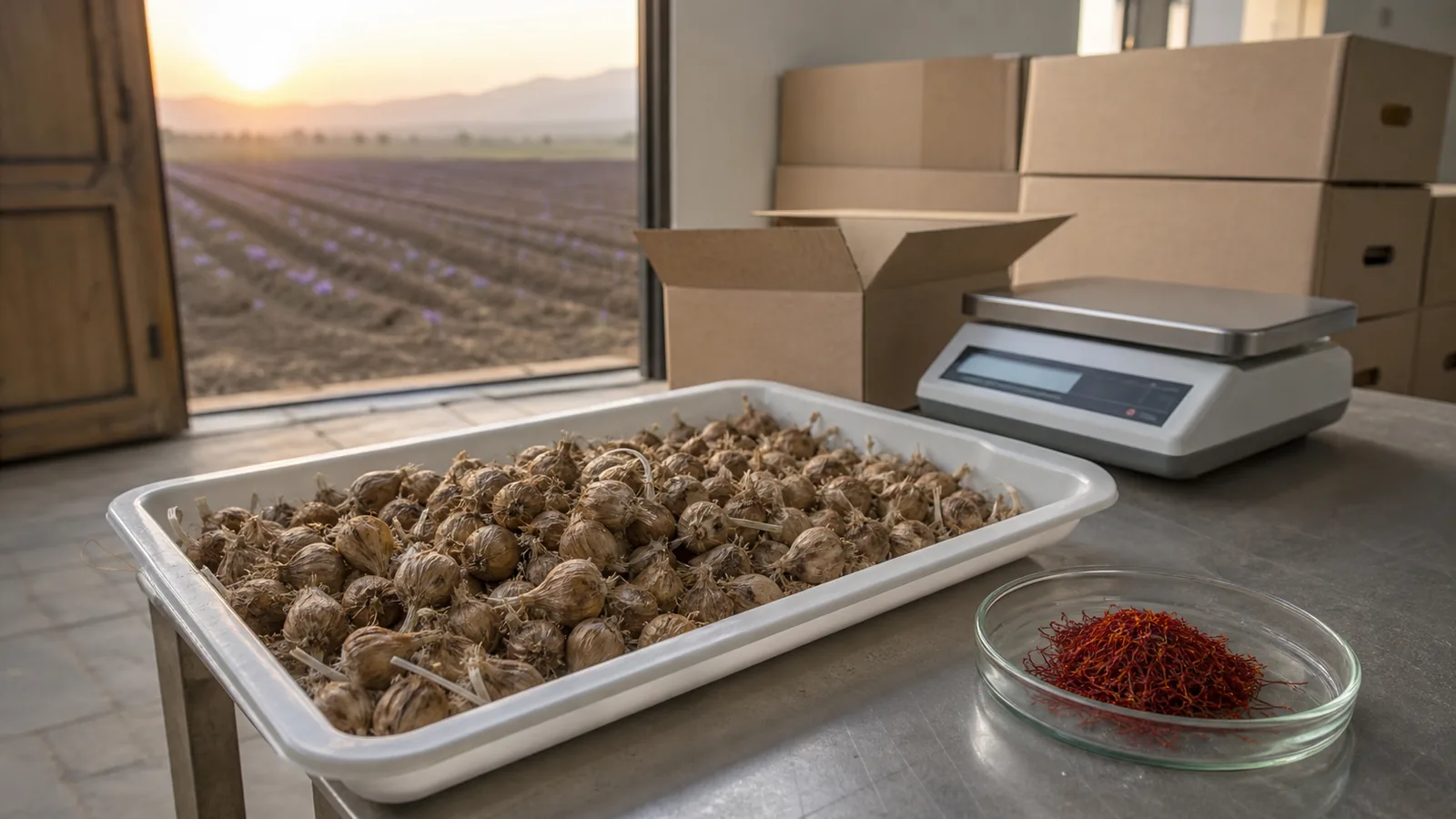
Cultivated saffron grows from corms, often called saffron bulbs or onions in translated reports. The article alleged that corms were leaving Iran illegally for Afghanistan, helping new fields develop across the border.
Abdullah Zadeh, described as a producer and exporter, said this created concern for Iranian growers because Afghan producers received more government support in export markets. He argued that the issue was not simply another country growing saffron; it was the difference in the conditions under which exporters competed.
Corm movement alone does not determine market leadership. Agronomy, labour, quality control, yields, branding, logistics and buyer relationships also matter. The original report treated smuggling as one pressure within a wider commercial problem.
The reported support gap
Zadeh claimed that Afghanistan subsidised producers’ participation at international exhibitions by 20%, while Iranian exporters lacked comparable support. That percentage belongs to the 2017 interview and is not independently documented on this page.
Gholamreza Miri, identified as deputy chairman of the National Saffron Council, also called for working capital on single-digit terms, export-market development and negotiations over saffron tariffs with China and India. The report said Afghan saffron entered those markets at lower tariffs while Iranian product faced higher charges.
Those details should be read as stakeholder statements, not as a current tariff schedule. Import duties and trade arrangements can change, and a buyer or exporter must consult the latest official customs rules.
What the proposed saffron bank meant
Several interviewees called for a comprehensive saffron bank. In this context, the phrase did not mean an ordinary consumer bank. It described a coordinated mechanism that could purchase surplus product at the start of the season, hold stock and release or trade it in a way intended to balance supply and demand.
Supporters believed this could reduce distress selling and the margin captured by repeated intermediaries. Zadeh said a more direct buying and selling channel could bring the product to consumers with a normal profit rather than allowing brokers to dominate the chain.
A National Saffron Council member said any such institution would need rational rules and participation from the different market actors. The inherited translation gives that speaker more than one surname, so this page does not choose an identity that the source cannot reliably establish.
Would Afghanistan replace Iran?
The headline warning was forceful, but the report itself included a more measured view. One council member said Afghanistan’s cultivated area was still low and that it had a long way to go before reaching Iran’s production level.
The concern was therefore about trajectory and export competitiveness rather than an immediate change in production rank. A rising competitor can gain customers without overtaking the largest producer, particularly if it offers dependable quality, favourable market access or better promotion.
Risks to Iran saffron beyond production volume
- Loss of planting material: uncontrolled corm movement can transfer productive stock and may create plant-health risks.
- Weak market development: large output has limited value if exporters cannot build or retain demand.
- Price pressure: surplus at harvest can weaken growers’ negotiating position.
- Trade friction: tariffs and administrative costs can alter the delivered price in target markets.
- Inconsistent identity: poor grading, packaging or traceability can make origin less valuable to buyers.
These are enduring categories of risk, but their present severity cannot be measured from a report published in 2017.
What the historical discussion shows
The interviews did not argue that restricting competitors was enough. They asked for a stronger domestic chain: lawful planting-material controls, finance, standardised trade, market intelligence, promotion and workable export terms.
Iran’s long association with saffron remains an important asset, but origin alone does not secure a market. Producers protect that position when quality is repeatable, claims are traceable and buyers can obtain the product reliably. Any current assessment should begin with recent production, customs and trade data rather than treating the 2017 forecast as a present fact.

![Exporting Saffron to Turkey + Price Guide [Complete 0 to 100]](https://img.rowhanisaffron.com/20260827003933/saffron-export-turkey-quality-inspection.webp)



