


The Iran saffron market is not accurately described as a business controlled by two or three traders. In the historical industry interview behind this article, National Saffron Council member Ali Hosseini pointed to customs records showing 52 companies exporting under different brands. His broader concern was different: Iran produced most of the world’s saffron, yet farmers and exporters still struggled to keep the value created by processing, packaging and access to overseas markets.
That distinction matters. A market can have many participants and still leave growers exposed to uncertain crop statistics, sharp seasonal price movements, unequal tariffs and illegal movement of saffron corms. The original reporting also contains competing estimates about frost damage and production. They should be read as dated assessments made at different points in a harvest, not as current statistics or precise facts that can be combined into one total.
What the claim about “several businessmen” actually meant
The interview rejected the allegation that two or three people monopolised Iranian saffron trading. Hosseini said that 52 companies appeared in export records, each selling different brands. That does not prove that every exporter held an equal share, but it does show why a simple two-or-three-trader claim is too strong without company-level customs data.
His criticism focused instead on the conditions around the trade. Iranian saffron was often exported before the higher-value work was done. Buyers in other countries could package it, develop consumer products and sell it under their own names. Processing and dependable branding at origin were therefore presented as ways to retain more value, support employment and make the export market less dependent on raw bulk sales.
The interview also described an estimated annual trade value of about US$500 million when suitcase exports were included. A separate nine-month customs figure was reported as more than 87 tonnes worth about US$130 million, exported to 47 countries, with year-on-year growth of 37%. The source text is damaged around that passage, so those figures should be treated as an attributed historical snapshot rather than a clean statistical series.
Production estimates changed as the harvest developed
Several figures in the source articles describe the scale of production. One interview said the two Khorasan provinces produced 360 tonnes and accounted for 92% of global output, while saffron was cultivated in 22 Iranian provinces. A later report said 24 provinces were producing saffron, with about 96% concentrated in Khorasan Razavi and South Khorasan on more than 90,000 hectares.
These numbers are not interchangeable. They come from different reports and may reflect different seasons, definitions or estimates. They also should not be promoted as Iran’s current share of world production. The useful conclusion is narrower: Khorasan was the dominant production centre, and decisions about marketing, crop expansion and corm movement could affect a large part of the country’s saffron economy. Our article on saffron in Khorasan explains that regional production context in more detail.
Why the frost assessments appear to conflict
In the longer interview, Hosseini said a large share of the crop had already been collected when frost arrived. On that assessment, there was no major loss in total production, although unharvested flowers could suffer some quality damage.
A later statement offered a less optimistic view. The pre-season estimate of more than 360 tonnes, based on roughly 3.5 to 4 kilograms per hectare, was revised to more than 300 tonnes after a cold wave reached Khorasan Razavi and South Khorasan near the end of harvest. Hosseini asked the Ministry of Agriculture to publish an exact total quickly so growers, buyers and exporters could plan.
Both statements belong in the record because they show why a timely official crop estimate is important. Weather can affect districts and harvest stages differently. Until measured production is available, a forecast, a field report and a final crop total answer different questions.
Price volatility is not the same as monopoly
The historical interview placed saffron at roughly 4.4 million to 6 million tomans per kilogram. It alleged that some speculators bought and stored product early in the season, then tried to sell into a tighter market later. Those prices are preserved here only as figures quoted in the old report. They are not a present-day offer, and the article did not provide a transaction dataset with which to test the speculation claim.
Seasonality can move prices even without coordinated behaviour. Fresh supply enters the market around harvest, exporters rebuild inventory, grades and moisture levels differ, and exchange-rate or payment conditions can change the effective cost. A useful saffron quote therefore needs a date, currency, unit, grade, test method, lot size, packaging, delivery term and destination. A number without those fields is not a comparable market price.
For an exporter, the safer response to volatility is not a promise that prices will never change. It is a quote tied to a defined lot, a validity period and a written specification, supported by traceable records. The current ISO 3632-1:2025 saffron specification defines requirements for dried saffron, while the FAO/WHO Codex standard CXS 351-2022 provides an international product standard. Neither standard sets the market price; they help buyers and sellers describe what is being traded.
Tariffs, sanctions and value added
Hosseini said Iranian saffron faced tariffs of 35% to 38% in China and India while Afghan saffron received different treatment. This was an attributed trade-policy claim from the period, not a current tariff schedule. Tariffs can change by product code, origin, agreement and year, so an exporter should verify the applicable customs classification and rate before quoting a shipment.
The interview also recalled that sanctions had reduced access to some markets, including the United States. It said Spanish businesses bought Iranian saffron, packaged it and re-exported it, allowing some product to reach markets indirectly but leaving the Iranian producer’s identity behind. Re-entering a market after competitors have established distribution takes more than having a good crop. It requires lawful payment and logistics, reliable supply, consistent grading and a brand that buyers recognise.
Processing can create value, but the original article used “conversion industries” very broadly and included food, cosmetic and pharmaceutical uses. Not every saffron lot or product can legally enter each category. Product claims, purity specifications, manufacturing controls and labelling requirements depend on the intended use and destination market.
Why saffron-corm smuggling concerned growers
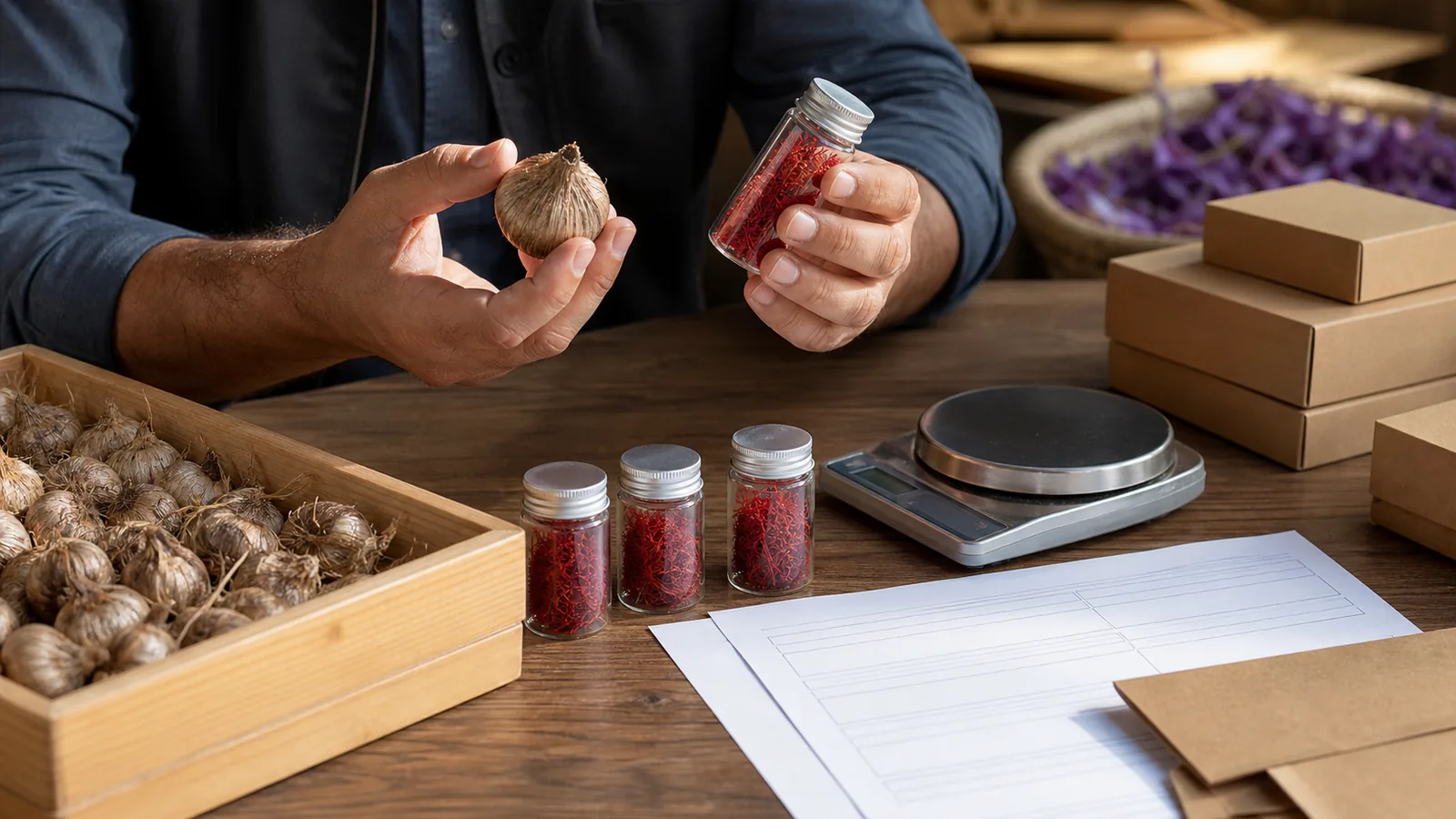
Saffron is propagated with corms, often called saffron bulbs in trade reporting. The source articles described illegal removal of high-yield Iranian planting material as a long-term risk: it could help uncontrolled cultivation expand elsewhere while weakening oversight of plant health, production and legitimate corm sales at home.
One report said Iran’s anti-smuggling authorities had seized a shipment of 50,000 kilograms of saffron corms. Officials quoted in that article believed the real volume was higher. The report also repeated a claim that about 99% of Afghanistan’s saffron area had been established from corms smuggled from Iran. No underlying border or planting dataset was supplied, so the seizure and the 99% figure must remain clearly attributed rather than stated as independently verified facts.
Another account described more than 300 tonnes of saffron being produced by Khorasan farmers in that season. Hosseini argued that the Ministry of Agriculture should control illegal border movement and manage the expansion of cultivation. He proposed organised corm trading in Khorasan Razavi and South Khorasan, where established fields naturally produce surplus planting material.
The practical case for control is stronger than a claim of permanent national exclusivity. Legal corm movement can be documented, inspected and planned. Illegal movement bypasses those checks and makes it harder to know the origin, health and agronomic performance of the planting stock.
What a better-managed Iran saffron market would require
The combined reports point to a set of connected improvements:
- Publish credible crop information. Report planted area, harvest progress, measured output and frost losses separately, with dates and methods.
- Protect lawful planting-stock channels. Register corm sellers, document lots and enforce plant-health and border requirements without obstructing legitimate trade.
- Specify the product. Put grade, test results, origin, harvest or packing date, net weight and lot identification on the commercial record.
- Make price commitments precise. State currency, unit, delivery term, quote validity and payment conditions so buyer and seller are comparing the same transaction.
- Invest beyond bulk export. Packaging, quality control and suitable food products can retain value when they meet the destination market’s rules.
- Support real market access. Export finance, lawful payment routes, tariff verification and dependable distribution matter as much as promotional branding.
What buyers should take from these historical reports
The central lesson is not that one old production number or price range should guide a purchase today. It is that saffron’s origin, physical quality, documentation and commercial terms need to agree. Buyers should ask for a dated specification and representative lot information. Exporters should avoid using national production forecasts as proof of an individual shipment’s quality.
Nor does the presence of 52 exporting companies, by itself, prove a perfectly competitive market. It answers the narrow claim that all Iranian saffron exports were in the hands of two or three businesses. Concentration, access to finance and actual company market shares would require more detailed evidence.
A strong Iran saffron market gives growers a lawful route for their crop and planting material, gives exporters consistent evidence about what they sell, and gives buyers a product whose identity survives beyond the bulk transaction. That is how branding becomes more than a label: the name is attached to a repeatable product, a traceable lot and terms that can be honoured.

![Exporting Saffron to Turkey + Price Guide [Complete 0 to 100]](https://img.rowhanisaffron.com/20260827003933/saffron-export-turkey-quality-inspection.webp)



