


Did Iran import saffron? In two reports published in 2016–2017, Iranian trade representatives said the larger concern was not imported saffron but saffron corms being moved illegally out of Iran. They argued that Iran’s dominant production position gave little commercial reason to import the finished spice, while the loss of planting material could help production expand elsewhere.
That distinction was blurred in the original articles, where awkward translations used “onions,” “imports” and “smuggling” almost interchangeably. This unified account explains what the officials actually claimed, what evidence the reports did not provide, and why an old market statement should not be mistaken for a current customs finding.
Saffron imports and corm exports are different issues
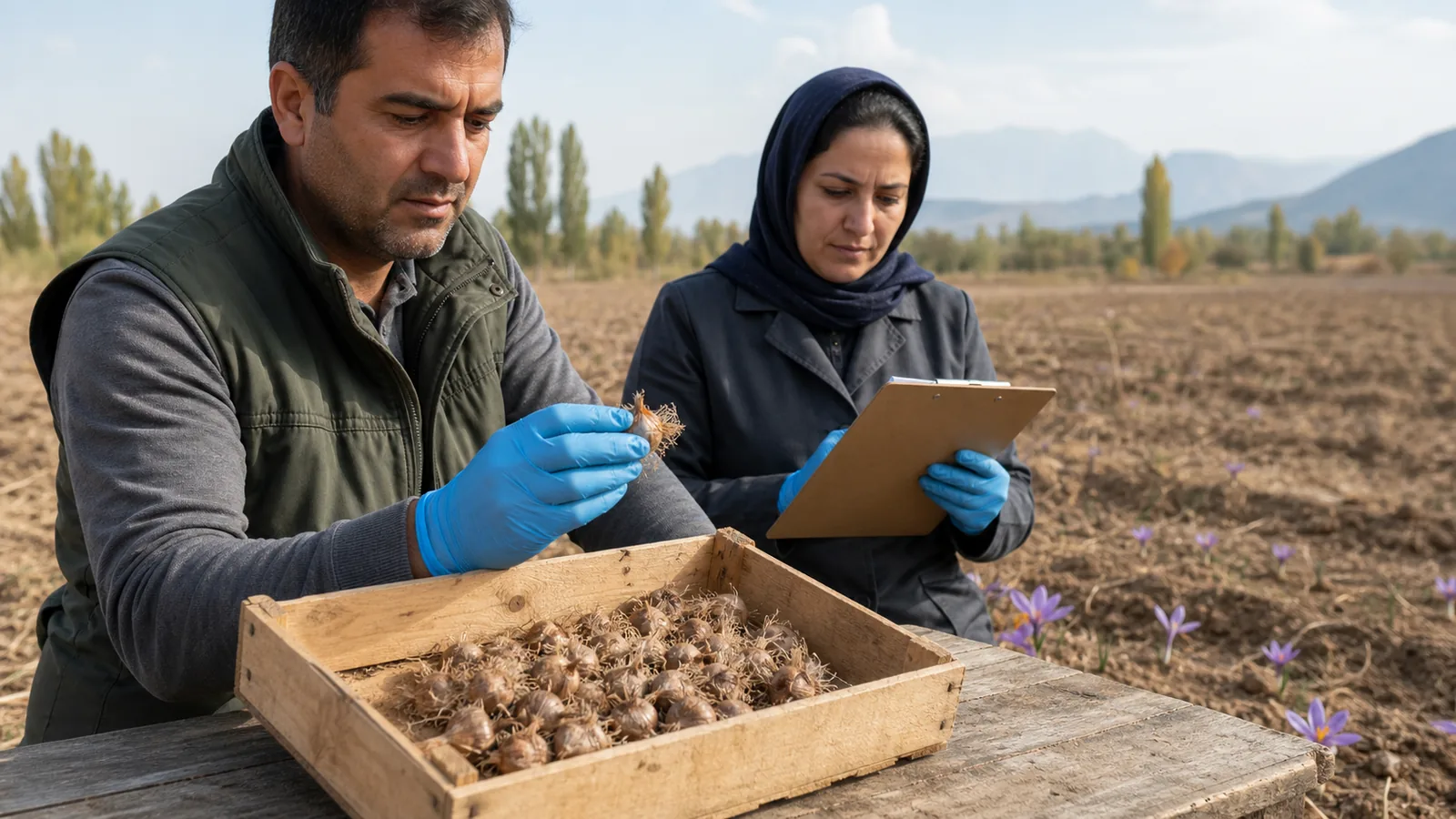
Saffron sold as a spice consists of dried red stigmas. A saffron corm is the underground structure used to propagate Crocus sativus. The plant is sterile, so growers establish and expand fields with daughter corms rather than seed. Our guide about Iranian saffron explains the plant and its cultivation cycle in detail.
Importing spice into Iran would mean bringing harvested saffron across the border for sale or processing. Moving Iranian corms out without the required declaration or permission would be an export and, if unlawful, smuggling. One does not prove or disprove the other.
The destination article quoted Seyyed Reza Nourani, then identified as head of a union for exporters and importers of agricultural products. He said Iran produced about 95% of the world’s saffron at the time and argued that importing saffron was therefore commercially implausible. He assigned the remaining share broadly to Afghanistan and Spain.
Those percentages are retained as Nourani’s historical statement, not as current market data. Production estimates depend on the year, source and whether the measure is harvested crop, formal exports or retail sales. A large domestic crop also cannot establish that no shipment was ever imported. Confirming that would require customs records for a defined period and product code, which the original article did not supply.
Why officials were concerned about saffron corms
Nourani’s main warning concerned corms leaving Iran. In his account, the practice could help growers in other countries establish their own fields and gradually reduce Iran’s production advantage. He compared that possibility with the development of pistachio competitors abroad.
The pistachio comparison was an argument made by the speaker, not proof that the two industries would follow the same path. Crops differ in climate requirements, propagation, time to maturity, labour, plant-health risks and market structure. The old story provided no volume of corms, seizure record, destination manifest or measured effect on saffron production outside Iran.
Still, the economic concern is understandable. Corm production supports the next planting cycle, while saffron fields support work in land preparation, cultivation, flower picking, stigma separation, drying, grading and packing. Losing healthy planting material through an unrecorded trade could affect growers even before a new foreign crop reached the spice market.
The warning about Chinese and Afghan buyers
A separate source article attributed a more specific warning to Gholamreza Miri of the Khorasan Razavi Saffron Exporters Union. In the translated report, Miri said Iranian-grown corms had been moved to Afghanistan for several years. He then alleged that Chinese actors had entered Iran to obtain corms with help from local dealers.
The article did not name a buyer, intermediary, border crossing, quantity, enforcement action or court case. The responsible reading is therefore that a union representative reported a perceived increase in corm trafficking. It is not evidence that Chinese people or Afghan people generally participated in smuggling, and it should not be rewritten as a proven organized scheme.
Planting material also raises questions beyond market competition. A legal international movement may require documentation, phytosanitary controls and compliance with the rules of both countries. The original reports did not establish which rule applied to any particular shipment. Anyone trading corms now would need current advice from the relevant agricultural and customs authorities rather than relying on a 2017 news article.
What the reports said about exports and market balance
Miri described the domestic saffron market as calm, with supply and demand in balance and recent price volatility reduced. He also complained that customs had not provided the provincial export figures he wanted for May.
The last figure cited in the source concerned the first month of the Iranian year, from March 20 to April 19, 2016. A contemporary report stated that Iran exported 10.344 tonnes of saffron worth about $15 million during that month, roughly 10% more by volume than in the same period a year earlier. The same report quoted Miri on improved market conditions and balanced supply and demand. These figures can be reviewed in the dated June 2016 Iran Front Page report.
Those numbers describe one historical month. They do not tell us today’s export volume, price, destination mix or level of unrecorded trade. Even in the source account, the absence of later customs statistics was part of the complaint, so the article cannot responsibly fill that gap with an estimate.
Did the reports prove saffron was not imported into Iran?
No. They recorded officials saying that imports were unlikely or commercially unnecessary because Iran produced most of the crop. They did not present a complete customs dataset proving zero imports. Nor did they prove the scale or route of alleged corm smuggling.
What the combined reports do establish is the shape of the industry’s concern at the time:
- trade representatives saw Iran’s production strength as the reason finished-saffron imports were not the central issue;
- they viewed saffron corms as strategic planting material connected to future production and rural jobs;
- they alleged that corms were leaving through Afghan and, later, Chinese-linked channels with local assistance;
- they described a temporarily balanced domestic market while asking for better access to customs statistics; and
- the only quantified export comparison in the reports was a 10% year-on-year increase for one month in 2016.
Readers comparing that account with wider production claims should also see our analysis of the historical statement that Iran produces about 90% of the world’s saffron. As with the 95% figure here, the year and metric matter.
How to read this article today
This page preserves a dated industry warning, not a live import rule or accusation. It should not be used to decide whether a present shipment is legal, to identify the origin of saffron now on sale, or to infer current trade volumes. Those questions require current customs data, traceable product documents and, for corms, the relevant agricultural and plant-health requirements.
The useful lesson is narrower. When an official says it makes little sense to import saffron to Iran, that is a market opinion. When a union warns about corm smuggling, that is an attributed allegation until shipment or enforcement records confirm it. Keeping those categories separate makes the historical record clearer and avoids turning a short news report into a claim it never proved.

![Exporting Saffron to Turkey + Price Guide [Complete 0 to 100]](https://img.rowhanisaffron.com/20260827003933/saffron-export-turkey-quality-inspection.webp)



