


Iran grows most of the world’s saffron, yet production leadership does not automatically produce the strongest export position. The saffron export process creates lasting value only when cultivation, testing, processing, packaging, branding, finance and access to the final market work as one chain. Historical industry reports show that Iran often exported the product successfully while capturing too little of the value around it.
Why the saffron export process matters
An older interview with Mohsen Ehtesham, then head of Iran’s National Saffron Council, said that about 85% of Iranian saffron was exported. He argued that the process remained weak because foreign buyers had too much influence over the price and much of the crop left Iran without enough domestic processing, product development or brand recognition.
The percentages in these archived reports vary: one placed Iran’s production share at 95%, while current FAO material uses 85–90%. They refer to different years and should not be blended into a new estimate. The durable point is that a dominant producer can still surrender value when buyers chiefly see a raw ingredient rather than a documented product with a recognizable origin and dependable specification.
Exporting raw saffron is not the same as building a market
Another Ehtesham interview claimed that more than 94% of Iran’s saffron exports left as raw product and only about 6% was sold under Iranian company brands. Those are attributed historical figures, not a current market audit. They describe the concern clearly: another business can buy bulk saffron, package it for its own customers and own the relationship with the final buyer.
Bulk trade is not inherently bad. Restaurants, food manufacturers and established packers may legitimately need large quantities. The weakness appears when exporters have no choice but to compete as interchangeable suppliers, cannot demonstrate quality consistently, or never learn what the final market values. A resilient mix can include verified bulk lots, retail products, food-service packs and carefully developed saffron-based products, each with clear quality and traceability.
Quality and traceability support a stronger price
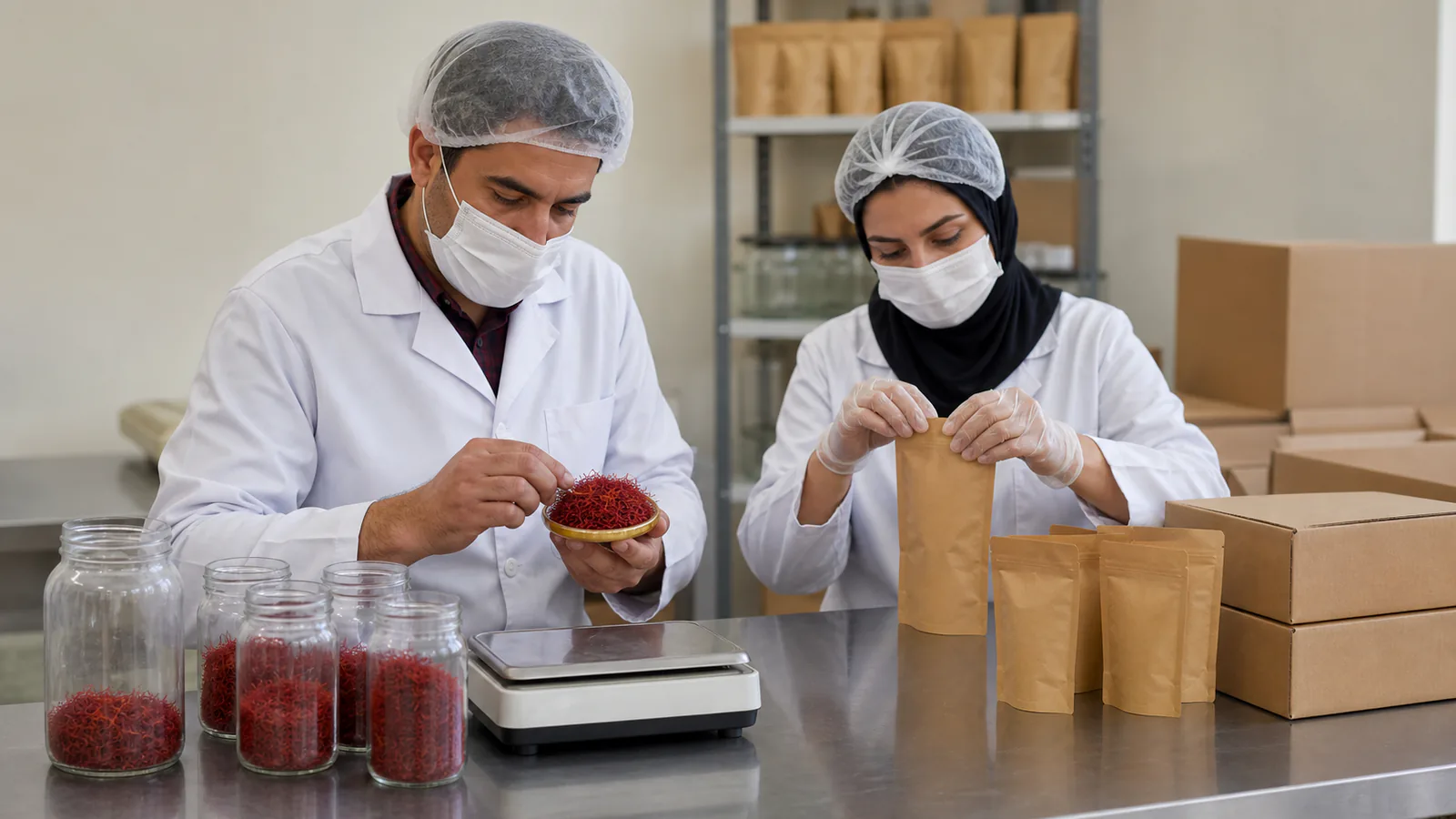
Branding cannot rescue an inconsistent product. It has to rest on accurate grading, safe handling, batch records and packaging that protects the spice. FAO’s current Iran saffron work brings farmers, processors, cooperatives, traders and experts together around improved production, post-harvest handling, safety, traceability, marketing and quality assurance. FAO reported in 2025 that Iran produced about 85–90% of global saffron and emphasized that maintaining market confidence depends on quality integrity throughout the chain. Read the FAO value-chain update.
This is more substantial than putting a logo on a box. A useful export specification tells the buyer what the lot is, how it was handled, how it was tested and how the result can be traced back. That evidence gives a serious exporter something other than price alone on which to compete.
Foreign-exchange repatriation changed exporters’ calculations
A 2019 report quoted Ehtesham saying that foreign currency earned from saffron exports had to be returned to Iran’s economic cycle through one of four central-bank methods. He expected the rule to reduce exports and then place downward pressure on saffron prices. The article did not describe all four methods or provide later outcome data, so it cannot establish that the prediction came true.
It does show why finance belongs inside an export analysis. An exporter considers not just the sale price but also settlement method, exchange-rate treatment, documentation, timing and the ability to use the proceeds. A rule that makes those steps uncertain can deter a compliant exporter even when foreign demand exists. If export volume then falls, the effect can travel back through processors and traders to the price offered to farmers.
The same interview said that the new responsibility was to help genuine exporters develop markets, particularly emerging destinations such as China, rather than simply expand cultivated area. Production without matched demand can put growers under pressure during harvest.
Single-use export cards and the informal route
Ehtesham also criticized what the translated report called “disposable” or single-use export cards. His argument was that temporary operators could enter a transaction without the long-term obligations or reputation of established exporters, leaving genuine businesses at a disadvantage. He connected currency-return problems with informal trade and said one of the National Saffron Council’s eight policy requests addressed those issues.
These were the council chairman’s claims and proposals, not verified findings about every exporter. Still, the governance problem is credible: a company that invests in testing, compliance and a lasting customer relationship cannot compete fairly if another route avoids equivalent obligations. Enforcement should distinguish legitimate small exporters from operators designed only to escape responsibility.
Tariffs can redirect saffron without changing its origin
The archived interview described tariffs of about 37% on Iranian saffron entering India and China. It said this encouraged shipments to China through Hong Kong or Vietnam and shipments to India through Afghanistan, which reportedly benefited from a zero-tariff arrangement. These details are historical and must not be used as a current tariff guide; trade rules and product classifications can change.
The economic mechanism remains important. A high origin-specific tariff can alter the route, paperwork or declared supplier while the saffron itself still began in Iran. That weakens origin recognition and makes trade data harder to interpret. Before acting on a market opportunity, an exporter should verify the current tariff schedule, rules of origin and import requirements for the exact product code in both the origin and destination jurisdictions.
Harvest timing increases the need for planning
The 2019 report noted that harvest could begin around September 20 in colder districts of South Khorasan and Razavi Khorasan, with broader harvesting following as conditions changed. This was a local, dated observation, not one fixed national harvest date. Weather, altitude and field conditions affect timing.
When a large share of the crop reaches the market within a short period, farmers need practical access to drying, storage and buyers. Exporters need packaging material, finance and confirmed demand before that rush. Otherwise, urgency shifts bargaining power away from the grower. This is one reason the price of saffron cannot be separated from the structure of its value chain.
Households depend on more than export tonnage
One source report said more than 200,000 households in South Khorasan depended on saffron. That figure belongs to the speaker and period, but it reflects the crop’s importance to rural income. Export success should therefore be measured by more than tonnes shipped or foreign currency recorded. The relevant questions include how much value remains with growers and local processors, whether payments are reliable, and whether the market rewards safer, higher-quality work.
FAO likewise describes saffron as supporting hundreds of thousands of smallholders, particularly in the Khorasans. Better returns do not come from forcing every farm to become a retail brand. They come from a chain in which each participant can prove what was contributed and receive a fair share of the resulting value.
What a stronger Iranian saffron export system needs
- Consistent quality definitions: buyers and sellers should know how a lot will be sampled, tested and graded.
- Traceable origin and handling: batch records should connect the product to its processing and storage history.
- Reliable export finance: currency and settlement rules should be clear enough for compliant businesses to price risk.
- Direct market knowledge: exporters need relationships with final buyers, not only another intermediary.
- Product and packaging choices: bulk, food-service and retail formats should answer real demand rather than a quota.
- Current trade compliance: tariffs, certificates, labeling and rules of origin must be checked for every destination.
- Support for small producers: cooperatives and processors can give growers access to testing, drying, storage and aggregated orders.
From production leader to value-chain leader
The core problem in the saffron export process was never a lack of saffron. It was the distance between growing an exceptional spice and controlling enough of the route to the customer to protect its identity and value. Iran’s strongest position will come from dependable quality, transparent trade, capable exporters and products designed around what buyers actually need. Branding then becomes the visible result of a good system, not a substitute for one.

![Exporting Saffron to Turkey + Price Guide [Complete 0 to 100]](https://img.rowhanisaffron.com/20260827003933/saffron-export-turkey-quality-inspection.webp)



