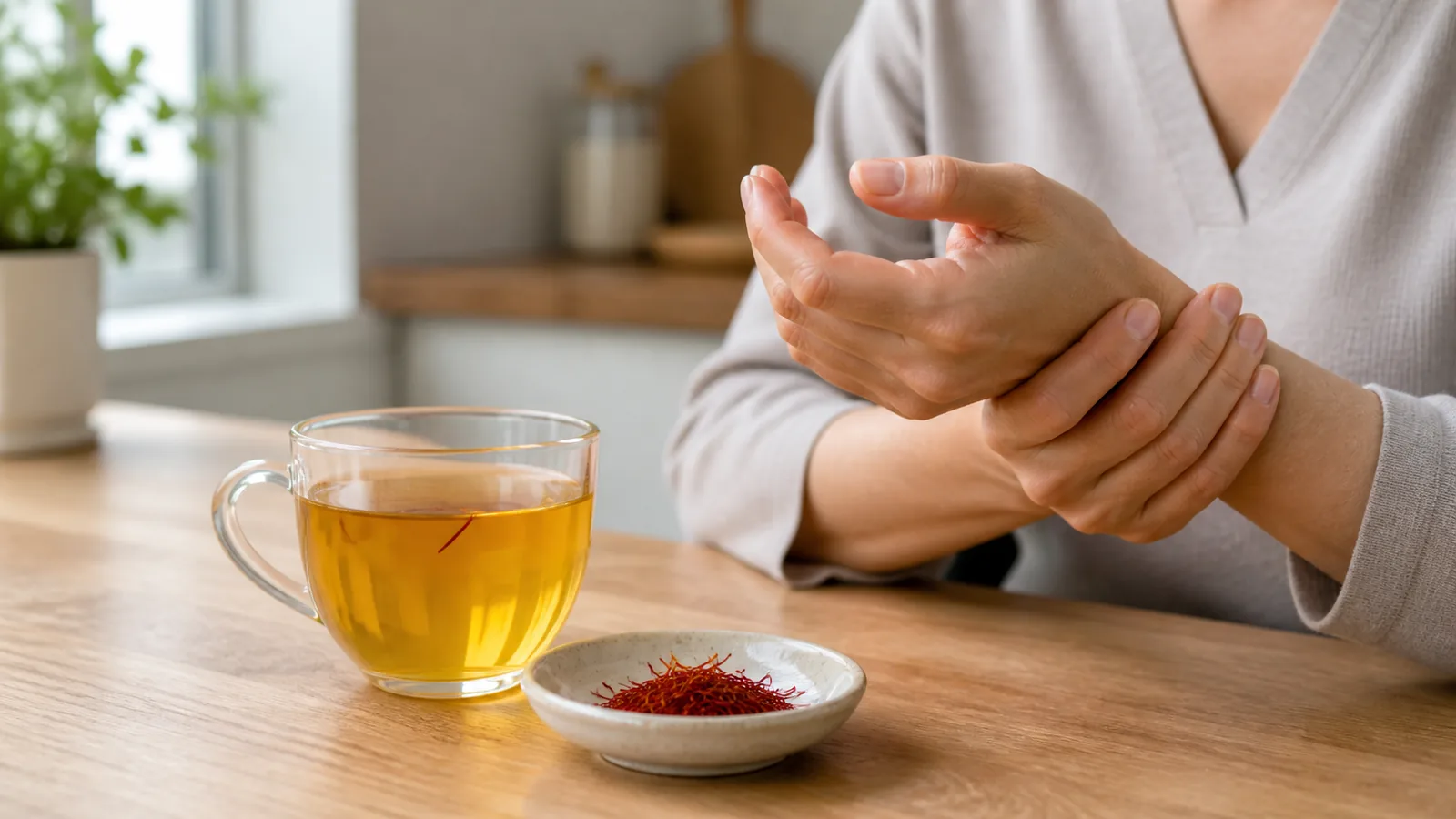
Saffron petals are the purple flower parts left after the red stigmas are removed. They contain anthocyanins and flavonols and are being studied as a useful agricultural by-product, but they are not the same ingredient as saffron spice. Most proposed medicinal properties of saffron petals still come from laboratory, animal, or small early human studies.
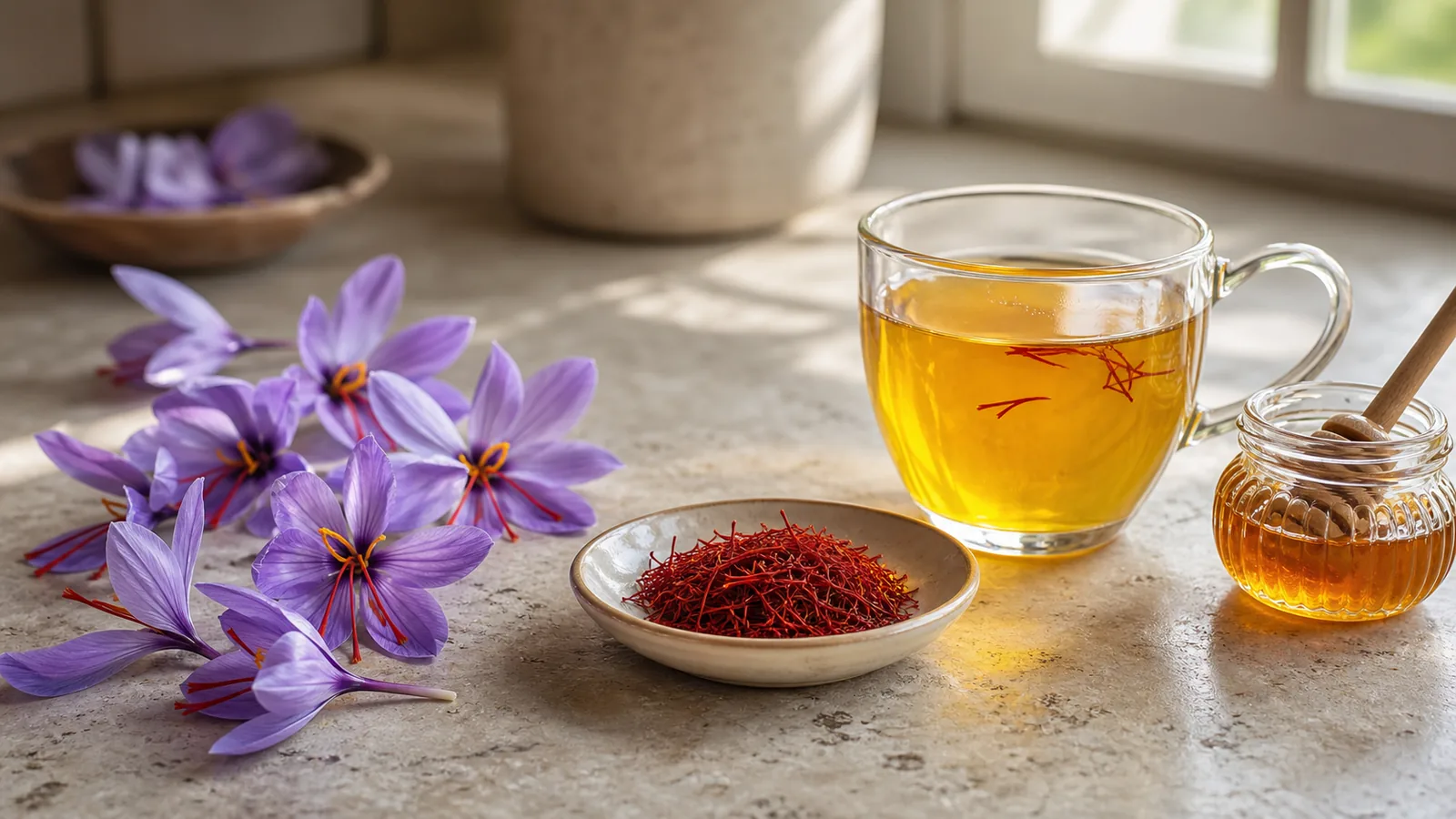
That distinction matters. Research on a standardized saffron extract cannot automatically be applied to homemade petal tea, and adding honey does not multiply saffron’s effects. This guide separates what is known about the petals from what has been studied in the red stigmas, then explains how saffron and honey can be enjoyed as food without turning a recipe into a medical claim.
What are saffron petals?
The commercial spice comes from the three red stigmas in each Crocus sativus flower. The showy purple structures are more precisely called tepals because the flower does not have clearly distinct petals and sepals. “Saffron petals” remains the familiar name, so we use it here.
Petals make up much more of the harvested flower than the stigmas and have often been discarded or composted. Their color comes mainly from anthocyanins. Researchers have also identified flavonols, including kaempferol derivatives, along with smaller amounts of other plant compounds. A 2024 review of saffron and its by-products describes this chemistry and the growing interest in recovering useful compounds from floral material.
The compounds are not present at fixed levels. Cultivar, growing conditions, handling, drying, storage, extraction method, light, heat, and pH can all affect the final product. A cup made from dried petals therefore cannot be assumed to deliver the same amount as an extract used in a study.
Saffron petals and saffron threads are not interchangeable
Red saffron threads provide the familiar color, aroma, and bitter-honeyed flavor used in rice, desserts, and drinks. Their best-known compounds include crocins, picrocrocin, and safranal. Petals have a different chemical profile, with much more emphasis on purple anthocyanin pigments and flavonols.
This difference is easy to lose in translated health articles. A paper about “saffron” usually means stigma powder or a standardized stigma extract unless it explicitly names petals or tepals. Claims about eyesight, mood, premenstrual symptoms, or metabolic markers are often based on those preparations, not on a casual petal infusion.
What the research on saffron petals actually shows
A dedicated review of saffron-petal pharmacology found several promising lines of research, including antioxidant, antispasmodic, pain-related, mood-related, blood-pressure, and metabolic effects. The important qualification is that much of this evidence came from cells or animals. Those experiments help researchers decide what to test next; they do not show that petal tea prevents or treats disease in people.
Antioxidants and inflammation
Petal extracts can show antioxidant activity in laboratory assays, and anthocyanins are genuine plant pigments with antioxidant properties. “Contains antioxidants,” however, is not the same as “prevents cancer” or “protects the heart.” Human outcomes depend on dose, absorption, metabolism, the preparation used, and many other parts of a person’s health and diet.
Mood and depression
Older, small trials of standardized petal preparations reported a possible benefit for mild-to-moderate depressive symptoms. A systematic review of herbal depression trials found a signal for saffron petals, while also showing how limited the evidence base was. Later clinical research has focused much more heavily on saffron stigma extracts.
Petals should not replace assessment, psychotherapy, prescribed medicine, or urgent mental-health care. Anyone with persistent low mood, loss of interest, major changes in sleep or appetite, impaired daily function, or thoughts of self-harm needs help from a qualified clinician. A household infusion is not equivalent to the standardized products tested in trials.
Blood pressure, menstrual symptoms, and pain
Laboratory and animal findings have led to interest in whether petal extracts affect smooth muscle, pain pathways, or blood pressure. That does not establish a dependable treatment in humans. Likewise, clinical studies of saffron for premenstrual symptoms generally concern measured stigma-based preparations rather than ordinary petal tea. It is inaccurate to promise that petals normalize blood pressure, regulate menstruation, stop uterine bleeding, or cure cramps.
Unexpected or heavy bleeding, severe pelvic pain, fainting, pregnancy-related bleeding, or markedly high or low blood-pressure readings deserve medical assessment. They should not be managed by increasing an herbal drink.
Cancer and eye health
Petal compounds have been tested against cells in laboratory settings, but no evidence establishes saffron petals as a cancer treatment. Antioxidant activity cannot be used to infer that a food prevents tumours. The earlier claim that the petals treat liver cancer is therefore not retained.
Research interest in saffron and vision has principally involved specific stigma-derived supplements, not petals mixed with honey. Neither a petal infusion nor a honey-saffron drink should be described as a treatment for macular degeneration, blindness, or another eye condition.
Can saffron petals be made into tea?
Petal infusions have a traditional place in some communities, but consumer products vary and clinical safety data for homemade petal tea are limited. Use only correctly identified, food-grade Crocus sativus petals supplied for consumption. Flowers sold for decoration may have pesticide residues, and a plant that merely resembles saffron may be unsafe.
Do not assume that more petals make a better drink. Product directions should govern preparation because there is no universal household dose. People who are pregnant, breastfeeding, taking blood-pressure or anticoagulant medicine, managing a chronic condition, or considering regular medicinal use should ask an appropriate clinician first. Stop using the product and seek advice if it causes a rash, dizziness, digestive symptoms, breathing difficulty, or another suspected reaction.
Honey and saffron: what the combination can and cannot do
Honey and saffron make an aromatic drink, but most recipes use the red stigmas, not the purple petals. The two ingredients do not create a new substance whose health effects are automatically greater than either ingredient alone.
A small randomized trial has studied a mixture containing saffron, Astragalus honey, and another herb alongside usual treatment for a neurocognitive disorder. Because it tested several ingredients in a specific patient group, it cannot prove that an everyday honey-and-saffron drink improves mood, memory, or concentration. It also does not support the source article’s claims that the pairing treats eye disease, prevents cancer, flushes the kidneys or bladder, guarantees heart health, suppresses appetite, or relieves pain without side effects. The trial can be reviewed in the Journal of Research in Medical Sciences record.
Honey provides sweetness and can make saffron more pleasant to drink. It also adds sugar and calories. Someone managing diabetes or trying to reduce added sugar should account for that rather than treating honey as a weight-loss ingredient.
Two simple honey-and-saffron drinks
Cool saffron and honey drink
- Crush a small culinary pinch of saffron threads and steep it in a little warm water until the color and aroma open.
- Add the infusion to two glasses of cool water.
- Stir in honey to taste. A small splash of food-grade rose water is optional.
- Serve promptly. Treat it as a flavored drink, not an energy treatment or immune-system medicine.
Warm saffron tea with honey
- Place a small pinch of crushed saffron threads in a cup and add hot water.
- Let it infuse for several minutes.
- Allow the drink to cool to a comfortable temperature, then add honey to taste.
- Add a little cinnamon or food-grade rose water if you enjoy the flavor.
Honey must not be given to children younger than 12 months because of the risk of infant botulism; the CDC gives this advice explicitly. For everyone else, allergy to honey, pollen, saffron, or another ingredient remains possible.
What about a honey, almond, and saffron face mask?
The absorbed source also described a mask made from ground almonds, honey, and saffron. It may feel softening or exfoliating, but that is a cosmetic experience rather than evidence that it treats acne, pigmentation, wrinkles, or another skin condition.
Finely ground almond can still be abrasive. Anyone who chooses to try the mixture should avoid the eye area and broken or inflamed skin, test a small amount first, and stop if irritation develops. Do not use it with a nut, honey, pollen, or saffron allergy. Persistent skin problems belong with a dermatologist, not a kitchen scrub.
Safety: food use and medicinal use are different
A culinary pinch of saffron in a shared recipe is not the same exposure as a capsule, concentrated extract, or repeated medicinal drink. A 2026 systematic review of human saffron safety found that saffron preparations were generally well tolerated, but adverse effects did occur, most often gastrointestinal symptoms. The studies covered measured products and should not be used to declare every petal or honey preparation harmless.
- Do not use saffron or petals to replace prescribed treatment.
- Ask a clinician or pharmacist before concentrated or regular use if you take medicine or have a health condition.
- Pregnancy deserves particular caution; culinary exposure and medicinal dosing are not equivalent.
- Do not give honey to an infant under 12 months.
- Use accurately identified, food-grade ingredients and follow the supplier’s directions.
The useful conclusion about saffron petals
Saffron petals are a chemically interesting part of the flower and a potentially valuable alternative to agricultural waste. Their anthocyanins and flavonols justify further study, but current evidence does not support presenting petal tea as a treatment for cancer, hypertension, menstrual disorders, blindness, or heart disease.
Honey and saffron can still make an enjoyable drink, and petals may have future uses in food, cosmetics, and carefully standardized extracts. The honest position is to appreciate those uses while keeping laboratory promise, early clinical evidence, and proven medical care clearly separate.