


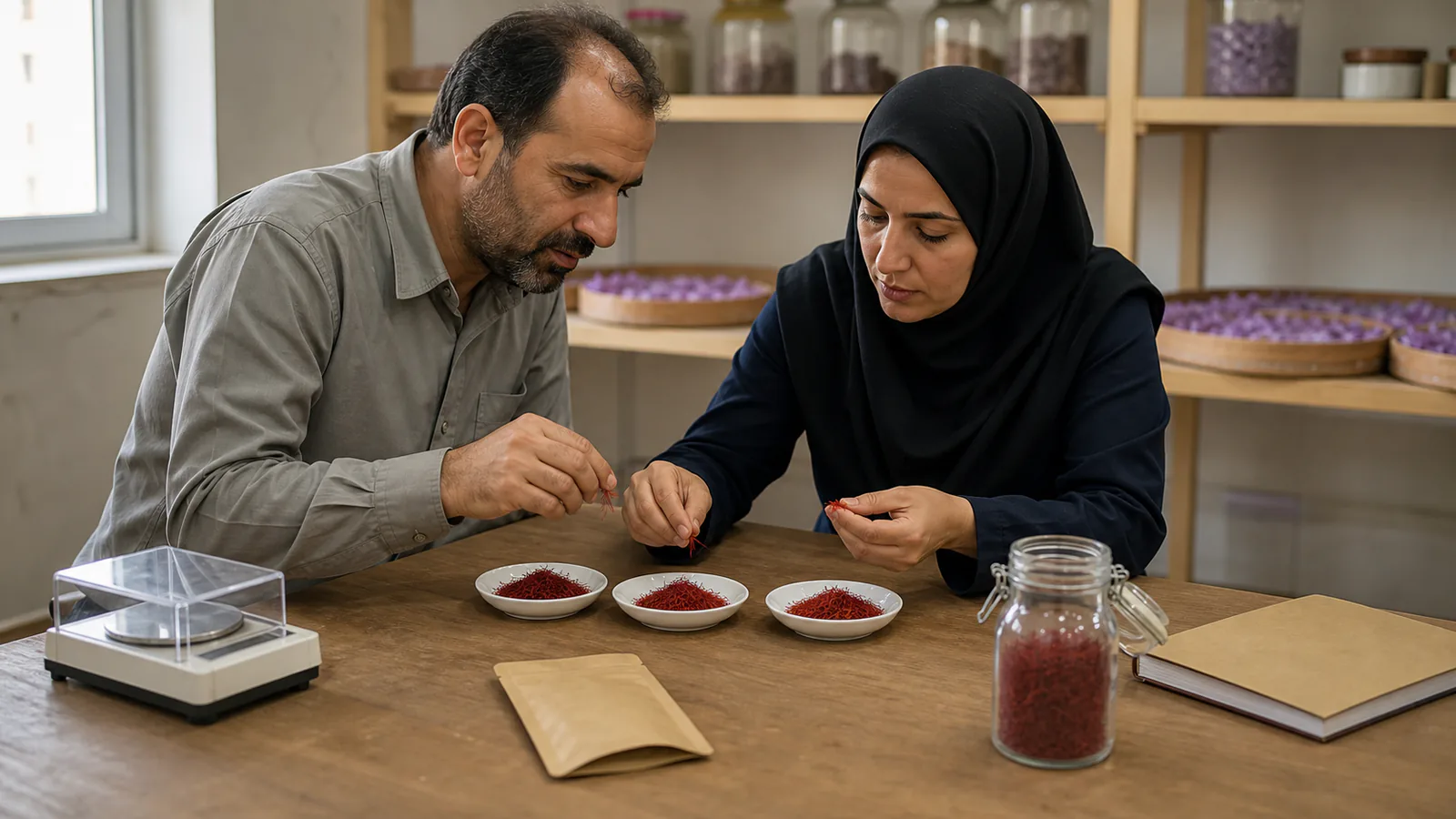
The price of saffron is not set by harvest volume alone. Quality, timing, processing, access to buyers, export rules and the balance of bargaining power all affect what a farmer receives and what a customer eventually pays. Historical Iranian market reports show why two lots harvested in the same province could sell at different prices, and why a larger crop did not always produce a simple or lasting fall in the market.
What determines the price of saffron?
Five forces matter most:
- Harvest size: a larger crop can increase supply, but the effect depends on how much older stock is still held and how quickly buyers enter the market.
- Grade and post-harvest care: clean separation, controlled drying, safe storage and verifiable quality can make one batch more valuable than another.
- Market access: farmers who must sell immediately may accept less than sellers who can store a sound product or reach processors and exporters directly.
- Trade conditions: exchange rates, export demand, packaging rules and transaction costs can alter both the price and the form in which saffron leaves the country.
- Policy intervention: cooperative or government purchasing can create another route to market, but its effect depends on the announced grades, prices, timing and ability to buy.
This is also why a headline saying that saffron will rise or fall should be read as a dated forecast, not a permanent rule. For a closer look at those short-term movements, see our history of an unpredictable saffron market price.
Production matters, but the figures must be read carefully
An older report quoted Ali Hosseini of Iran’s National Saffron Council as saying that roughly 24 provinces had some production, while most output came from Razavi Khorasan and South Khorasan. It placed the combined cultivated area above 90,000 hectares and forecast national production above 360 tonnes. The machine-translated version also mixed units when describing yield, so that part cannot safely be repeated as a reliable per-hectare figure.
The useful lesson is not the exact forecast. It is the relationship between supply information and planning. Farmers, buyers and exporters make better decisions when planted area, harvested volume and carry-over stock are reported consistently. Without that context, a production headline can create expectations that do not match the amount or grade actually reaching the market.
Recent evidence confirms Iran’s central position without turning an old estimate into a current statistic. The UN Food and Agriculture Organization reported in 2025 that Iran produced about 85–90% of the world’s saffron and that the crop supports hundreds of thousands of smallholders, particularly in the Khorasan provinces. FAO also emphasizes production practice, post-harvest handling, safety, traceability and quality assurance across the value chain. Those are price-forming fundamentals, not decorative extras. Read the FAO value-chain update.
Why quality can outweigh a simple supply increase
The same historical council report described a multi-year quality-improvement program in selected villages. It associated training and local processing facilities with better handling, stronger buyer confidence and higher returns for participating growers. The report claimed price gains of about 30% and cited old purchase values of roughly 3 million tomans per kilogram before the program, around 4.6 million afterward, and as much as 5.8 million for qualifying saffron.
Those numbers belong to that historical program and currency period; they are not today’s quotation. What remains relevant is the mechanism. A lot that is carefully separated, dried, protected from moisture and contamination, and supported by credible testing may command more than an anonymous batch whose origin or condition is uncertain. FAO’s current work on authenticity and traceability follows the same logic: confidence in what is being sold helps protect value for both farmers and buyers.
Government and cooperative purchasing
A separate report quoted then–Razavi Khorasan governor Alireza Rashidian announcing that a government saffron purchase price would be released and that rural cooperatives would handle purchases. The stated purpose was to stop farmers’ returns being captured by brokers and to continue an earlier market-management program.
A purchase program can help only if farmers know the eligibility rules, grades, delivery locations, payment timetable and actual buying capacity. An announced floor is not automatically the price received by every grower. Quality deductions, limited intake, delayed payment or the need for immediate cash can still send farmers to private buyers. Cooperative access should therefore be evaluated alongside, not instead of, a transparent commercial market.
The source report also contained unrelated material about provincial construction budgets and contractor support. That does not explain saffron pricing and has not been carried into this article.
The economic case for a coordinated saffron market
For many small growers, saffron income is concentrated around a short harvest. Production policy, processing, distribution and export policy therefore affect the same household balance sheet. Supporting cultivation while ignoring drying, grading, storage or access to buyers can leave the farmer exposed at the moment the crop must be sold.
Older commentary called for a small saffron commodity market and crop-specific investment. A well-designed trading venue can improve price discovery and standardize grades, but it is not a cure by itself. Contracts must describe quality clearly, testing must be credible, and small producers need a practical route to participate. Otherwise, the formal market may record prices without changing the weaker seller’s options.
A historical export rule shows how policy can reshape trade
One archived interview reported an 18% decline in saffron exports in 2009 and linked part of the pressure to higher prices. It also described a 150,000-toman charge on export packages above 30 grams. According to the interviewee, shipments below 30 grams then rose by 800%, not because underlying demand had multiplied eightfold, but because exporters changed pack sizes to avoid the charge.
These are attributed historical claims, not a description of current Iranian export law. They nevertheless illustrate a useful economic point: a threshold can change packaging behavior without increasing how much saffron people consume. When comparing export data, both total weight and the distribution of pack sizes matter. A surge in the number of small packages is not automatically a surge in the market itself.
Afghanistan became a real producer, not a footnote
The same interview viewed expanding Afghan cultivation as future competition and claimed lower labor costs and yields of 10–12 kilograms per hectare. We have not found primary evidence strong enough to present those particular comparisons as established facts, so they should remain attributed to that speaker rather than treated as a current benchmark.
The broader development is well documented. World Bank research examined saffron as an Afghan value chain and recorded producers, traders, processors and exporters in Herat. It found that handling, cleanliness, drying and packaging could add value, while also warning that its price observations were only snapshots. The study reported an average historical yield of about 2 kilograms of dried saffron per jerib, a local unit equal to about 2,000 square metres—not the unsupported 10–12-kilogram-per-hectare comparison in the old interview. See the World Bank value-chain study.
For Iranian producers, the sensible response to international competition is not to rely on a claim of automatic superiority. It is to make origin, purity, handling and grade easier to verify while maintaining reliable supply and buyer relationships.
How to interpret a saffron price today
A useful quotation should answer more than “how much per kilogram?” Before comparing two prices, check:
- the date and currency of the quotation;
- whether it is a farm-gate, wholesale, export or retail price;
- the saffron type and grade;
- whether testing, packaging, tax, shipping or insurance is included;
- the order size and payment terms;
- and whether the figure is an asking price or a completed transaction.
Historical prices in this article explain how the market behaved; they should not be used as a current offer. For a purchase, compare like with like and request a dated quotation tied to the product’s grade, weight and delivery terms.
The lasting lesson
The price of saffron is the outcome of a chain. Weather and harvest volume start the story, but processing, documented quality, storage, bargaining power, policy and access to export buyers decide how value is divided. Stronger information and credible quality controls help a grower receive a price that reflects the product, while clear specifications help a customer understand what that price actually buys.

![Exporting Saffron to Turkey + Price Guide [Complete 0 to 100]](https://img.rowhanisaffron.com/20260827003933/saffron-export-turkey-quality-inspection.webp)



