


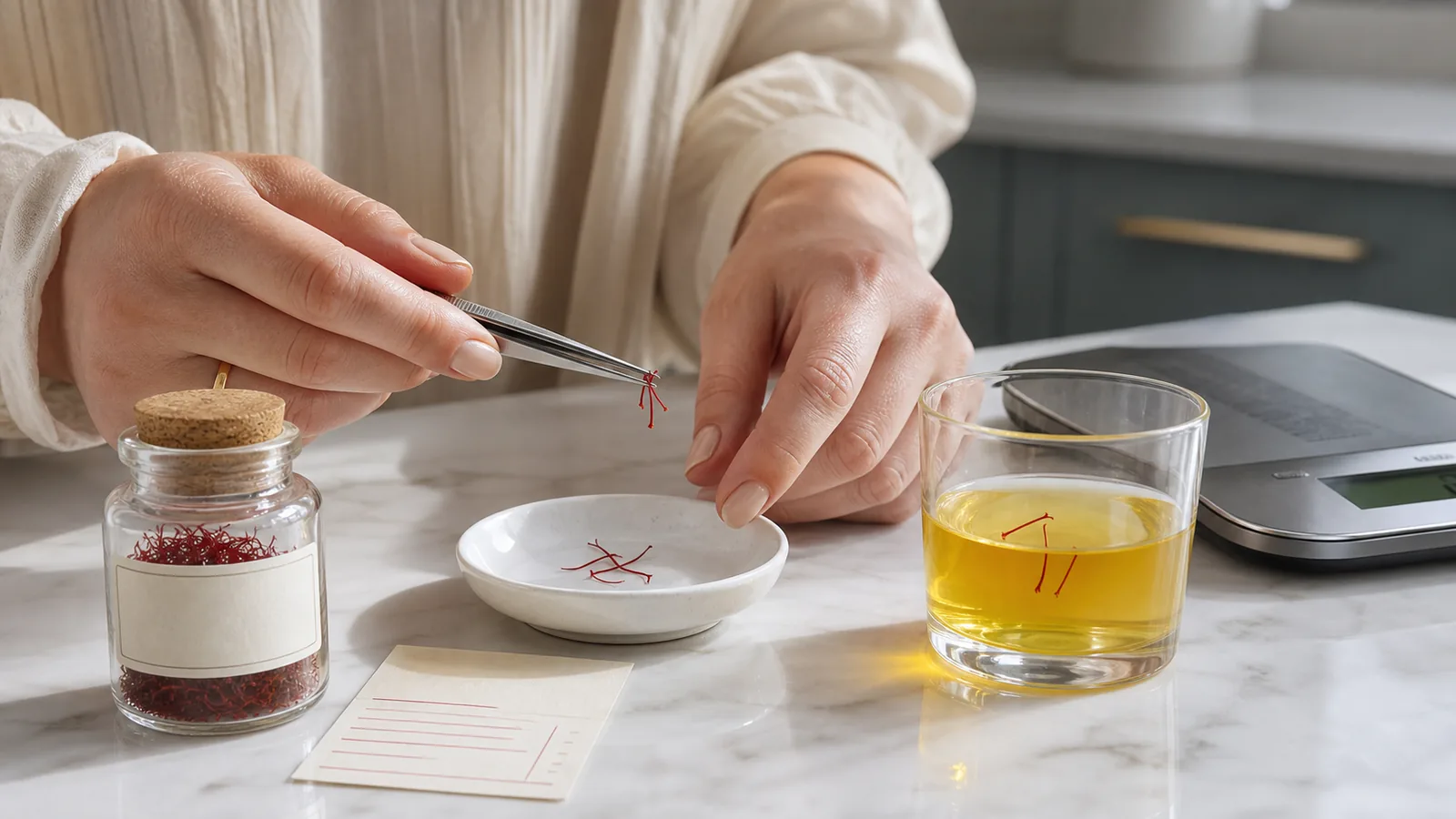
To buy saffron with confidence, begin with evidence rather than colour. Choose a seller who identifies the product and producer, gives a net weight and lot or batch reference, and can explain the saffron’s form, origin and testing. Whole threads are easier for a consumer to inspect than powder, but appearance alone cannot prove purity.
Saffron is valuable and is used in small quantities, which makes substitution and undeclared fillers commercially tempting. The US Food and Drug Administration gives saffron as an example of an expensive spice that may be bulked with cheaper plant material. In a large European Commission control exercise, 11 percent of the sampled saffron was considered at risk of adulteration. That result was not intended to represent every product on the market, but it confirms that authenticity deserves attention.
Start with the label and the seller
A credible package should make it possible to identify who is responsible for the food. Look for the producer or packer’s name and address, a contact route, the declared contents, net weight, batch or lot code, and relevant packing, best-before or expiry information. Depending on the country, a food-business licence, registration number, standard mark or health-authority approval may also be required. The exact legal fields differ by market, so the absence of a particular Iranian mark does not automatically make an overseas package false.
The details should agree with one another. A premium-origin claim beside an untraceable seller, missing batch code or vague product description is a reason to pause. For online purchases, save the listing and invoice. A seller should be willing to state whether the jar contains filaments, cut filaments or powder and whether anything else has been added.
What genuine saffron threads look like
The culinary spice is made from the dried stigmas of Crocus sativus. A whole stigma has a flared, trumpet-like end and becomes narrower toward the base. Threads are typically deep red, with natural variation rather than the perfectly uniform look of manufactured fibres. Some yellow or orange style may be present in certain commercial cuts; how much is included affects the grade and appearance.
Shape can expose crude imitations made from coloured fibres or other plant parts. It cannot detect every form of substitution, added moisture or undeclared dye. Finely ground saffron removes most visual clues, which is why powder from an unknown source carries more uncertainty.
Our overview of saffron types and quality explains common presentations such as Negin, Sargol, Poushal and Dasteh. These commercial names are useful descriptions, but the name on a packet is not a laboratory result.
Aroma and taste: useful clues, not a verdict
Good saffron has a distinctive dry, hay-like and honeyed aroma with a bitter edge. A thread touched briefly to the tongue should not taste sugary. Noticeable sweetness or saltiness can raise concern about added material intended to increase weight.
Do not eat a large sample as a test. Sensory judgment varies, and flavour can weaken through age, poor drying or storage without the product being counterfeit. Conversely, added flavour or aroma can make an adulterated sample seem convincing. Treat smell and taste as screening clues only.
What a water test can and cannot tell you
Placing a few threads in room-temperature water is a common home check. Genuine saffron usually releases colour gradually, and the liquid develops a clear golden-yellow tone while the threads remain visibly structured. Fibres that shed an intense red cloud immediately or turn pale at once may have been surface-dyed.
This test has limits. Release speed changes with thread size, water temperature, agitation and how the saffron was dried. A skilful adulterant may behave plausibly, while genuine cut threads can release colour faster than intact stigmas. The water test can reveal something suspicious; it cannot certify authenticity or assign an ISO category.
Skip the paper-and-grease myth
Older buying advice sometimes recommends pressing saffron between paper and judging the mark left behind. A visible oily or coloured trace is not a reliable consumer test for purity. Pressure, residual moisture, natural compounds, paper type and added substances can all change the result. The absence of a mark does not prove that a sample is genuine.
The same caution applies to claims that one quick kitchen trick can identify “real saffron” with certainty. Home observations may help reject an obvious fake, but sophisticated substitution, undeclared plant material, artificial colour and excess moisture require analytical methods.
When laboratory evidence matters
For a costly retail purchase, a sealed traceable package from a responsible supplier is usually more useful than trying several improvised tests. For bulk buying, food manufacturing or resale, request a batch-specific certificate of analysis and define the test methods in the purchase specification.
ISO 3632-1:2025 specifies requirements for dried saffron in filament, cut-filament and powder forms. Its companion test methods are used to assess characteristics linked to colour, aroma, flavour, moisture and extraneous matter. The FDA also publishes a supplemental macroanalytical method specifically for Crocus sativus. A certificate should identify the laboratory, sample, batch, date, method and actual results; a generic badge or undated report is not enough.
A practical saffron buying checklist
- Prefer intact threads when you do not know the seller well.
- Check the responsible business, contact details, net weight and lot code.
- Make sure the origin, grade and product form are stated clearly rather than implied by decoration.
- Reject damaged, damp or unsealed packaging and unexplained extra ingredients.
- Compare the price with the grade and quantity; an implausibly cheap offer deserves more scrutiny.
- Use sensory or water checks only to identify warning signs, not to certify the product.
- For bulk or commercial use, agree specifications and obtain batch-level laboratory results.
The basic principle is simple: buy saffron that can be traced and described, then use inspection as a second layer. A red colour, a familiar brand name or a dramatic home test is weaker evidence than an accountable supplier, an intact batch code and appropriate analysis.
Sources: See the FDA overview of economically motivated adulteration, the European Commission herbs-and-spices authenticity action, ISO 3632-1:2025, and the FDA’s saffron macroanalytical-method page.

![Exporting Saffron to Turkey + Price Guide [Complete 0 to 100]](https://img.rowhanisaffron.com/20260827003933/saffron-export-turkey-quality-inspection.webp)



