


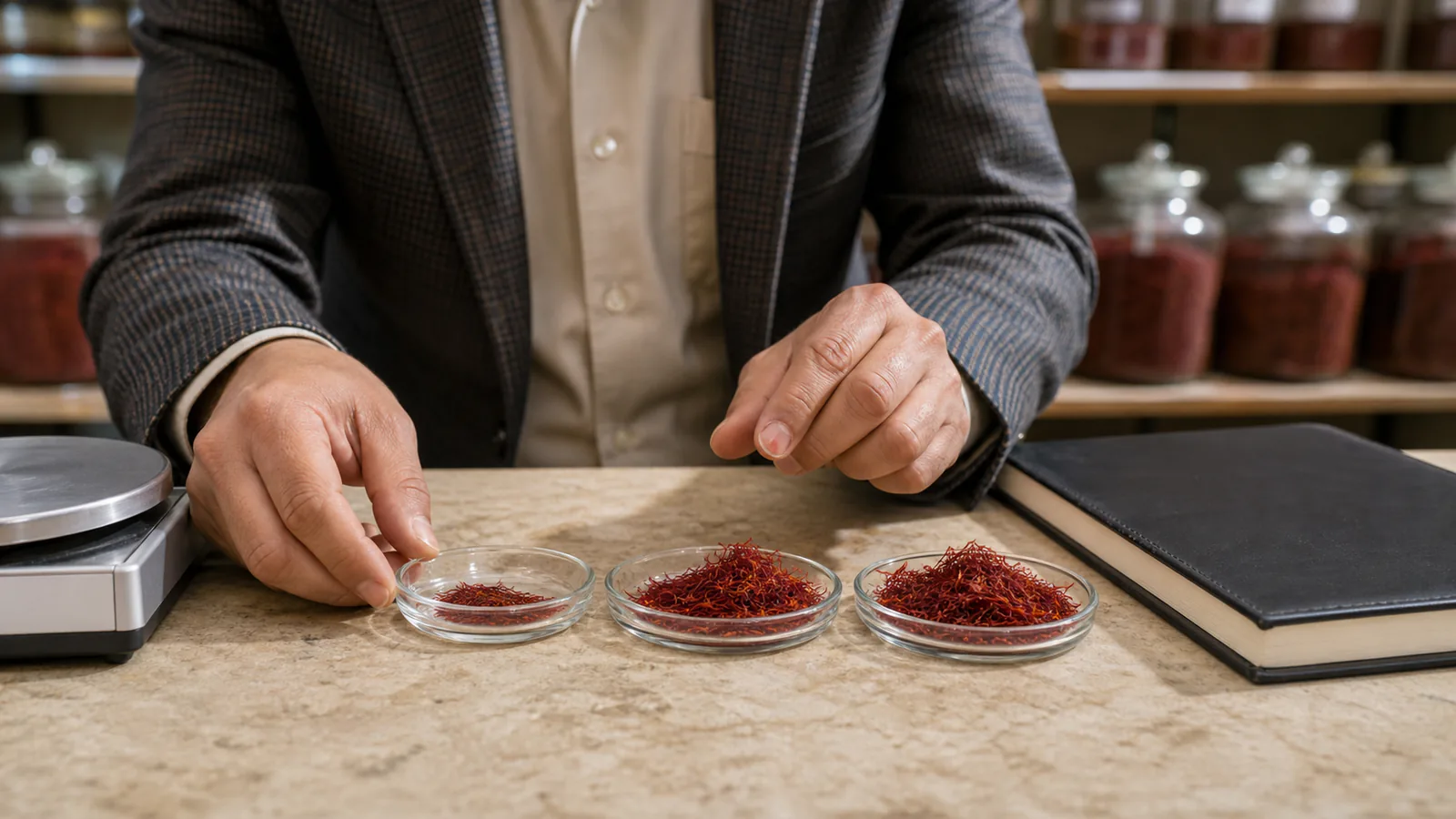
The Iranian saffron market price was hard to predict because harvest supply, farmer-held stock, export demand, exchange rates and policy changed at different times. The historical reports gathered here recorded prices from about 3.9 million to 13 million tomans per kilogram. Those figures describe several market periods between 2015 and 2022; they are not one continuous price series and are not current quotations.
The strongest lesson is not that saffron always rises or always falls. A small change in available stock or export buying can move the market when many growers hold only a few kilograms and release it according to household needs. Currency and official trade rules can add another layer of uncertainty.
For a current purchase, compare a dated offer for the same grade, test results, quantity, packaging and delivery terms on the current saffron price page. This article explains the older market dynamics rather than pretending to publish today’s saffron market price.
A stable 6.5–11 million toman market that still felt unpredictable
Gholamreza Miri, identified in the destination report as vice-chairman of the National Saffron Council, put saffron at 6.5–11 million tomans per kilogram. He said the range had been stable for several weeks, yet exchange-rate fluctuations, new instructions and uncertainty around currency repatriation made even the next day’s price difficult to forecast.
He also described a normal seasonal decline in March, when company finances and slower exports reduced buying. Household economic pressure added to the weakness. A previously discussed government purchase agreement had stopped because the market price had not fallen below the intended intervention level.
Exports rose, but the data arrived late
Miri cited 125 tonnes of saffron exports worth more than $250 million through the end of December, up 38% from the comparable period. He said a favourable exchange rate for foreign buyers helped drive the increase.
At the same time, he criticised the lack of newer customs statistics after a tariff-code or registration change. That gap made it harder to see whether growth continued. He also alleged that currency-contract and repatriation difficulties pushed some trade into undeclared channels, meaning official exports might not describe all cross-border movement.
These are historical attributed claims. They should not be read as a current description of Iranian currency or customs rules.
The 25% broker-hoarding episode
An earlier report shows how quickly available supply could tighten. Miri said brokers bought directly from farmers and encouraged people to store saffron at home. He attributed a roughly 25% price increase to that reduction in market supply.
The report also said more than 11 tonnes were exported in the Iranian month of Farvardin, 29% more than a year earlier. Sellers struggled to secure product, promise delivery or quote a final price to overseas customers. Miri warned that if the situation continued, the same price rise that rewarded holders could eventually damage exports.
The percentages remain his figures because the archived article does not provide the underlying customs table or exact reporting year needed to reproduce them.
Why many small growers could move supply
In a separate spring-price interview, Miri estimated that Iran had about 125,000 saffron farmers producing roughly 2 kilograms each on average. He said many kept some saffron at home as savings and sold when they needed money.
That structure matters. A large company usually releases inventory according to a procurement plan. Thousands of households may respond to holidays, bills, inflation expectations or a sudden price rumour. Their individual decisions are small, but together they can change the amount offered to traders.
The same report put national saffron area at about 83,000 hectares and said approximately 80% of production was exported. These are dated estimates, not current census results.
The recurring spring rise
Miri described a period when prices rose about 20%, from roughly 3.9 million to 4.5–4.7 million tomans per kilogram. He linked the move to farmers withholding stock between 25 March and 20 April while buyer demand continued.
He also said the exchange rate supported prices because a large share of production was exported. He warned that farmers could release stock at any time to meet household needs, increasing supply and slowing or reversing the rise.
This is a seasonal mechanism, not a calendar guarantee. Weather, inventory, demand and policy can make another year behave differently.
The 5% summer decline
Another report recorded a 5% fall. Its previous-month range of 4.25–5.8 million tomans moved to about 4–5.4 million. Miri attributed the decline to a seasonal increase in supply during summer.
The report said Khorasan Razavi produced 78% of Iranian saffron and advised consumers to look for a standards mark. The regional share is a historical figure and may differ by year. A badge can be useful only if it is genuine and tied to an applicable standard; buyers should also check the seller, packaging integrity, lot information and any promised laboratory evidence.
When farm-gate prices reached 8–13 million tomans
A later report put farm-gate prices at 8–13 million tomans per kilogram. Miri said growers delayed selling because other goods had become more expensive and they expected an export crop to retain value. Higher exports and alleged smuggling increased demand for limited available stock.
The report’s headline forecast 30% growth in Iranian production, while the body cited 20–25% growth in total exports and did not show a production calculation. The headline figure should therefore be treated as a forecast, not a measured harvest result.
Miri also expected exports to decline seasonally from June and warned that inexperienced participants and speculators contributed to high prices. More production would require export planning rather than an assumption that the market would automatically absorb it.
Khorasan Razavi’s 251-ton export report
For Iranian year 1397, Miri cited 251 tonnes of saffron exports worth $354 million from Khorasan Razavi, 14% higher than 1396. He said the province handled about 90% of national saffron exports.
This 90% figure refers to exports through the province, not necessarily the province’s share of production. It also belongs to that reporting period. Combining it with the older 78% production estimate without those definitions would create a false contradiction.
A separate 211-ton stability snapshot
Ali Hosseini of the National Saffron Council described another stable period at 6.5 million to 12–13 million tomans per kilogram. He said domestic buyers had limited tolerance for further increases because saffron was a discretionary or luxury item in the household basket.
Hosseini cited customs data for 211 tonnes exported in the first ten months of Iranian year 1397. He cautioned that customs base values did not necessarily match the prices achieved in target markets. He forecast continued export growth in 1398, arguing that Iran’s scale and currency-driven price advantage made competitors less competitive.
The forecast used monopoly language, but Iran is better described as the dominant producer, not the only source. The UN Food and Agriculture Organization estimated Iran’s share at 85–90% in a 2025 update, while other countries also produce saffron.
FAO’s current value-chain report provides the documented production-share context.
Bulk exports: problem or legitimate channel?
Hosseini called for restricting raw or bulk saffron exports and described them as a loss of capital. The concern was that processing, packaging and brand value would be created elsewhere.
More value-added work in Iran can benefit growers and processors when buyers pay for it. A blanket ban is not automatically the best route. Some food manufacturers legitimately need bulk saffron, and efficient bulk contracts can still preserve origin, quality specifications and traceability. Policy should compare the value retained, cost and market access of each channel rather than assuming every retail pack is more profitable.
Why the saffron market price changed
Across the reports, six forces recur:
- Harvest timing: expectations of new supply can lower bids before flowers arrive.
- Household-held inventory: growers release stock according to price and cash needs.
- Broker and speculative buying: accumulation reduces immediate supply and may disrupt contracts.
- Export demand: a large export share links local prices to overseas orders.
- Exchange rates and trade rules: these alter buyer advantage, settlement and reported flows.
- Data quality: late or incomplete statistics allow rumours to fill the gap.
How to use these historical prices
Do not average the 3.9-million and 13-million figures into a supposed market benchmark. They come from different years, seasons and likely grade mixes. Instead, use each episode to understand a mechanism.
A present-day comparison should identify the date, toman or rial basis, saffron grade, testing, bulk or retail quantity, packaging, origin, delivery terms and whether the number is an offer or a completed sale. Without those details, the apparent precision of a saffron market price is misleading.

![Exporting Saffron to Turkey + Price Guide [Complete 0 to 100]](https://img.rowhanisaffron.com/20260827003933/saffron-export-turkey-quality-inspection.webp)



