


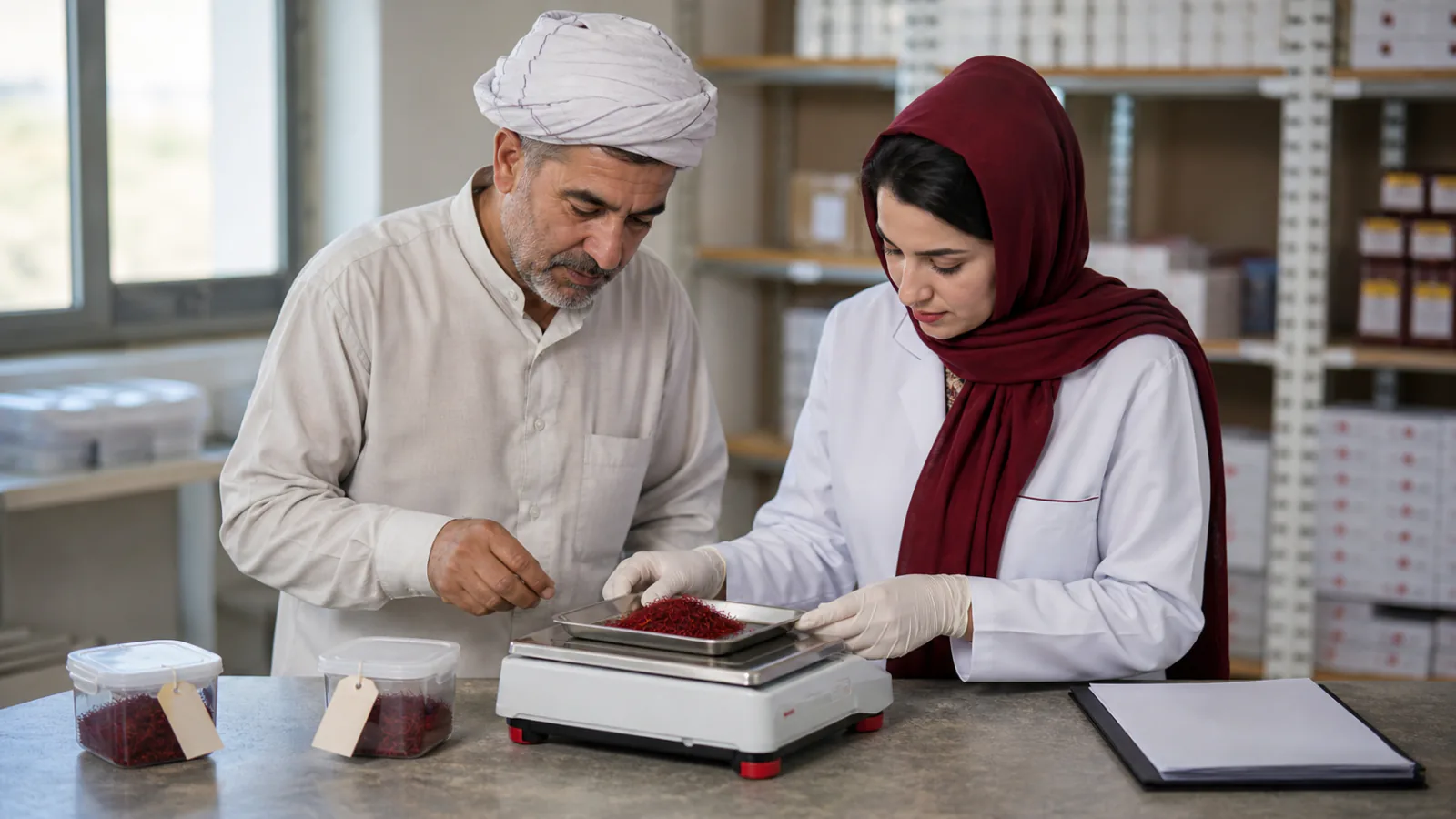
Iran’s first reported saffron bank was created as a secure place to receive, assess and store growers’ saffron. Despite the name, a saffron bank is not an ordinary bank branch. It is closer to a specialist warehouse: the physical spice is deposited, its lot and weight are recorded, and it remains identifiable until the owner sells or withdraws it.
The original news report on this page described a private facility in Khorasan, Iran’s main saffron-producing region. Its ambitions included protecting harvests from theft and deterioration, documenting quality and weight, helping farmers avoid a rushed sale during harvest, and building a stronger identity for Iranian saffron. The report was an early announcement, not evidence that every promised service is available today.
The First Saffron Bank in Iran: What It Was Designed to Do
Why saffron needs specialised storage
Dried saffron is compact, valuable and sensitive to its surroundings. Poor handling can expose it to moisture, odours, contamination, excessive light or heat. Storing anonymous material together can also weaken traceability: a buyer needs to know which tested sample belongs to which delivered lot.
The old report said some growers kept saffron at home and worried about theft during the harvest season. A secure facility aimed to address both problems. It reportedly used guarded premises and controlled, dim storage. It also quoted a temperature of roughly 7–9°C, but that historic facility claim should not be treated as a universal storage instruction. Packaging, relative humidity, product condition and condensation control matter as well.
ISO 21983:2019, confirmed as current in 2025, provides guidelines for harvesting, transport, stigma separation, drying and storage before packing. The standard’s existence is a useful reminder that preservation begins before a lot reaches a warehouse.
How a saffron deposit should work
- Receive an identifiable lot. The facility records the depositor, origin, delivery date, stated product form and package count.
- Inspect and sample it. Sampling should represent the whole lot rather than a few attractive threads taken from the surface.
- Weigh it on controlled equipment. The recorded net weight must exclude packaging and remain linked to the lot.
- Document its condition and quality. A receipt should distinguish measured results from a seller’s description.
- Seal and store it separately. Lot identity and tamper evidence need to continue throughout storage.
- Release or transfer it through a recorded process. The quantity leaving should reconcile with the quantity deposited, allowing for any documented sampling.
The original article said farmers received a certificate showing quality and weight, and could later recover their saffron or receive its value at the day’s rate. That description is incomplete. A real receipt must state its legal terms: who owns the saffron, whether it can be transferred or pledged, which fees apply, how price is determined, what insurance covers, and what happens if quality changes.
A warehouse receipt is only as reliable as the lot behind it
A document cannot compensate for weak sampling or mixed material. Useful records include a unique lot number, gross and net weight, package condition, sampling method, test laboratory, test date, specification used and custody history. They should also state whether the saffron consists of filaments, cut filaments or powder.
The current ISO 3632-1:2025 specification applies to those three forms of dried saffron and includes recommendations for storage and transport. A result under an applicable test method can support a trade decision, but “ISO quality” is not a complete description unless the report identifies the standard, category, sample and laboratory.
How secure storage can help growers
Harvest concentrates a large volume of saffron into a short period. Growers may need cash immediately while many sellers are entering the market. Storage can create time to obtain test results, compare offers, organise a cooperative lot or choose a buyer without keeping a valuable product in an unsuitable room.
That does not guarantee a higher price. Storage charges, insurance, financing costs, market movement and loss risk must be included. A grower benefits only when transparent terms and better sale options outweigh those costs. The facility must not lock depositors into an unexplained daily rate or a single buyer.
Quality preservation is different from quality creation
A warehouse can help preserve well-dried saffron; it cannot reverse damage caused by delayed stigma separation, poor drying or contamination. Incoming inspection should therefore record the lot as received. If lots of different quality or origin are blended without consent, both traceability and the value of the better material are lost.
FAO’s 2025 work on Iran’s saffron value chain connects improved production, post-harvest handling, safety, traceability, marketing and branding. A saffron bank can support that chain only when its records stay connected to the farm, sample and final package.
What buyers should ask before trusting stored saffron
- Can the warehouse show the lot’s origin and unbroken custody history?
- Who took the sample, and was the sampling representative?
- Which current specification and test methods were used?
- Are the weight, packaging and storage conditions documented?
- Is the facility independent from the buyer setting the price?
- What do insurance, security and dispute procedures actually cover?
- Can the buyer or depositor verify the lot before transfer or release?
Historical scale claims need a date
The earlier story attached regional figures—more than 8,000 hectares, 117,000 farming families and an average yield near 4 kg per hectare—to its description of Khorasan. Translation gaps obscured the exact district and reporting year, so those numbers should not be repeated as current statistics.
What remains valid is the reason the facility was proposed: saffron supports many smallholder livelihoods, and a high-value harvest needs better security, handling and market access. FAO reported in 2025 that Iran still produces the large majority of the world’s saffron and identified Khorasan Razavi and South Khorasan as central regions.
What would make a saffron bank credible today?
The idea succeeds when it gives growers and buyers evidence they can independently verify. That means clear ownership rules, representative sampling, competent testing, calibrated weighing, segregated lots, suitable storage, insurance, auditable releases and transparent fees. Branding should follow those controls, not substitute for them.
Iran’s first reported saffron bank was therefore important as a value-chain idea, not merely as a guarded room. Its lasting promise is a system in which the grower deposits an identifiable product, the buyer receives the same documented lot, and quality is preserved rather than assumed.

![Exporting Saffron to Turkey + Price Guide [Complete 0 to 100]](https://img.rowhanisaffron.com/20260827003933/saffron-export-turkey-quality-inspection.webp)



