


The life of the people of Seno village is tied to saffron: the crop shapes the work calendar, household income, local trade and the story this mountain community tells visitors.
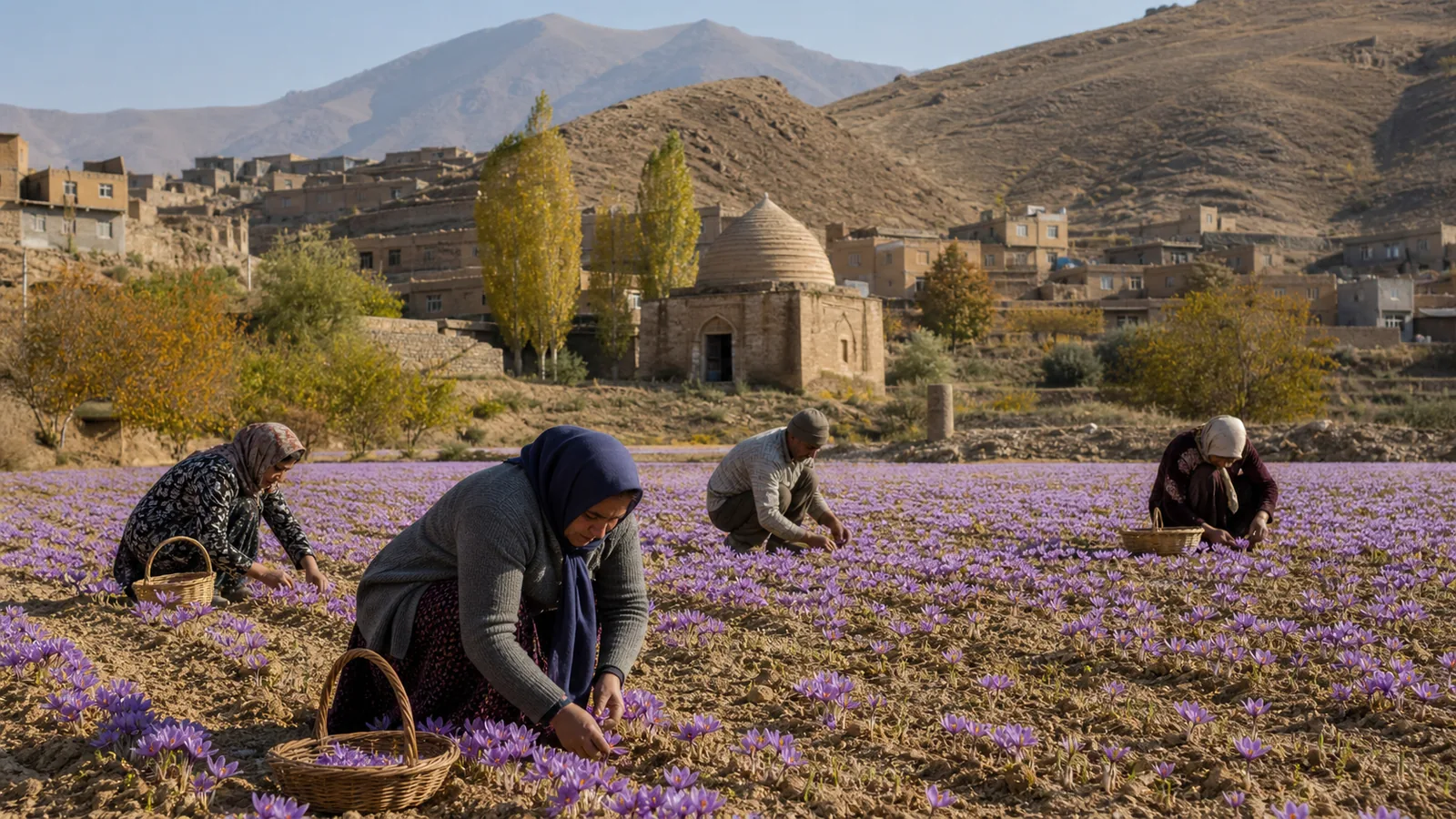
Seno lies about 22 km southwest of Gonabad in Khorasan Razavi, in the foothills of the range running toward northern Ferdows. Searches for the “Seno plant” usually point to the crop most closely associated with the village—saffron—and the harvest landscape explains why Seno is often described as the saffron village.
Where is Seno village?
Seno is a rural community in Gonabad County, surrounded by mountain scenery, springs, orchards and saffron fields. As the road approaches the village, rows of purple crocus flowers appear among trees and dry foothills during the short autumn bloom.
The original report said more than 90% of local people depended on “red gold.” That figure came from a village account rather than a published household survey, but it captures the breadth of saffron’s role: field preparation, irrigation, picking, separating stigmas, drying, flower trading and onward sales all draw on local labor.
Gonabad’s wider relationship with the crop has official recognition. The UN Food and Agriculture Organization designated the Qanat-based Saffron Farming System in Gonabad as a Globally Important Agricultural Heritage System in 2018. FAO highlights the way qanat water, local knowledge, livelihoods, biodiversity and tourism are connected in this dry region.
November sets the rhythm of village life
Families plan for the saffron harvest well before the first flowers open. In the report, November was the month when Seno’s normal routine gave way to early field work and long sessions separating the red stigmas from newly picked flowers.
The exact harvest window changes with temperature, elevation and the season. Once flowering begins, however, the work cannot simply be postponed. Flowers are picked promptly and the stigmas are separated and dried soon afterward, which brings several stages of production into homes and shared work spaces at the same time.
That is the sensory picture behind the old description of hands, houses and alleys smelling of saffron. It is not only a poetic image. During a concentrated harvest, flowers and freshly separated threads move through much of the village before they reach a trader or finished package.
How much saffron land was linked to Seno?
Mohammad Nabizadeh, identified in the report as Seno’s village administrator, said around 700 hectares of saffron cultivation serving Seno, Mosirz, Khanik and Sarasiab were irrigated from the Seno spring. Of that area, he attributed about 500 hectares to Seno’s own farms.
He described Seno as a production center in southern Khorasan Razavi and gave an annual harvest of roughly 200 tonnes of saffron flowers from village farms. Flower weight should not be confused with finished dried saffron: most of the flower is discarded after the three stigmas are removed, and drying reduces the remaining weight further.
These acreage and flower-volume figures are preserved as the local official’s historical estimates. They do not establish the current area or harvest, which would require a newer, dated agricultural record.
The Seno saffron flower market
Nabizadeh said Seno’s saffron flower market had operated for more than 50 years. Farmers could sell flowers in bulk rather than separating and drying every stigma themselves, a useful option when a crop must be handled quickly.
The same system can shift some value away from the grower. Fresh flowers are perishable and difficult to store, so sellers have less time to compare offers. Buyers who can organize separation, drying, grading and packaging take on more work and risk, but they also control more of the later commercial stages.
The report named Ghaenat, Torbat-e-Heydariyeh, Ferdows and Gonabad as the main destinations for Seno saffron and flowers. Those trading links help explain why a crop grown in one village may later reach the market under the name of a better-known production center.
Quality, identity and the missing Gonabad brand
Nabizadeh said earlier experiments had found Seno saffron to be of better quality than saffron from other cities. The article did not identify the laboratory, samples, dates or measurements, so the statement remains an attributed local claim rather than a universal quality ranking.
His broader concern was easier to assess. He said local conversion, processing and packaging industries had not developed far enough, and that even Gonabad lacked a saffron brand able to speak clearly for the region. In his account, some saffron grown around Gonabad was packaged and sold under the Ghaenat name.
Origin is more defensible when it is attached to records: a known grower, field or cooperative, a documented harvest, controlled drying, batch testing and packaging that accurately identifies where the spice came from. A place name on its own cannot prove quality, but traceability can keep a producing village visible as its saffron moves through the market.
Why falling prices worried local farmers
The report recorded Nabizadeh’s concern that saffron prices had fallen from year to year and were becoming uneconomic for farmers. It did not give a price series or define the years, grade or sales channel, so that comment should not be used as a current market quotation.
It does show the pressure on a village tied closely to one crop. When a household sells fresh flowers or bulk saffron, its return depends on the harvest volume, labor cost, moisture and quality, the number of buyers present, access to storage and how urgently cash is needed.
Processing and packaging do not guarantee a higher return, but they can give producers more options. Consistent drying, grading, cooperative lots, credible testing and a recognizable origin allow a sale to be based on more than immediate bulk weight.
Farmer training was part of the same problem
Nabizadeh also called agricultural extension in Seno too weak. He argued that growers needed practical training across planting, field care and harvest in order to improve production efficiency.
That need extends beyond yield. Training can cover healthy corm selection, field records, irrigation timing, clean separation surfaces, prompt drying, moisture control and storage. These details influence both the amount harvested and the consistency a buyer sees from one lot to the next.
Seno’s value is not that every farm uses one identical method. It is the accumulated local knowledge that links cultivation, water and family labor. Formal extension works best when it tests and strengthens that knowledge rather than replacing it with generic advice.
Seno’s saffron museum and a visit to the village
A historic village bath was adapted as a specialist saffron museum. A long-running Iranian tourism listing describes the museum as opening in June 2012 and displaying older tools along with the stages of planting, field care, harvesting and post-harvest work. It has been presented as Iran’s first specialist saffron museum.
Anyone planning a visit should confirm the museum’s current opening days and local access before traveling; a reliable current timetable is not published in the sources reviewed for this update. The autumn flowering period offers the clearest view of saffron work, while spring is commonly recommended for the wider landscape and village surroundings.
Visitors should treat working farms as workplaces, ask before entering fields or photographing people, and avoid stepping between planted rows. The crop is delicate, and harvest mornings are busy rather than staged demonstrations.
Why Seno remains part of Gonabad’s saffron story
Seno brings together the parts of saffron that are easy to separate on paper: water, land, household labor, flower markets, product identity and tourism. The village report’s numbers are historical, but the relationship it describes is reinforced by FAO’s recognition of Gonabad’s qanat-based saffron system.
Our broader guide to Gonabad saffron and qanat heritage places Seno within that regional system. What makes the village distinctive is not a slogan alone. It is the way a short purple harvest continues to organize work, memory and local ambition.

![Exporting Saffron to Turkey + Price Guide [Complete 0 to 100]](https://img.rowhanisaffron.com/20260827003933/saffron-export-turkey-quality-inspection.webp)



