


A dated local report recorded 27 kilograms of saffron production in Namin from ten hectares, with an estimated value of about 300 million tomans at the time. Cultivated area had grown to 15 hectares and more than 20 operators were involved. These are historical figures, not a current crop forecast or price.
Two other regional reports—from Abarkooh in Yazd and the mountainous counties of Gilan—show how small saffron sectors were expanding under very different climates. Keeping dried output, fresh flowers, area and crop year separate is essential when comparing them.
Saffron production in Namin
Mohammad Hassani, then director of the local agricultural organisation, said the 27-kilogram harvest came from ten hectares. That implies an aggregate near 2.7 kilograms of dried saffron per hectare if both numbers used the same area and output basis.
The report said cultivated area had increased from about ten to 15 hectares. More than 20 growers or operators were active, reflecting a relatively young local crop rather than a long-established production centre.
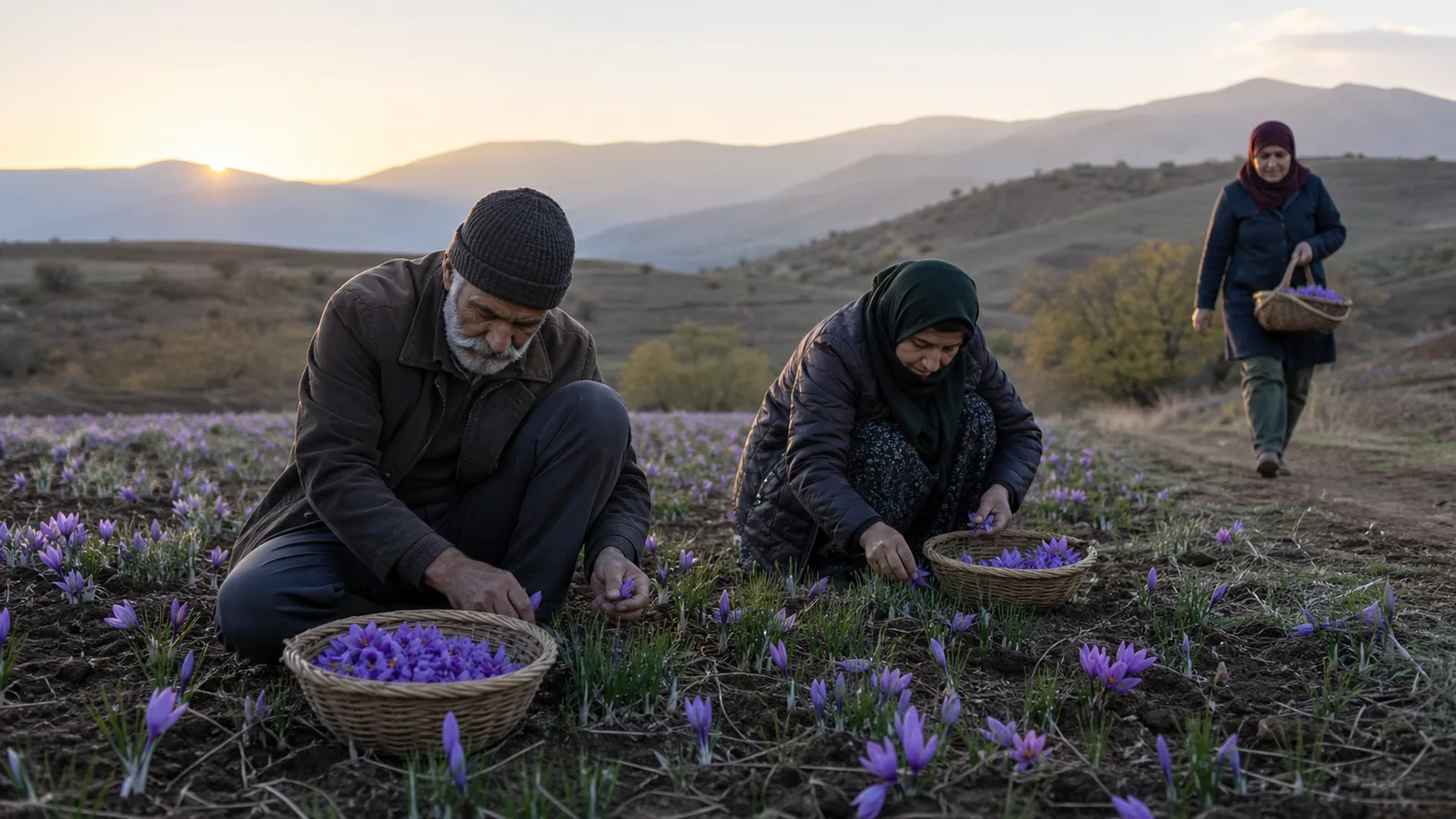
Hassani placed flowering and harvest between October and November, with an approximately 20-day bloom. He recommended collecting flowers early in the morning, before sunrise, and described suitable fields at elevations from 1,200 to 2,300 metres. These are attributed local observations; exact timing and field suitability still vary with altitude, weather, soil and the season.
Why Namin was changing its crop pattern
The local programme presented saffron as an alternative after reduced water availability and changing climate conditions. Officials also wanted more medicinal and aromatic crops to support rural income and employment.
Saffron can use less water than some alternative crops, but it is not water-free. Establishment and seasonal growth still need appropriately timed moisture. Expansion should fit the local water budget rather than rely on a general “low-water” label.
The source advised avoiding highly saline soil and preferred lighter soil texture. That guidance is too broad to replace field assessment: drainage, organic matter, salinity, irrigation-water quality, corm health and local disease pressure all affect performance.
Processing and packaging could retain more value
Hassani called for conversion and complementary industries near the growing area. For saffron, the useful operations are straightforward but exacting: clean flower handling, timely stigma separation, controlled drying, lot segregation, moisture-safe storage, testing and appropriate packaging.
The report called Namin saffron excellent quality but did not identify a test method, laboratory or results. Local origin may help tell a product’s story; it does not replace evidence for the lot being sold.
Abarkooh: 400 kg and a 15 percent increase
A separate report from Abarkooh said farmers harvested 400 kilograms of dried saffron in the preceding year and that production increased by 15 percent. About 200 farmers were active.
The stated average was four kilograms per hectare, with 5.5–6 kilograms on some farms. Faragheh village in the central district had the largest cultivation area. Corm planting was reported in September, with harvest from mid-November to late December.
Officials expected cultivated area to reach 120 hectares. The source text also says area would rise “120 percent to 120 hectares,” an internally awkward statement, so the target area is retained without treating 120 percent as a verified growth rate.
As in Namin, water scarcity and adaptation to local climate were given as reasons for expansion. The best-farm yields should not be applied to every new hectare, especially where fields are not yet mature.
Gilan: employment in mountainous counties
Ali Darjani of Gilan’s agricultural organisation said 162 growers were expected to harvest 53.4 kilograms across Rudsar, Amlash, Rudbar, Siahkal and Talesh, with a historical value near 800 million tomans. The archived English text calls the quantity “saffron flowers,” not dried saffron. Because it does not clarify the unit, the figure cannot be compared directly with Namin’s or Abarkooh’s dried output.
The report placed harvest through the end of November in mountainous land, again mentioning elevations from 1,200 to 2,300 metres. Saffron had reportedly been introduced to Gilan cultivation in 2008, and the organisation distributed corms free to interested farmers.
Officials described saffron as an employment opportunity and said tests placed Gilan product among Iran’s best for colour, taste and aroma. No laboratory or measured results were published, so this remains an attributed claim.
The source also listed numerous disease-treatment and prevention claims, including cancer, diabetes and depression. It supplied no clinical evidence, dose or safety context. Those claims are omitted rather than carried into a regional production article.
How to compare the three reports
Namin, Abarkooh and Gilan were at different stages and used different measurements. A fair comparison needs:
- the exact crop year and place;
- mature harvested area rather than total planted area alone;
- dried stigma output rather than an ambiguous flower weight;
- average yield rather than a best-farm record;
- dated prices or programme values in the correct currency;
- identified quality tests for the actual lot.
ISO 3632-1:2025 covers dried saffron in filament, cut-filament and powder forms. It gives buyers and producers a common specification framework but does not validate the regional quality rankings in these articles.
For more historical regional context, see this overview of saffron production in Iran.
Reference: ISO 3632-1:2025 saffron specification. Local output, area, employment and programme figures are retained as dated, attributed evidence from the three archived posts consolidated here.

![Exporting Saffron to Turkey + Price Guide [Complete 0 to 100]](https://img.rowhanisaffron.com/20260827003933/saffron-export-turkey-quality-inspection.webp)



