


The lack of conversion industries for the Iranian brand saffron in the city of Saveh was the central concern in a local agricultural report published in 2019. Saveh had growers, suitable land and an estimated 60 kilograms of annual output, but the report said the city lacked enough local capacity to prepare, pack and market that saffron under a recognisable name.
What the 2019 Saveh report actually said
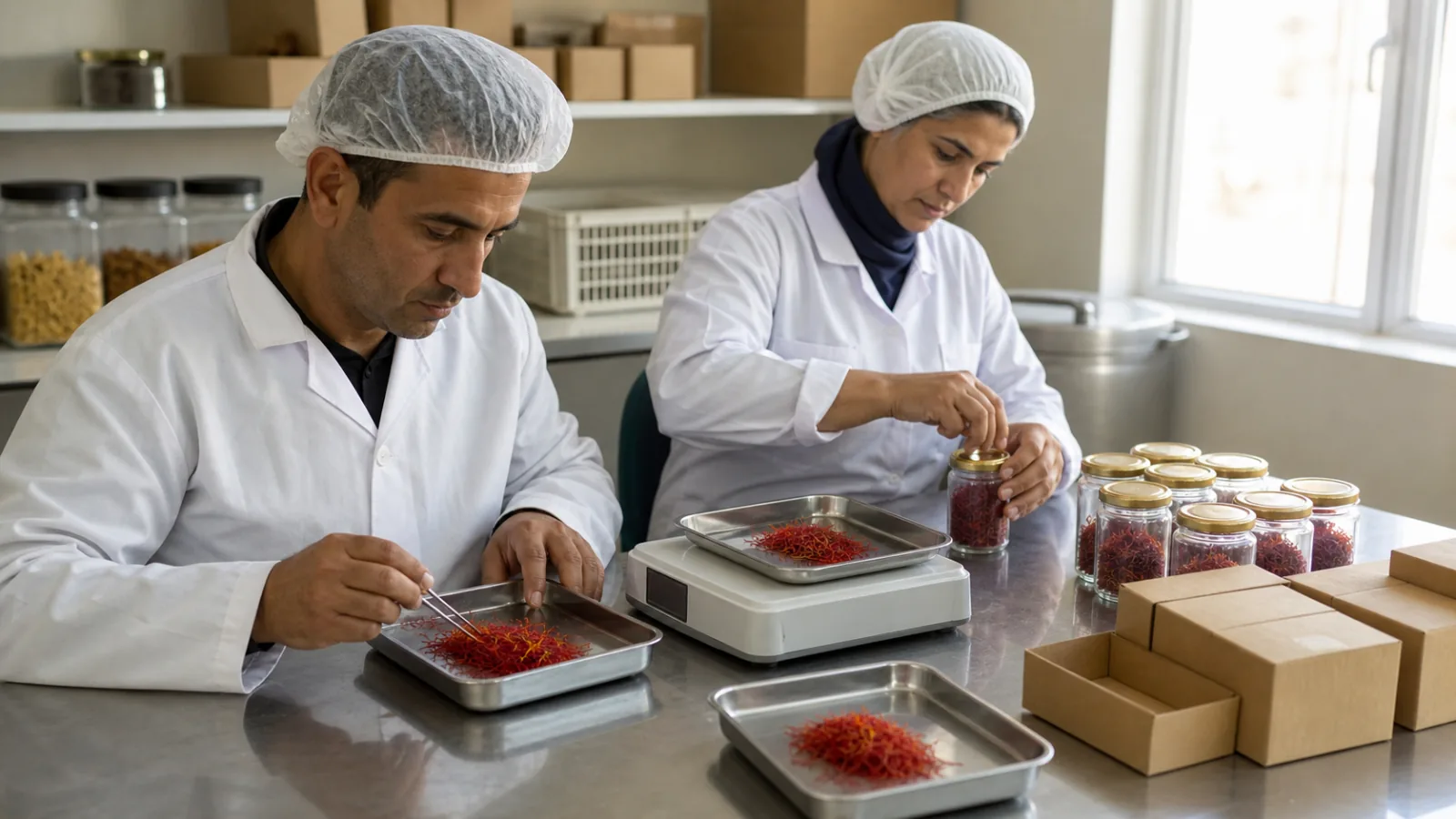
The article quoted Mohammad Reza Khalili, technical and executive deputy at Saveh’s Agricultural Jihad Organization. The original English translation called the missing facilities “conversion industries.” In this context, the phrase means the work carried out after harvest: receiving flowers or dried saffron, separating and drying stigmas where needed, grading lots, testing, packing, labelling and preparing orders for sale.
Khalili argued that saffron from Iranian producing areas was often sold in bulk and later presented to buyers under brands elsewhere, mentioning countries such as Turkey and Italy. That was a dated local official’s account, not a verified breakdown of every export route. It should not be read as proof that all bulk saffron loses its origin or that repacking is inherently improper.
His practical point was narrower. When a growing region supplies only an anonymous raw lot, much of the customer relationship belongs to the company that tests, packs and consistently delivers the finished product.
Saveh’s reported saffron figures
The report put Saveh’s saffron area at 12 hectares and annual production at 60 kilograms. It also described an average harvest of five kilograms per hectare. Those three figures agree arithmetically: 12 hectares multiplied by 5 kg/ha equals 60 kilograms.
Khalili said 86 Saveh farmers were involved in saffron cultivation that year and described the city as the leading producer in Markazi Province. Both are historical claims tied to the 2019 report. They are not a current census or a current provincial ranking.
The original translation referred to “savage farmers,” which is plainly a machine-translation error for farmers in Saveh. That wording has been corrected without changing the reported count.
Why a small crop still needs organised post-harvest work
Sixty kilograms is modest beside the output of Iran’s largest saffron districts, but it is valuable enough to require discipline. Small lots can be combined efficiently, provided their identity is not lost. Each delivery should arrive with a grower or supplier record, harvest period, field reference and weight. Lots should remain separate until they have been checked and a deliberate blending decision has been made.
That record matters when quality differs. A clean, well-dried filament lot should not be mixed casually with material that has absorbed moisture, contains floral waste or has an uncertain handling history. Once several deliveries are blended without records, neither the packer nor the grower can trace a later complaint back to its cause.
ISO 21983:2019 gives current guidance for saffron harvesting, flower transport, stigma separation, drying and storage before packing. ISO 3632-1:2025 specifies requirements for dried saffron in filament, cut-filament and powder forms. A local facility does not have to be large to build its procedures around defined handling and product specifications.
Packaging is only one part of a credible Saveh saffron brand
A new carton can make a product easier to display, but it cannot establish origin or quality by itself. A credible pack needs an accountable business, consistent product, accurate net weight, a lot code and the information required in its intended market. Storage protection is equally important because saffron is sensitive to moisture, light and unsuitable surroundings.
The brand name also needs a legal owner and a clearance process. The World Intellectual Property Organization explains that a trademark is a sign that distinguishes one enterprise’s goods or services from another’s, and that protection is normally obtained through national or regional registration. A city name, a collective producer identity, a private company mark and a geographical indication are not interchangeable tools.
Saveh growers therefore need to decide what the proposed identity represents. It could belong to one packing business, a cooperative using shared rules or another formally governed organisation. Whatever the model, the package must tell the truth about the product inside it.
What an appropriate local facility would do
The first useful investment is not necessarily a fully automated line. For a crop reported at 60 kilograms a year, the sensible capacity depends on how much additional saffron the facility can receive and whether it will serve nearby areas.
A practical operation may need:
- a clean receiving point with calibrated scales and lot identification;
- separate, dry storage for accepted, held and rejected material;
- a hygienic area for sorting and packing;
- documented sampling and access to suitable testing;
- packaging that protects the product and can be sealed consistently;
- label controls so the wrong lot, weight or market information is not applied; and
- records connecting every finished pack to the saffron used in it.
Our guide to packing saffron for customer requirements explains why the buyer’s product specification has to be agreed before pack size and presentation are selected.
Water limits were part of the cultivation argument
Khalili linked saffron development to Saveh’s limited water resources. He described the crop as relatively low in water demand and encouraged farmers to consider expanding it because of its value.
That recommendation needs a farm-level calculation. Saffron may fit a local rotation, but it still requires suitable soil drainage, healthy corms, timely establishment and water at critical stages. A statement about fewer irrigations is not a complete measure of water productivity.
Before increasing area, a grower should compare the irrigation volume, pumping cost, labour, establishment expense and saleable dry yield with the crop being replaced. The reported five-kilogram yield is a useful historical reference, not a guaranteed result for every field.
How investors can judge whether the project is viable
The 2019 report called for private investment and licensing so Saveh saffron could reach domestic and foreign markets. That remains a sound question, but the answer begins with throughput rather than machinery brochures.
A feasibility study should establish how many growers will commit product, the likely kilograms by harvest period, the grades and pack sizes buyers request, testing and compliance costs, and who will sell the finished packs. It should also show what happens if only part of the expected crop arrives.
The business case becomes stronger when the facility solves a proven problem: inconsistent drying, no traceability, unsuitable storage, unavailable small packs or a buyer who needs a documented specification. Building capacity first and looking for customers later leaves expensive equipment idle.
A workable route from grower to branded pack
Saveh does not need to disguise its scale. A smaller origin can compete through careful handling and clear records. Growers can agree harvest and drying practices, deliver identified lots to a shared point, receive results for their own material and be paid according to an understood specification.
The packer can then choose lots deliberately, retain samples, assign finished-product codes and make only claims it can document. Buyers receive a consistent product, while the supplying growers remain connected to its origin.
That is the useful meaning behind the lack of conversion industries for the Iranian brand saffron in the city of Saveh. The missing link was not simply a colourful package. It was an organised chain between the 86 reported growers, post-harvest control, an accountable brand owner and a market willing to buy the finished product.

![Exporting Saffron to Turkey + Price Guide [Complete 0 to 100]](https://img.rowhanisaffron.com/20260827003933/saffron-export-turkey-quality-inspection.webp)



