


The production of saffron in Ardebil province in Iran has exceeded 100 kilograms was a 2019 report on Ardabil’s emerging saffron sector. Its body documented corm support, approximately 58 hectares split between small and larger holdings, and extensive training. It did not publish the final harvest table behind the “exceeded 100 kilograms” headline, so that number remains a dated reported threshold rather than a current production figure.
The 2019 Ardabil saffron report
The source quoted Ahmad Shahriar, deputy director for plant-production improvement at the provincial Agricultural Jihad Organization. “Ardebil” is the spelling retained in the historic title and URL; “Ardabil” is now the more common English spelling.
Shahriar presented saffron as part of a policy to reform the crop pattern, use agricultural water more effectively and improve farmer income. The programme combined planting-material distribution with technical workshops and individual guidance.
The headline said provincial production had passed 100 kilograms. Because the body gives no crop year, weighed total, moisture basis or reporting method, that headline cannot be upgraded into a more precise number.
How much land and how many growers were involved?
The translated report described two holding groups. A total of 167 operators managed 32 hectares in plots smaller than one hectare. Another 15 operators managed about 26 hectares in holdings above one hectare.
Taken together, that indicates roughly 58 hectares and 182 operators. It also shows how fragmented the developing sector was: most participants cultivated a small plot, while a small group accounted for nearly half the stated area.
Those figures should not automatically be treated as 58 productive hectares. New saffron fields can flower differently from mature stands, and the article’s corm-distribution programme suggests some area was still being established.
What the 100-kilogram headline implies—and does not prove
If more than 100 kilograms came from all 58 stated hectares, the simple average would be above 1.7 kg/ha. That is only a scale check. The actual productive area may have been smaller, and “more than 100” supplies no exact numerator.
A reliable provincial yield needs final dry stigma weight divided by area actually harvested. It should identify field age, product cut and moisture basis. A forecast, a headline threshold and a laboratory-tested lot answer different questions.
Our saffron production statistics guide explains why productive area, crop year and dry-product definition must stay attached to a yield figure.
The corm-distribution programme
Shahriar said more than 38 tonnes of high-quality saffron planting material had been distributed among growers in the province. The original called these “onions” or “bulbs,” but saffron is planted from corms.
He separately said a subsidy of 64 million rials had been allocated for purchasing 12 tonnes and 800 kilograms of saffron corms. The 12.8 tonnes appears to be a subsidized portion within a larger distribution programme, although the brief source does not expressly reconcile the two quantities.
“High quality” needs measurable criteria. A useful corm record includes botanical identity, source field, lot, size distribution, visible injury or rot, storage history and any treatment. Weight alone does not show how many sound corms reached each farm.
What saffron gardens look like
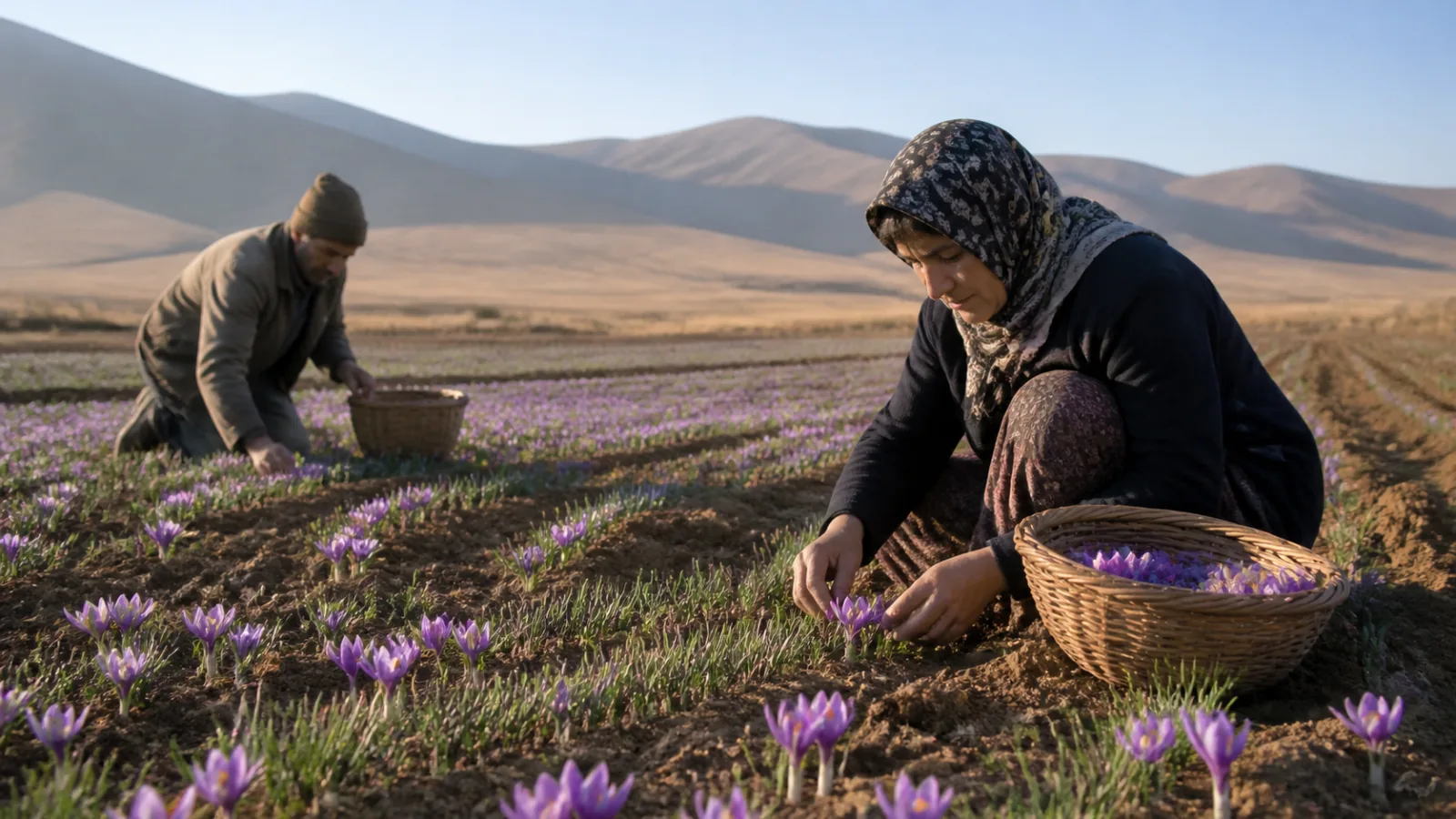
The phrase “saffron gardens” in the report refers to cultivated fields or plots. Saffron is a low perennial crop. In autumn, purple flowers emerge near the ground among narrow green leaves. The valuable spice is the set of three red stigmas inside each flower.
Useful saffron gardens photos should show that scale clearly: flowers at soil level, fine leaves, planted rows that may be uneven and baskets holding whole blooms during harvest. Images of tall crocus shrubs, giant red threads growing outside the flower or densely carpeted ornamental lawns misrepresent the crop.
The new photograph on this page depicts a plausible Ardabil field and harvest scene. It is editorial imagery, not evidence of the exact 2019 plot, participants or production total.
Why Ardabil needed training as well as corms
The report said two technical workshops were held for experts and specialists, while 84 workshops were provided for users or growers. It also referred to individual training and programmes delivered through the provincial centre.
That distinction makes sense. Advisers need a shared method for diagnosing fields and recording results. Growers need practical instruction at the right time: corm selection and planting, irrigation, weed and disease monitoring, flower collection, stigma separation, drying and storage.
A workshop count does not show impact on its own. Follow-up should record whether participants adopted the practice, what changed in yield or quality and which advice failed under local conditions.
Water saving should be measured, not assumed
Shahriar linked saffron to better use of agricultural water. The crop’s seasonal cycle may fit some Ardabil farming systems, but field suitability still depends on rainfall, soil drainage, irrigation timing and winter conditions.
A crop-pattern comparison should measure irrigation volume, pumping cost, labour and saleable output against the crop being replaced. Fewer irrigations do not automatically mean higher water productivity, and poor drainage can damage corms even in a generally cool or dry environment.
Small plots are useful for testing because farmers can learn without committing an entire holding. Their records become more valuable when fields using different corm lots or irrigation practices are kept separate.
Protecting quality after the flowers are picked
More area and more corms create a larger flower-handling task. Whole flowers need clean containers and prompt transport. Stigmas should be separated hygienically, dried consistently and protected from moisture before packing.
ISO 21983:2019 provides current guidelines for harvesting, flower transport, stigma separation, drying and storage before packing. The ISO 3632-1:2025 specification applies to dried saffron in filament, cut-filament and powder forms.
Lot codes should connect the finished saffron to its grower, field, harvest period and drying batch. That is especially important when 182 operators may contribute small quantities to shared processing or packaging.
How to evaluate growth after 2019
The original report expected training and support to increase saffron area in the following years. A later review should not judge success only by tonnes of corms distributed or hectares announced.
Useful measures include corm survival, productive area, dry yield by field age, water used, labour per kilogram, tested lot quality and the share sold at a sustainable return. The final harvest should be reported separately from forecasts and estimates.
Ardabil’s reported move beyond 100 kilograms marked an early stage. The more durable achievement would be a network of saffron gardens whose growers can show where their corms came from, how the crop was handled and why the final lot meets the buyer’s specification.

![Exporting Saffron to Turkey + Price Guide [Complete 0 to 100]](https://img.rowhanisaffron.com/20260827003933/saffron-export-turkey-quality-inspection.webp)



