


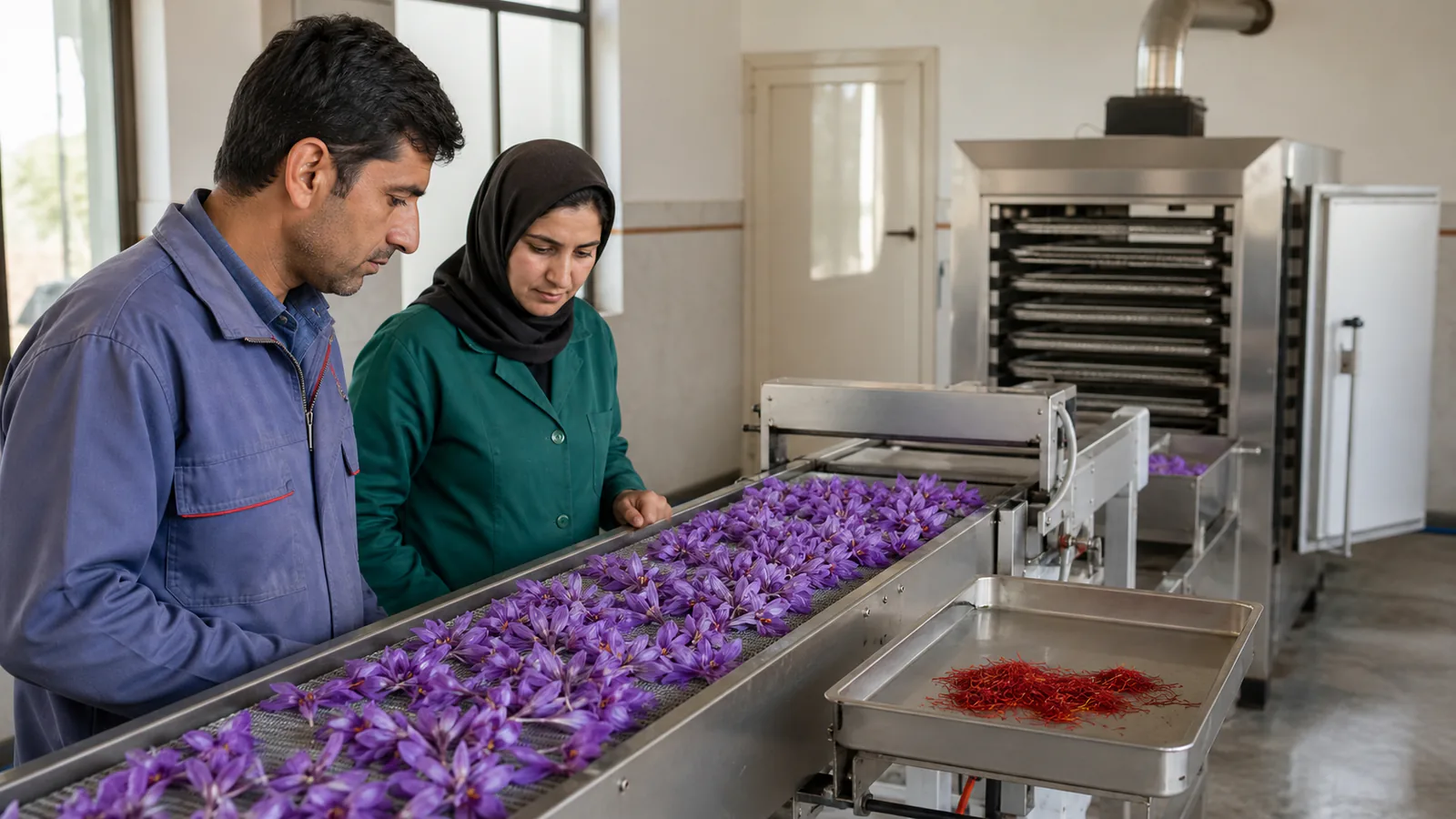
In early 2015, the Khorasan Razavi Agriculture and Natural Resources Research Center announced that several new technologies would be presented at a national conference on harvesting and post-harvest work. For saffron growers, the most relevant exhibits were a mechanized processing line—combining flower-to-stigma separation with drying—and a portable machine intended to collect saffron flowers.
This is an archive of that announcement, not a report that the equipment is currently available for sale. The old English version blurred the event date, the speaker’s name and even the machines themselves. Here is what was actually announced, what the proposed line was meant to do, and what the notice did not tell prospective users.
What the Khorasan Razavi research center announced
Dr. Ali Akbar Moayedi, then head of the provincial research center, said the National Conference on Modern Technologies for Harvesting and Post-Harvest Agricultural Products would be held at the center on 29 and 30 Bahman 1393. Those Persian-calendar dates correspond to 18 and 19 February 2015.
According to the announcement, the event was organized with the Agricultural Engineering Research Institute, Khorasan Razavi Agriculture-Jahad Organization, the province’s agricultural training center, the Agricultural Mechanization Development Center, and the Agriculture and Natural Resources Engineering Organization.
Moayedi listed five pieces of equipment among the planned demonstrations:
- a mechanized saffron processing line with a stigma separator and dryer;
- a portable machine for harvesting saffron flowers;
- a three-row self-propelled combine;
- a cotton stripper; and
- a self-propelled cotton picker.
The saffron machines were only part of a wider agricultural programme. The original notice did not provide model names, manufacturers, production capacity, prices or test results.
What a mechanized saffron processing line does
Saffron processing begins after the whole flower has been picked. The red stigmas must be separated from petals and stamens, then dried under controlled conditions. A processing line tries to move those delicate operations away from slow, repetitive hand work without sacrificing clean separation or damaging the threads.
The announcement described two linked stages rather than a machine that produces finished, packaged saffron in one step:
- Separation: the line isolates the red stigmas from the other flower parts.
- Drying: it removes moisture from the separated stigmas to produce the spice that can be graded and packed.
That distinction matters. A separator can be fast and still leave petals, styles or broken material in the output. A dryer can remove moisture quickly and still produce uneven results. Throughput alone does not establish quality.
A published engineering prototype from researchers at the University of Cagliari combined a portable flower-harvesting device with an airflow-based separator. The prototype paper explains the mechanical and fluid-dynamic principles and reports experimental characterization. It shows that these ideas were technically plausible before the Khorasan announcement, but it does not test the particular Iranian line unveiled in 2015.
Why separation and drying are difficult to mechanize
Saffron flowers are light, irregular and easily bruised. Their valuable stigmas are much smaller than the surrounding petals, and the harvest arrives in a short seasonal rush. A useful machine must cope with variation in flower size and condition while keeping the red material clean and intact.
Timing matters too. A review of saffron’s post-harvest chemistry notes that picking and manual stigma removal are labour-intensive, while drying is the step that turns the fresh stigma into the spice and helps establish its characteristic colour, aroma and taste. The open-access review of drying conditions also describes the use of airflow machinery in flower separation and explains why drying method and conditions cannot be treated as an afterthought.
For that reason, a credible processing trial should report more than kilograms per hour. It should measure the proportion of clean stigma recovered, breakage, retained floral material, moisture uniformity, hygiene, energy use, labour saved and the quality of the dried saffron. None of those measurements appeared in the conference notice.
The portable saffron flower harvester was a separate machine
The announcement also referred to a portable flower-harvesting machine. Its job would have been in the field, before the processing line: remove or collect the flower while minimizing harm to the plant and the product.
Portable is not the same as fully autonomous. A hand-held or operator-carried tool may reduce bending and speed up collection, yet still depend on a person to find each flower, position the device and handle the collected crop. Field performance would also vary with row spacing, flower density, soil surface, leaves, moisture and the stage at which flowers were picked.
The 2015 notice did not state how the machine detached flowers, how many it collected per hour, whether it had been tested against hand picking, or whether it affected next season’s corm growth. Those are questions for a field trial, not details that can be inferred from the word “portable.”
The conference was about more than machines
Moayedi said the programme would examine how mechanization and new technologies could reduce crop losses. It was also expected to cover precision agriculture, the use of sensors to improve harvest and post-harvest efficiency, modern sorting equipment, and the challenge of turning research prototypes into commercial tools for field and orchard crops.
That last theme is particularly important. Unveiling a prototype proves that a device can be shown; commercialization requires repeatable performance, safe operation, maintainable parts, trained operators and a cost that makes sense during a short harvest season. Small farms may need a shared-service or cooperative model rather than owning equipment that sits idle for most of the year.
A later Rowhani Saffron article looks at a different case of saffron flower processing technology. It should not be read as evidence that the 2015 conference machine became that later device. The two reports do not establish a shared manufacturer or model.
The dates and registration details are historical
The electronic secretariat was once listed at kanrrc-congress.ir, with a paper-submission deadline of 15 Dey 1393, equivalent to 5 January 2015. That deadline has passed, and the old conference address is retained here only as part of the record. Readers should not use it as a current registration or equipment-support contact.
The February event date was mistranslated as “29 and 30 February” in the former article. It referred to the Iranian month of Bahman, not to two dates in the Gregorian month of February. Converting the calendar makes the chronology clear: submissions closed in January, and the conference followed in February 2015.
What the announcement established—and what it did not
The report establishes that Khorasan Razavi’s agricultural research center planned to present a saffron stigma-separation and drying line alongside a portable flower harvester at a national event. It also records the institutions involved and the conference’s interest in sensors, sorting, loss reduction and commercialization.
It does not establish that either saffron machine entered commercial production, was adopted by growers, reduced costs, improved quality or remained available after the conference. No capacity, recovery rate, quality analysis, purchase price or independent field comparison was published in the notice.
A grower or processor evaluating similar equipment today should ask to see a live run with their own flowers. The useful record would include input weight, clean dried-saffron output, rejected material, processing time, labour, electricity, cleaning time, maintenance and a recognized quality test on the finished batch. Those measurements turn an unveiling into an agricultural decision.
The event names, participants, equipment list and calendar dates in this article are preserved from the site’s November 2015 report. The engineering and post-harvest sources were reviewed on 29 August 2026.

![Exporting Saffron to Turkey + Price Guide [Complete 0 to 100]](https://img.rowhanisaffron.com/20260827003933/saffron-export-turkey-quality-inspection.webp)



