


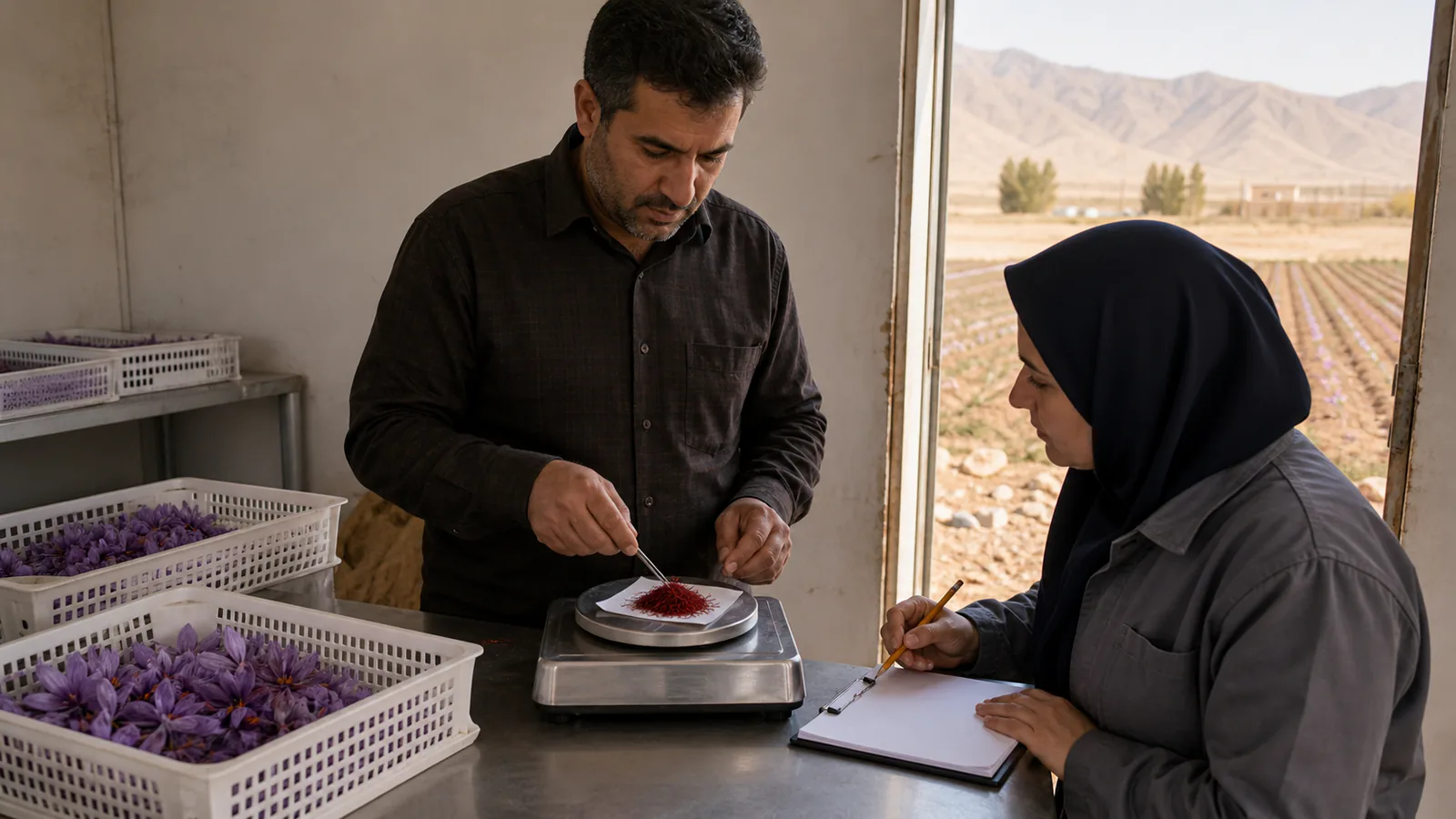
The report that Qom produced 21 kilograms of saffron refers to a small provincial crop in 2015. Reza Vakil, then identified as deputy for plant-production improvement at Qom’s Agriculture-Jahad Organization, said seven hectares yielded 21 kilograms of dried saffron. The arithmetic is straightforward: an average of three kilograms per hectare across the reported area.
That makes this one of the site’s more internally consistent historical production figures. It still needs boundaries. The statement does not identify field age, hectares by district, moisture at weighing, saffron grade or the method used to calculate the average. Those omissions matter when the number is compared with another harvest.
The 2015 saffron in Qom figure
Vakil attributed production to three parts of Qom Province: Khalajestan, Salafchegan and Kahak. Their names were damaged in the old English article—Kahak became “Galaxy,” while Vakil’s surname was translated as the profession “lawyer.” Both are proper names.
The reported calculation can be written in one line:
7 hectares × 3 kg of dried saffron per hectare = 21 kg.
The source describes 21 kilograms as produced, rather than forecast. It also calls the crop “pure and dry.” In this context, dry usefully distinguishes finished saffron from the much heavier fresh flowers. “Pure” is the official’s description; no laboratory result, lot number or grade was supplied, so it should not be read as an independently verified purity claim.
What the seven-hectare total leaves unanswered
A provincial total is helpful, but seven hectares can hide several different situations. All the fields might have been mature and harvested. Some might have been newly planted or too young to contribute much. One district may have supplied most of the crop while another had only a trial plot.
The report gives no area or dried weight for Khalajestan, Salafchegan or Kahak separately. It also does not say whether three kilograms per hectare was calculated from every planted hectare, only bearing hectares, or a sample of fields. For that reason, the result belongs to the 2015 Qom report; it is not a benchmark for every local grower.
A broader article on saffron harvesting in Qom Province places the same figure beside a separate Qazvin report. This page keeps the Qom record on its own and examines what its area-and-yield calculation can—and cannot—show.
Field age can change the yield
Saffron is a perennial crop grown from corms. A field’s yield does not stay constant from its first season to its last. Daughter corms multiply underground, plant density changes, and crowding or declining corm condition can eventually reduce flowering.
A six-year field study of corm size and planting density found that growing season and corm size affected flower and stigma yield. Under that study’s conditions, flowering rose from the first through third year and declined in the fifth and sixth years. The pattern is not a formula for Qom, but it explains why “three kilograms per hectare” is incomplete without the age of each plot.
This also limits comparisons with later Qom reports. An increase in total production might come from more planted land, older fields reaching stronger flowering years, better field management, different weather or some combination. A bare kilogram total cannot separate those effects.
Correcting the old climate description
The former translation called saffron a tropical plant. That is misleading. The original point was that saffron can suit places with dry, sunny summers and a cooler growing season. The corm passes through a summer rest period; shoots and flowers emerge as the next active cycle begins, and foliage continues to support daughter-corm development after flowering.
The precise calendar changes with climate. The Qom official described activity from about Aban to Ordibehesht—roughly November to April—and said the leaves yellow and dry as warm weather returns. He also gave Mordad through Mehr, approximately August to October, as a local planting window.
The University of Vermont’s saffron production-cycle guide shows the same broad sequence while warning that timing varies by climate: late-summer planting and sprouting, autumn flowering, winter and spring foliage, corm development, then dormancy. It should be used as biological context, not as a Qom irrigation calendar.
Light soil is not the only site requirement
Vakil said lighter-textured land could be suitable for saffron. Texture matters because saffron corms do poorly in waterlogged soil, but “light” does not automatically mean productive. Drainage, soil depth, salinity, organic matter, irrigation-water quality, previous crops and disease pressure all deserve inspection before planting.
Qom’s dry summer may fit the corm’s dormant period, yet the crop still needs moisture at the right stages. Calling saffron a low-water crop should never be shortened to no-water. The 2015 article supplied no irrigation volume or water-quality data for its seven hectares.
How long can a Qom saffron field remain planted?
The official said a planting could remain for four to seven years and, in some places, as long as ten. This was presented as an advantage over annual replanting. The damaged translation called the planting material both bulbs and tubers; the correct horticultural term is corms.
The range is plausible as local practice, but ten years is not a guaranteed productive life. Corm health, starting size, density, soil, climate, disease and management affect when a field should be lifted and replanted. The six-year study cited above is a useful reminder that the strongest yield years may occur before the end of a field’s possible lifespan.
A grower should watch measured output and corm condition instead of waiting for a fixed anniversary. Field longevity and profitable longevity are not necessarily the same.
Seasonal work is part of the production cost
The old report said saffron cultivation could provide work for rural women and girls and contribute to household income. It described that work as filling leisure time, language that understates the skill and urgency involved. Flower picking, stigma separation and drying are time-sensitive agricultural jobs with a direct effect on the saleable crop.
The statement did not count workers, paid hours or household earnings. Nor did it give the costs of corms, land preparation, irrigation, weeding, picking, separation, drying, packaging or sales. A valuable spice can support income, but 21 kilograms of provincial production does not reveal how that income was divided or whether every field made a profit.
What a useful Qom harvest record would include
To make the next production figure comparable, a provincial report should record:
- planted and bearing hectares by district;
- field age, corm source, size and planting density;
- irrigation quantity and water quality;
- fresh flowers and final dried-stigma weight;
- moisture, grade and testing method;
- paid and family labour hours; and
- full production cost and the price growers received.
The 2015 account gives a sound starting point: seven hectares, three named areas, a three-kilogram average and 21 kilograms of dried saffron. Its strength is that those three figures agree. Its limit is that the field-level evidence behind them was never published.
Names, locations and production figures are preserved from this site’s November 2015 report. Agronomy sources were reviewed on 29 August 2026.

![Exporting Saffron to Turkey + Price Guide [Complete 0 to 100]](https://img.rowhanisaffron.com/20260827003933/saffron-export-turkey-quality-inspection.webp)



