


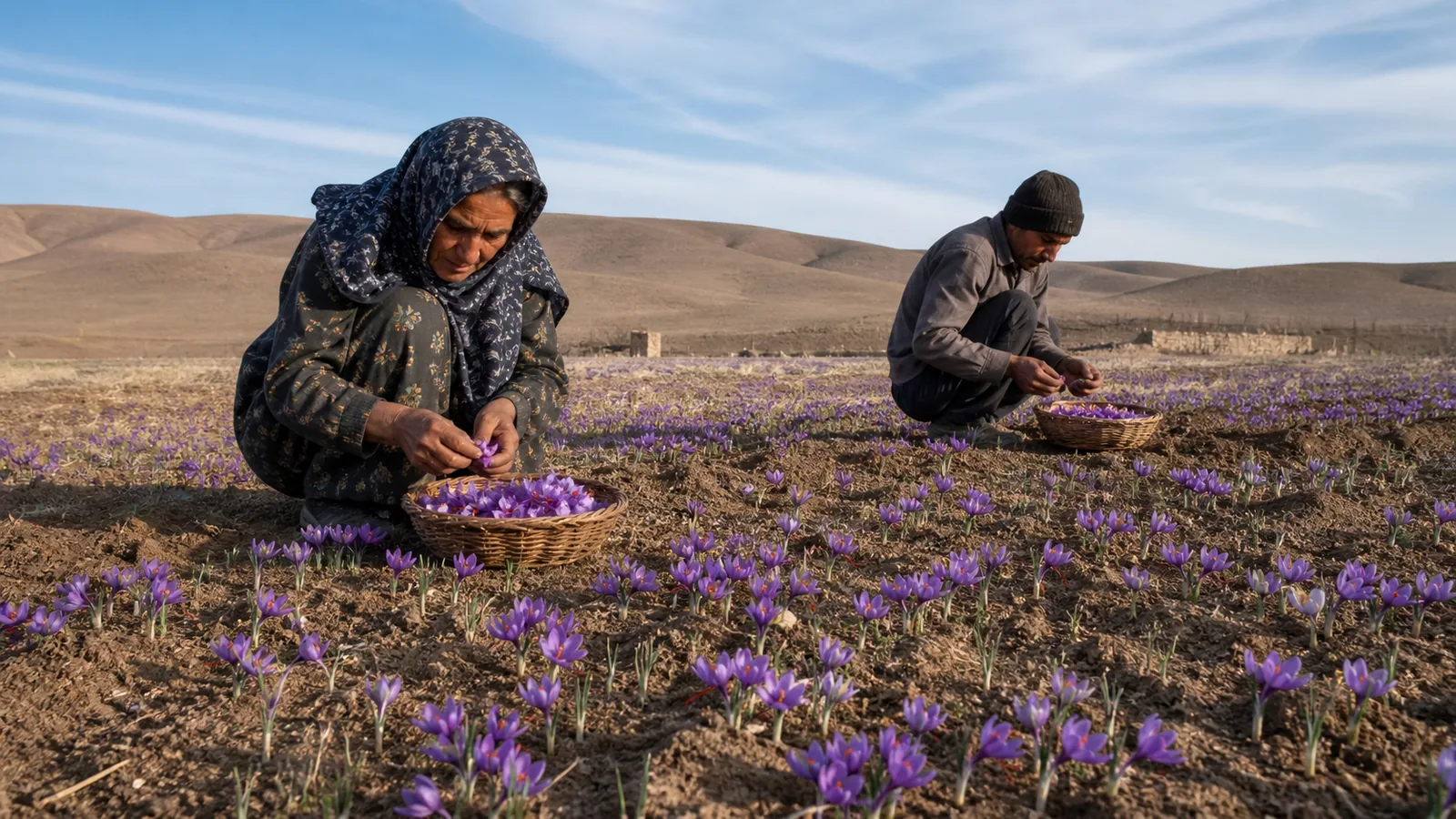
Saffron Harvesting in Qom Province Farms covered a small but measurable crop: seven hectares produced a reported 21 kilograms of pure dried saffron, an average of three kilograms per hectare. The cultivation was concentrated in Khalajestan, Salafchegan and Kahak, where growers used the crop’s summer dormancy and autumn growth cycle.
A historical report from Qazvin adds a useful comparison. It described about 30 hectares, local production of planting corms, average yields of five to six kilograms per hectare and loans that encouraged farmers to expand. Combining the two reports gives a clearer view of how saffron was introduced outside Iran’s main eastern production areas.
Qom’s seven-hectare saffron harvest
The Qom report states that seven hectares yielded 21 kilograms of dried saffron. Unlike many agricultural news items that publish only a forecast, the wording says the product “was produced.” The arithmetic is exact: 21 kilograms divided by seven hectares equals three kilograms per hectare.
The source names Khalajestan, Salafchegan and Kahak as the producing areas. An older machine translation rendered Kahak as “Galaxy”; the place name, not the literal English word, belongs in the article.
The report did not state how much of the seven hectares belonged to each district, the age of the fields or whether the weight was tested at a standard moisture level. Those missing details limit comparisons with another province, but the Qom total itself is internally consistent.
Why saffron fitted Qom’s seasonal pattern
A provincial plant-production official described saffron’s cycle as active from about November through April, with leaves yellowing and drying as heat returns and the underground corm enters summer dormancy. Planting was recommended from August to October in that local programme.
The old translation calls saffron a tropical plant, which is misleading. Crocus sativus is an autumn-flowering perennial grown in climates that can include hot, dry summers and cool or cold winters. The relevant point for Qom is seasonal fit, not a tropical classification.
The article also says saffron has “no planting costs.” Establishing a field clearly requires corms, soil preparation and labor. What the source appears to mean is that once established, a perennial planting can produce for several seasons without buying and planting a new annual crop each year. Ongoing irrigation, weeding, nutrition, pest management, flower picking, stigma separation and drying still cost money.
How long can a saffron field remain?
The Qom official said planted corms could remain productive for four to seven years and, in some areas, up to ten. That is a local range, not a fixed replacement schedule. Daughter corms multiply underground, density changes, and yield can rise and later decline.
A grower should base lifting and replanting decisions on field performance, corm health, crowding, disease and local advice rather than the calendar alone. The historical range is useful context, but it does not guarantee ten productive seasons.
Rural employment and household income
The original Qom report emphasized potential work for rural women and girls. Its wording described this as filling leisure time, which understates skilled seasonal labor. Flower picking, stigma separation and drying are time-sensitive tasks that contribute directly to product quality and should be recorded and paid as agricultural work.
Whether saffron improves household income depends on final yield, labor hours, corm and water costs, drying losses and the price received. A high retail price per kilogram does not by itself show what a family earns from a small field.
Saffron in neighboring Qazvin Province
Qazvin’s agricultural report described about 30 hectares under saffron in Takestan and Bouyin Zahra, including five hectares in Bouyin Zahra. Akbari, identified as a provincial plant-production official, gave an average yield of five to six kilograms per hectare and forecast more than 150 kilograms.
The numbers agree at the lower end: 30 hectares at five kilograms per hectare equals 150 kilograms. At six kilograms, the total would be 180. “More than 150 kilograms” is therefore compatible with the stated range, although it remains a forecast rather than a final harvest total.
Farmers planted during summer and expected to harvest in late November. The report said saffron had been cultivated in Qazvin for 12 years at the time of the announcement. That is a historical age relative to the report, not a statement that cultivation is only 12 years old today.
Local corm production and loan support
Qazvin reportedly produced its own saffron corms and supplied planting material to some other provinces. The old article calls them onions, but saffron is propagated through corms. Local supply can reduce transport distance and help farmers obtain material adapted to the region, provided corm health and identity are controlled.
The province also used “resiliency” loans to encourage cultivation. The report does not give loan amounts, interest, repayment performance or the number of recipients. The finance should be recorded as a promotion factor, not evidence that every supported planting was profitable.
Akbari described Qazvin saffron as having very good color, taste and aroma. Those sensory claims were not tied to a named lot or test. They remain the official’s assessment rather than a verified grade.
Comparing Qom and Qazvin responsibly
- Qom: seven hectares and 21 kg reported produced, equal to three kg/ha.
- Qazvin: about 30 hectares, five-to-six kg/ha stated average and more than 150 kg forecast.
The figures should not be turned into a quality ranking. Qom’s number is phrased as produced weight; Qazvin’s is a forecast. Field age and measured moisture are unknown in both reports.
What future harvest reporting should add
A useful follow-up would separate productive and new hectares, record final dried weight and moisture, name the districts’ field ages, document corm health and source, count paid labor hours, report loan outcomes, and tie color, aroma or grade claims to a named method and lot.
The destination’s original purpose remains intact: it records saffron harvesting in Qom Province. The Qazvin material now adds what a reader arriving from that source needs—area, yield, timing, local corm supply and finance—without confusing a neighboring province’s forecast with Qom’s measured account.

![Exporting Saffron to Turkey + Price Guide [Complete 0 to 100]](https://img.rowhanisaffron.com/20260827003933/saffron-export-turkey-quality-inspection.webp)



