


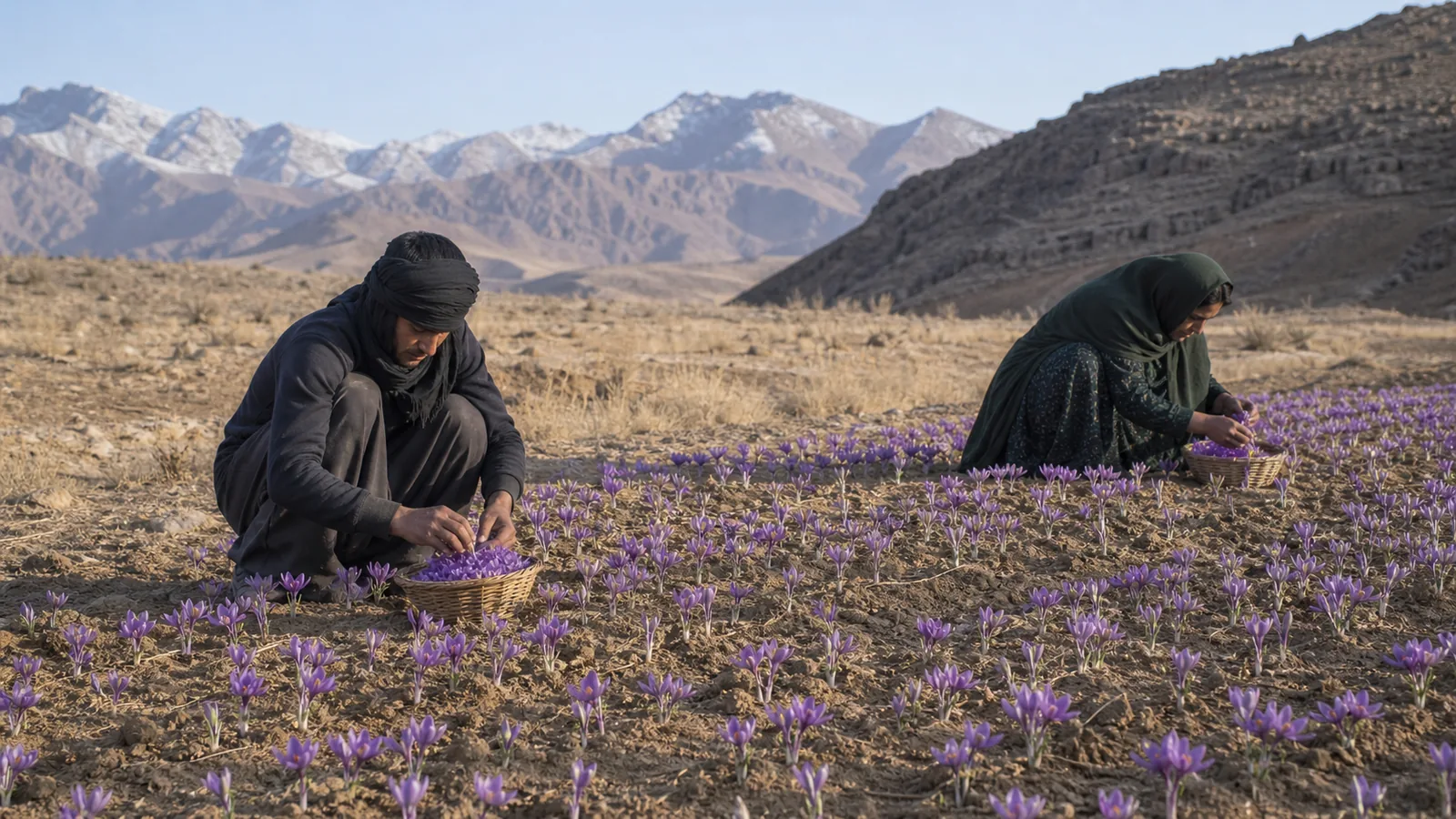
The historical saffron harvest from Kerman province was reported at more than 3,600 kilograms after picking began in late Mehr, roughly the second half of October. Provincial officials named Zarand, Kohbanan and Baft as the three leading counties by planted area and said saffron had expanded to 199 hectares across Kerman.
Two later reports add the missing detail for Baft: 70 hectares under saffron, a 390-kilogram forecast, three grower cooperatives and a deliberate shift toward crops suited to drought pressure. Together, they explain both the provincial headline and how one mountain county organized its part of the harvest.
Kerman’s reported saffron harvest
Abbas Saeedi, identified as head of the provincial Agricultural Jihad organization, said the harvest concluded at more than 3,600 kilograms. The same announcement gave 199 hectares as the province’s planted area.
If those numbers refer to the same fields and the same dried product, they imply more than 18 kilograms per hectare. That is much higher than the three-to-six-kilogram figures in the Baft reports and many other local announcements. The Kerman source does not state whether the 3,600 kilograms was a forecast or final weighed total, whether it included all product forms, or whether the 199 hectares covered every producing field.
The provincial total is therefore preserved exactly as reported but not converted into a verified dry-saffron yield. A follow-up would need to reconcile product form, productive area and measurement date.
Zarand, Kohbanan and Baft led by area
The provincial report ranked Zarand, Kohbanan and Baft first through third for saffron area. It also called Kerman saffron high quality, but provided no sample results, laboratory, grade or testing method. The location ranking is useful; the quality description remains an official opinion rather than a verified specification.
Officials promoted saffron as part of a cultivation-pattern change because its main growing cycle differs from many summer crops and it can have a comparatively limited water requirement. That does not make the crop water-free. Suitability still depends on field drainage, local weather, healthy corms, irrigation timing, labor and a viable buyer.
Baft’s 70 hectares and 390 kg forecast
Baft’s Agricultural Jihad office reported 70 hectares under saffron. A separate announcement forecast a 390-kilogram harvest for the city. Together, those figures imply about 5.57 kilograms per hectare, although the 390 kilograms was explicitly a forecast rather than a final measured result.
The county treated saffron as one part of its drought response. Officials also discussed Damask rose, known locally as Rosa Mohammadi, and greenhouse cultivation as alternatives to more water-demanding summer crops. This was a portfolio approach, not a claim that one crop could replace every existing farm system.
The source described Baft as a cold, mountainous city about 159 kilometres southwest of Kerman at nearly 2,300 metres above sea level. Those conditions were cited as favorable for saffron. Elevation alone does not prove quality, so the report’s “very good quality” statement is not converted into a grade without test evidence.
How Baft growers were organized
Thirty-five members cultivated saffron through three cooperatives, while five additional growers operated individually. The wording suggests at least 40 participants in the reported structure, but it does not state whether the cooperative count included every active saffron grower in Baft.
The local development office made saffron a priority within its cultivation-pattern programme and said facilities would be offered to new growers. The article does not identify the amount, terms, recipients or repayment status of that support. It should be recorded as an offer, not as proof that finance reached every participant.
Cooperatives can help coordinate corm purchasing, training, harvest labor, drying and market access. Their value should still be measured through participation, services delivered, product handled and the price members receive.
What the WHO “healthy city” statement actually means
The Baft source says the city was introduced by the World Health Organization as one of 70 healthy cities in Iran and one of 1,000 worldwide. WHO material provides a more precise context: about 70 Iranian cities received urbanization-and-health certificates for activities connected to World Health Day 2010 and registration in the “1,000 cities, 1,000 lives” initiative.
That participation is not the same as later formal WHO Healthy City designation. WHO identifies Sahand as Iran’s first awarded Healthy City in 2021 and Maragheh as the second in 2024. No official WHO source reviewed for this article identifies Baft as a formally designated Healthy City. The old report’s wording is therefore corrected rather than repeated.
Why the Baft detail matters to the Kerman total
The province-wide article names Baft but gives no county figures. The two Baft reports fill that gap: a 70-hectare programme, a 390-kilogram forecast, organized and individual growers, and a stated shift away from water-intensive summer production.
They also show why regional totals need local denominators. Baft’s implied forecast of 5.57 kg/ha is plausible within the local range, while the unreconciled provincial figures imply more than 18 kg/ha. Keeping those calculations visible prevents a large headline number from being mistaken for a measured average.
What a complete Kerman harvest report should include
- Final dried-saffron weight and the date it was measured.
- Productive versus newly planted hectares by county.
- Yield, field age and losses in Zarand, Kohbanan and Baft.
- Quality results tied to a named method and lot.
- Water, labor, corm, drying and packaging costs.
- Cooperative participation, finance actually disbursed and grower sale prices.
Until those data are available, the safest conclusion is historical and specific. Kerman reported a harvest above 3,600 kilograms and 199 hectares, while Baft separately documented 70 hectares and a 390-kilogram forecast. The province was expanding saffron in response to drought, but the reported totals still require reconciliation before they can support precise yield or quality claims.

![Exporting Saffron to Turkey + Price Guide [Complete 0 to 100]](https://img.rowhanisaffron.com/20260827003933/saffron-export-turkey-quality-inspection.webp)



