


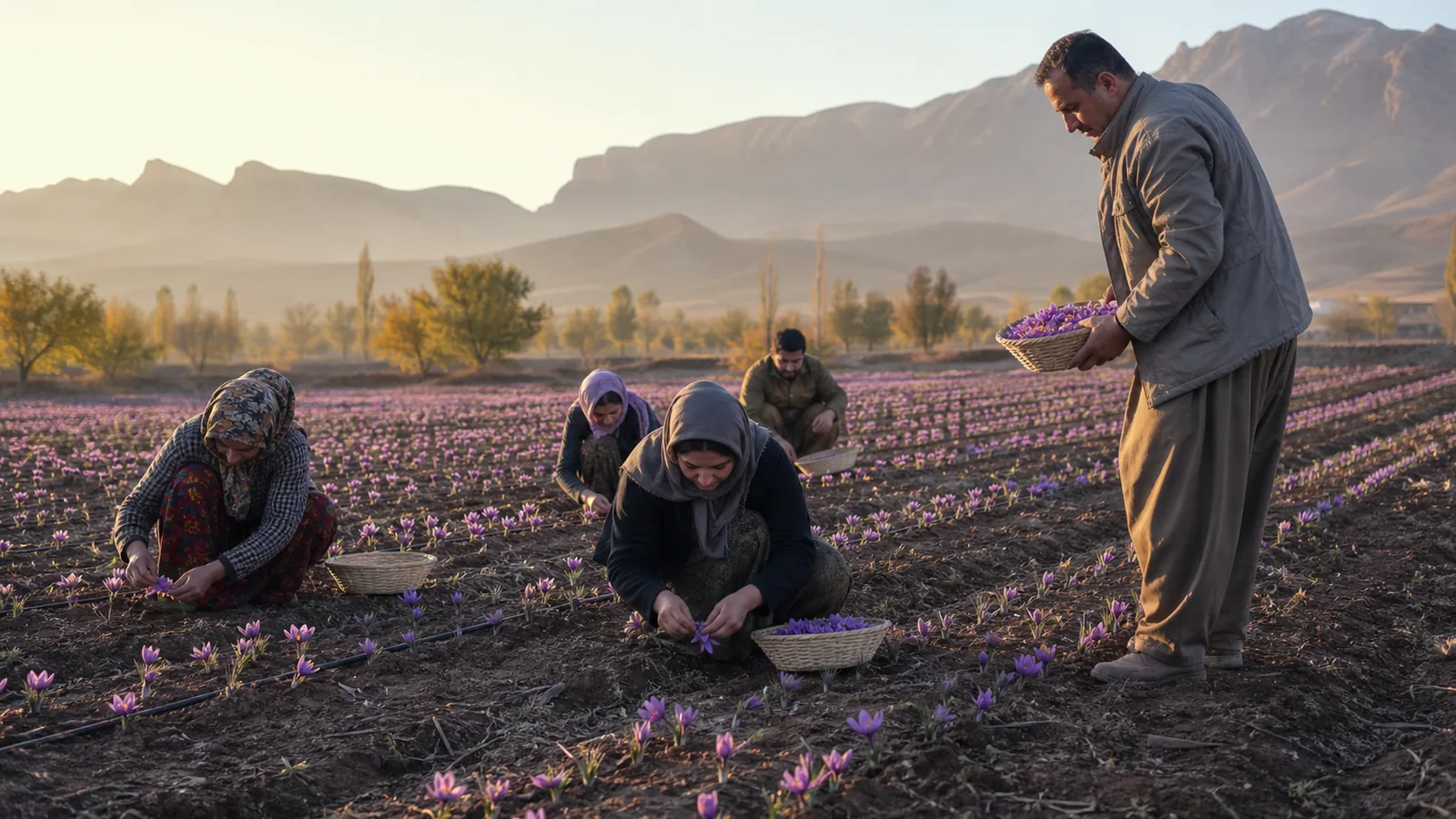
Kermanshah farmers harvested a reported 320 kilograms of saffron in the season covered by this historical article. Provincial horticulture director Reza Zarei said the crop occupied 92 hectares, 12 hectares more than the year before, and could be grown in 12 of the province’s counties.
These numbers describe an earlier stage of Kermanshah’s saffron sector. They should not be read as the province’s current area, price, or production, but they do show how field expansion, picking labour, packaging, and public support were connected.
The reported Kermanshah saffron harvest
Zarei told Tasnim News that 320 kilograms had been harvested from Kermanshah Province that year. Dividing that total by the reported 92 hectares gives about 3.5 kilograms per planted hectare.
That derived average is only a rough indicator. The source did not separate new fields from mature bearing fields, and newly planted saffron may contribute little or no commercial harvest. A reliable productivity comparison needs the bearing area and field age, not only total planted hectares.
The report said saffron could be cultivated in 12 counties, with limitations in Sarpol-e Zahab and Qasr-e Shirin. It did not explain whether heat, soil, water, or another constraint caused those limits. Suitability should therefore be assessed field by field rather than inferred from the county name alone.
When saffron was picked in Kermanshah
The Persian source gives a window from the beginning of Aban to early Azar, roughly the autumn flowering period. Its wording refers to both planting and harvesting, but that short window is more clearly consistent with flower picking than with the full planting calendar.
Saffron picking is concentrated into early mornings over a brief season. Flowers need to move promptly from field to separation, and the stigmas then need controlled drying. Planning therefore starts before the first flower appears:
- organise pickers by field and expected daily flowering;
- use clean, shallow containers that do not crush the flowers;
- keep different growers’ lots identifiable;
- prepare clean separation space and trained hands;
- match drying capacity to the busiest harvest day; and
- record fresh flowers, dried output, grade, and rejected material.
Zarei estimated that 20 people per hectare worked on collection during the harvest season. This is a historical labour statement, not a universal staffing rule. Flower density, field layout, picker experience, and the length of the daily picking window can change the requirement.
Price and income in the archived report
The article said farmers received 100,000 rials per gram and placed average revenue at 400 million rials per hectare. Those two figures imply four kilograms sold per hectare, which is close to but not identical to the rough 3.5-kilogram average obtained from the province-wide harvest and planted area.
The difference may reflect a typical mature field rather than all planted land. The source does not say. It also does not list production costs, so 400 million rials should be read as stated gross revenue, not verified profit. Historical prices should never be used for a current planting budget.
Zarei described saffron as a crop that could contribute to household income and employment. Whether it does so depends on yield, labour cost, quality, buyer access, and payment terms as much as the headline price.
Packaging and public support
Two saffron packaging workshops were said to operate in Kermanshah. Their existence does not tell us their capacity, services, standards, or how much local crop they handled. For growers, useful capacity means that a traceable lot can be dried or received, tested, packed appropriately, and sold without avoidable delay.
Zarei also reported a shortage of public funds. A proposal would subsidise 100 hectares of saffron planting each year, and he argued that grants could support interested growers as part of the “resistance economy” policy and lower-water agriculture.
The article does not confirm that the subsidy was approved or paid. A grant can reduce establishment cost, but it does not replace field suitability, healthy corms, labour planning, or a buyer. Public programmes work best when support follows verified production and market plans rather than acreage alone.
What the 320-kilogram harvest tells us
It marks a real period of growth: Kermanshah reportedly added 12 hectares, harvested 320 kilograms, operated two packing workshops, and was considering support for further planting.
It also shows why picking cannot be treated as the final isolated step. The crop’s value depends on enough labour at dawn, prompt separation and drying, preserved lot identity, accurate grading, and a selling route. Those practical links matter more to a grower than repeating an old province-wide price.

![Exporting Saffron to Turkey + Price Guide [Complete 0 to 100]](https://img.rowhanisaffron.com/20260827003933/saffron-export-turkey-quality-inspection.webp)



