


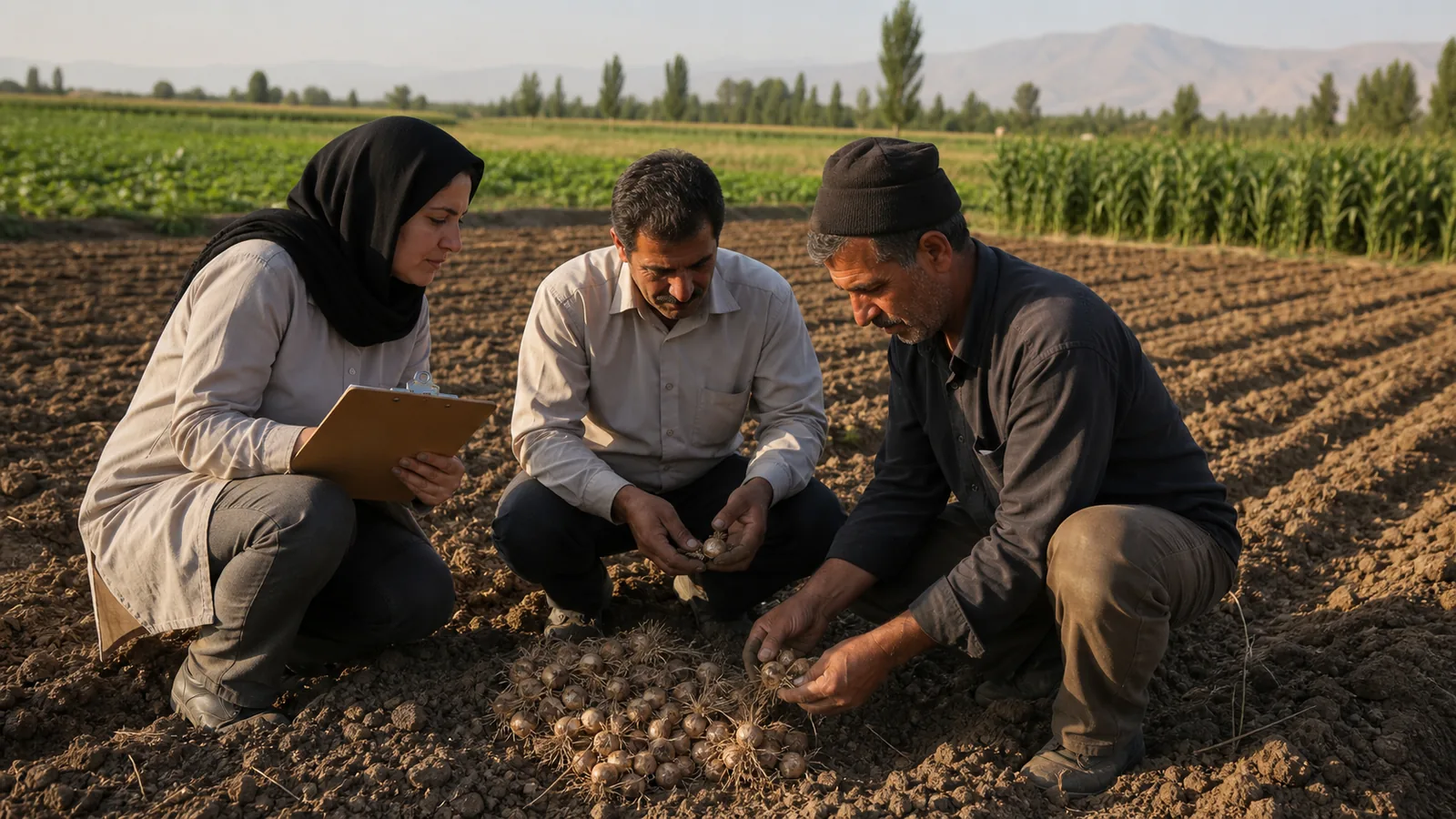
Saffron planting in Bouin Zahra began on six hectares in the historical programme described here. The Qazvin county was testing the crop as part of a response to water scarcity and a changing crop pattern, with credit and technical training used to encourage growers.
The place is also written Buin Zahra or Buein Zahra in English. These spellings refer to the same county. Saffron was one of several Buin Zahra agriculture crops, not a replacement for the county’s entire farming system.
Why Bouin Zahra introduced more saffron
Majid Esmaeili, then identified as director of the Bouin Zahra Agricultural Jihad office, said the planted area had increased from the previous year. Mehr News carried his comments through the Qazvin provincial agricultural authority.
Esmaeili linked the increase to the water crisis and a change in the cultivation pattern. That policy context does not mean saffron requires no water, or that it is suitable for any dry field. Drainage, winter conditions, summer heat, corm health, labour, and a reliable water schedule still determine whether a planting can succeed.
Six hectares was a small start. At that scale, the programme could test local establishment, flowering, yield, corm multiplication, and harvest logistics without committing a large area before evidence was available.
Where saffron fits among Buin Zahra agriculture crops
Official agricultural reporting shows that the county’s wider crop mix included canola, alfalfa, wheat, and barley, while vegetable farms and vineyards were also part of local production. For example, an IANA field report from Bouin Zahra recorded those four arable crops at two local production units.
A sound crop-pattern decision compares water timing, income, rotation, livestock needs, machinery, labour, and market demand across the farm. Saffron may fit part of that plan because its crop cycle differs from summer crops, but it brings its own demands: expensive planting material and a concentrated manual harvest.
The six-hectare figure should therefore be understood as diversification. It did not show that saffron had become a major county crop or that other crops were unsuitable.
Credit encouraged the first plantings
Esmaeili named lending under the “resistance economy” programme as one of the main reasons growers increased the saffron area. The archived article does not state the loan amount, interest, repayment term, recipient count, or what costs were eligible.
Credit can help with corms, land preparation, irrigation, and equipment, but repayment begins whether the field performs well or not. Before borrowing, a grower needs a multi-year cash-flow plan that allows for establishment, variable early yield, seasonal labour, drying, and an uncertain selling price.
Training included rural women facilitators
The county also held technical and vocational saffron-cultivation courses. Esmaeili specifically noted the participation of rural women facilitators, preserving an important part of the original report that the old English translation obscured.
That involvement is practical as well as social. Saffron production includes decisions in the field and time-sensitive work after picking. Training should cover:
- selecting and inspecting corms before planting;
- preparing a well-drained field and local irrigation schedule;
- recording inputs, field age, and crop performance;
- organising early-morning flower picking;
- separating stigmas hygienically and drying them consistently; and
- keeping lots traceable through storage and sale.
A later Qazvin agricultural report showed that interest continued. In 2022, provincial officials reported 100 hectares of saffron across Qazvin and visited a three-hectare Bouin Zahra field, with expected yield of three to four kilograms per hectare. See the IANA’s 2022 saffron report.
Is Bouin Zahra suitable for planting saffron?
The county has demonstrated that saffron can be grown there, and later reporting confirms continued cultivation. That is not the same as approving every parcel.
A farmer should use local field records and current extension advice to assess soil, water, planting material, labour, expected yield, and buyers. The original six-hectare programme is most useful as evidence of a cautious start supported by training, not as a blanket instruction to change crops.

![Exporting Saffron to Turkey + Price Guide [Complete 0 to 100]](https://img.rowhanisaffron.com/20260827003933/saffron-export-turkey-quality-inspection.webp)



