


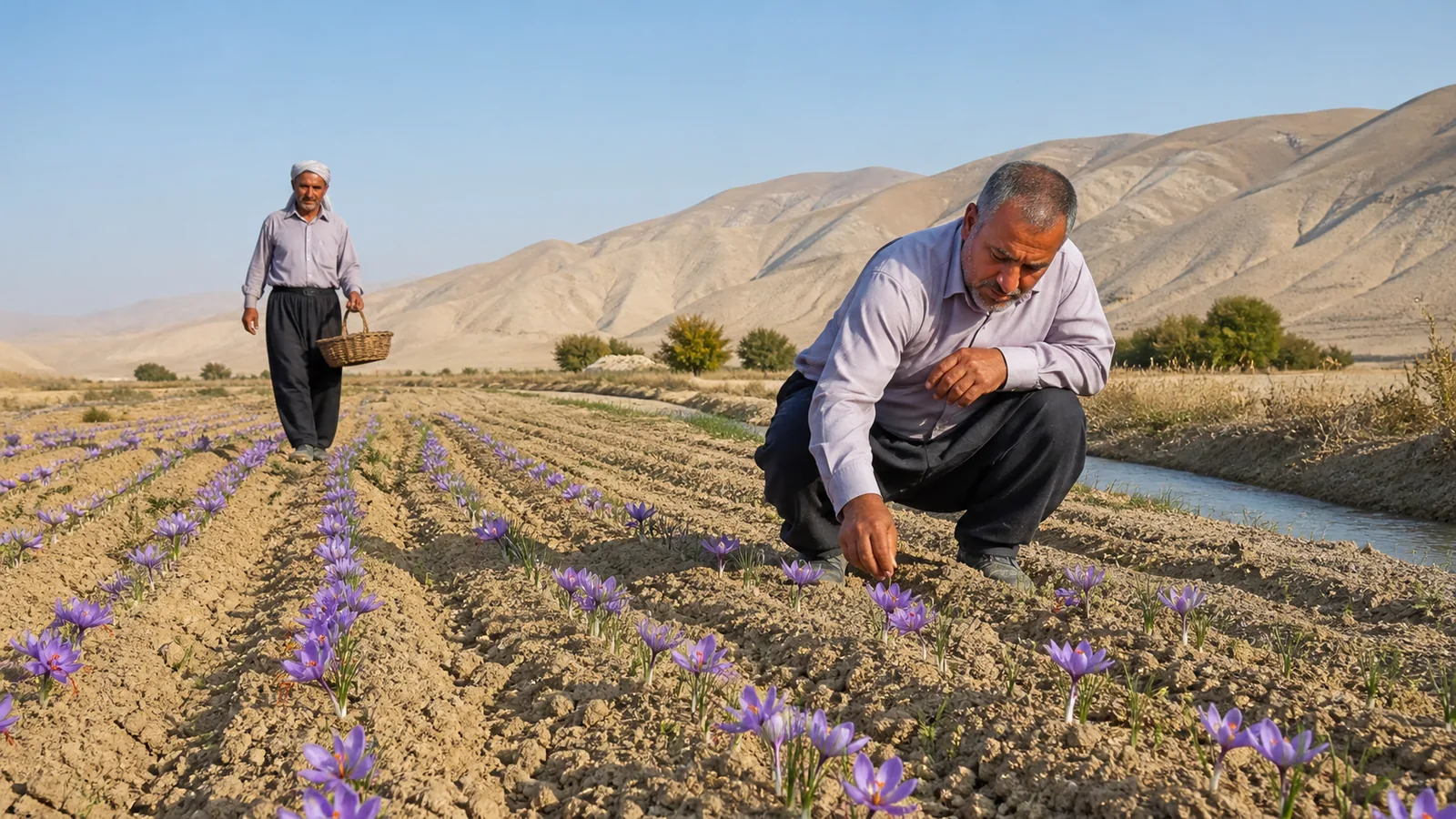
Qom Province produced a reported 21 kilograms of dried saffron from seven hectares in the season covered by this historical article. Reza Vakil of the provincial Agricultural Jihad Organization gave an average yield of three kilograms per hectare, so the area, yield, and total align.
The crop was grown in Khalajestan, Salafchegan, and Kahak. These names were badly distorted in the old English translation, which rendered Khalajestan as “Khalkhistan” and Kahak as “Galaxy.”
Where saffron was produced in Qom
Vakil, then deputy director for improving plant production, described a small provincial saffron sector spread across three districts with different local conditions. Seven hectares is enough to demonstrate production, but not enough to treat every Qom field as suitable.
The reported average of three kilograms per hectare refers to pure dried saffron. It says nothing about differences between farms, the age of the fields, the grade produced, or how the crop was dried. Those details are necessary before comparing Qom with another producing area.
The 21-kilogram figure is also historical. It should not be quoted as Qom’s present output without a current provincial record.
Qom’s saffron growing cycle
The report described saffron as suited to a climate with hot, dry, sunny summers and a milder autumn and winter. It called the plant “tropical,” but that label is misleading. The more useful information is the seasonal cycle it gave.
Saffron corms are dormant during summer. In Qom’s reported calendar, active growth ran from around Aban to Ordibehesht. As the warm season began, the leaves yellowed and dried and the corm returned to dormancy.
That summer dormancy does not remove the need for care. During the active season, the field still needs an appropriate water and nutrient plan, weed control, and monitoring for poor growth or corm problems. A lighter, well-drained soil was identified as preferable because standing water around corms creates risk.
The Food and Agriculture Organization also describes saffron as a perennial propagated by daughter corms and notes the use of selected, disease-free planting material. See the FAO cultivation overview.
When to plant saffron in Qom
Vakil gave a local planting period from Mordad through Mehr. In Gregorian terms, that spans roughly late summer into early autumn, but the exact dates shift each year. A grower should confirm timing for the particular district and field rather than rely on a translated month range alone.
Before planting, the practical checks include:
- well-drained soil and suitable water quality;
- healthy, traceable corms graded for the intended system;
- planting depth and spacing based on local advice;
- enough labour for the short flowering period;
- clean space for rapid stigma separation and controlled drying; and
- a buyer and quality specification for the finished lot.
Does saffron need to be replanted every year?
No. The Qom report said a planting could remain in the ground and produce for four to seven years, and in some places up to ten. That is why the official said growers did not face a fresh planting cost every season.
The old translation turned this into “no planting costs,” which is not accurate. Establishment can be expensive, and a perennial field still has annual irrigation, labour, maintenance, harvest, drying, and marketing costs. Productive life also varies as daughter corms multiply and become crowded. The stated four-to-ten-year range is a local guideline, not a guarantee.
Income and work for rural households
Vakil argued that saffron could add to household income and create work for rural women and girls. The source’s phrase about “filling leisure time” understates skilled agricultural work. Flower picking, stigma separation, drying, grading, record-keeping, and sales all affect the value of the crop.
A fair production model should recognise those tasks, provide suitable working conditions, and pay transparently for the time and skill involved. High retail value does not automatically become high farm income once corms, labour, losses, quality, and buyer terms are counted.
What does the Qom production report establish?
It establishes that saffron was grown commercially in Khalajestan, Salafchegan, and Kahak, with a reported seven hectares, three kilograms per hectare, and 21 kilograms of dried output in that season.
It also records the local dormancy and planting calendar and the crop’s potential role in rural income. For a decision today, those historical observations need current field data, input costs, climate and water assessment, and verified buyers. The arithmetic was sound; the economic promise still requires evidence from the farm.

![Exporting Saffron to Turkey + Price Guide [Complete 0 to 100]](https://img.rowhanisaffron.com/20260827003933/saffron-export-turkey-quality-inspection.webp)



