


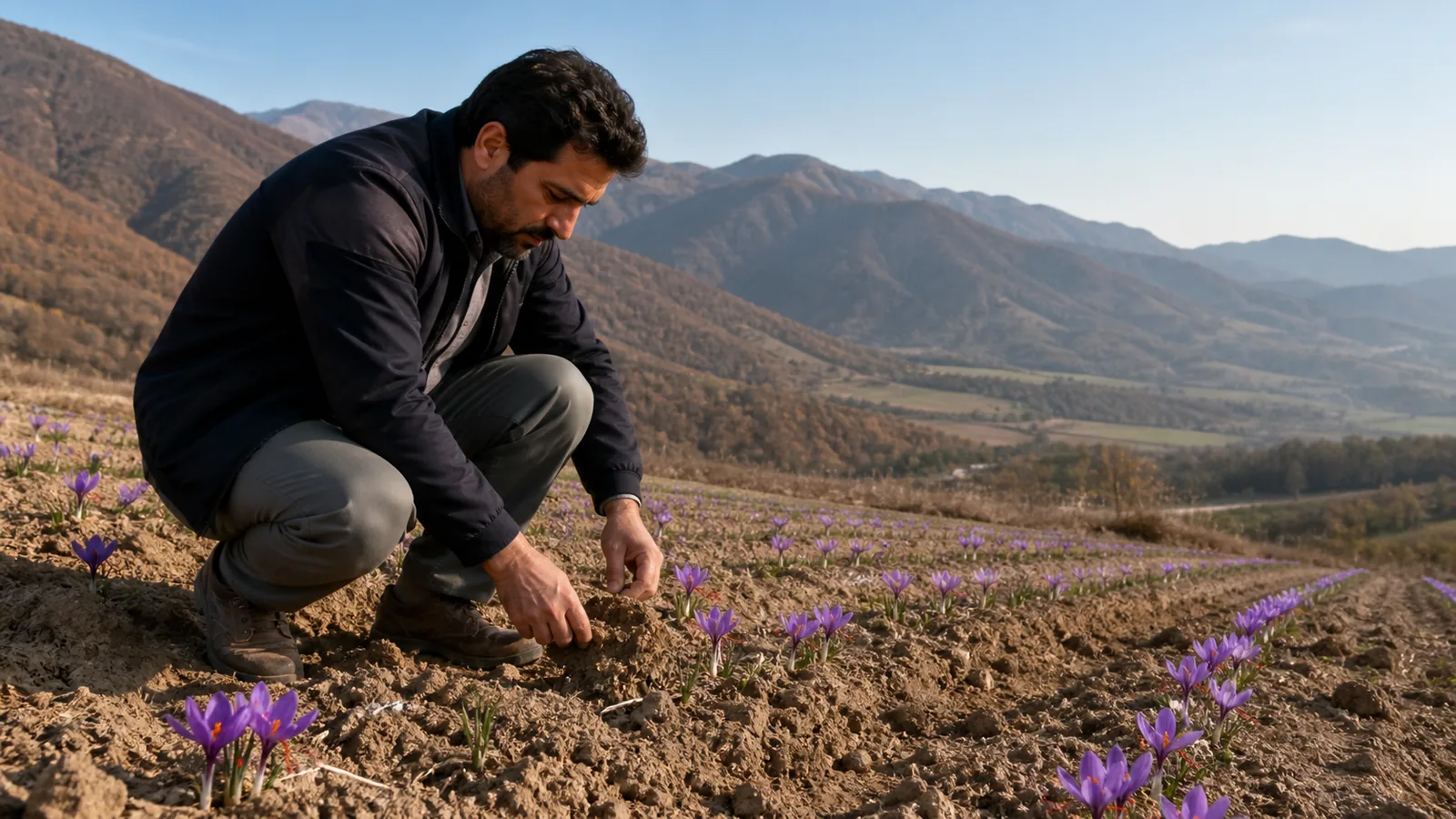
The most suitable areas for planting saffron in Mazandaran are the province’s higher, drier inland districts, not its humid coastal plain. The local example behind this article is Yaneh Sar in the Hezarjarib highlands of Behshahr, where early fields were established around the villages of Andarat and Piteh Now. Even there, altitude alone does not make a plot suitable. Drainage, summer moisture, winter conditions, corm health and access to labour at harvest all need to be checked at field level.
That distinction matters in Mazandaran. A crop that tolerates the conditions of a well-drained mountain slope may struggle in a low-lying field that remains wet. Saffron spends much of the warm season dormant underground, and its corms are vulnerable when water sits around them. Anyone considering a new planting should therefore treat the Behshahr experience as a useful regional example, not as proof that saffron will thrive everywhere in the province.
Where saffron cultivation began around Behshahr
In the original local report, Behshahr agricultural official Khalil Haghighi Zaidi described the first harvests in the mountainous Yaneh Sar section of Hezarjarib. Farmers had brought saffron corms from Khorasan two or three years earlier and planted them on their own land. At that stage, about three hectares in Andarat and Piteh Now were reported under cultivation.
The trial produced roughly 400 kilograms of fresh flowers and four kilograms of dried saffron. If both figures refer to the full three hectares, that works out at about 1.3 kilograms of dried saffron per hectare. It was an encouraging start, but not a promise of yield for every farm. Establishment year, corm size, planting density, soil, rainfall and handling after harvest can all alter the result.
The district’s industry has since moved beyond that small trial. A 2025 report from Tasnim, citing Behshahr agricultural authorities, put saffron cultivation in the county at about 70 hectares and described expected yields of four to six kilograms per hectare. That later figure shows that saffron became an established crop in the area; it should not be read as a guaranteed return from a new field.
What makes a Mazandaran site suitable?
The conditions reported in Yaneh Sar and Hezarjarib are markedly different from the wet Caspian lowlands. The original official account associated good performance with mountain elevations of roughly 1,300 to 2,300 metres, mild winters, and hot, dry summers, with summer temperatures reaching about 35–40°C. Those figures describe the successful local setting. They are a screening guide rather than a universal prescription.
Before buying corms, a grower should inspect the proposed field for:
- Free drainage: rain and irrigation water should move through the root zone rather than pool around the corms.
- A dry dormancy period: persistent summer moisture raises the risk of rot and weakens the logic for choosing saffron.
- Appropriate soil: a friable, workable soil is easier to prepare and harvest than a compacted or waterlogged plot.
- Local temperature and frost pattern: elevation is useful only when the field’s actual microclimate suits the crop.
- Harvest access: flowers open over a short autumn window and must be picked and processed promptly.
Soil testing and a small pilot plot are sensible where cultivation is new. A local agricultural adviser can also assess disease history, irrigation water and slope-specific drainage. This is especially important in a province where rainfall and humidity can change sharply between the coast, foothills and mountain valleys.
Planting time and corm requirements
The historical Behshahr guidance placed planting from early Mordad through Shahrivar, roughly late July to late September, with the Yaneh Sar mountain fields normally planted during Shahrivar. The right day still depends on soil moisture and local weather. Corms should be healthy, firm and free from visible rot; moving diseased planting material into a clean field can undermine the crop before it emerges.
The same account gave a broad planting requirement of 2,500–3,500 kilograms of corms per hectare. That is a substantial range. The appropriate quantity depends on corm grade, spacing, planting depth and the production system, so it should not be converted into an order without a field plan. Larger, vigorous corms and sound bed preparation matter more than meeting a number mechanically.
Harvesting saffron in the Mazandaran highlands
Flowering was reported from late Mehr to early Azar, approximately late October to late November, with timing shifting by elevation and season. Growers traditionally pick early in the morning, preferably before strong sunlight opens the flowers fully. This protects the delicate material and gives the team more time to separate the red stigmas while the flowers are fresh.
Harvest planning should happen before the first bloom. Labour, clean collection containers, a hygienic separation area and controlled drying all need to be ready. A suitable field can still produce poor saffron if flowers wait too long, become crushed, or are dried unevenly.
Is saffron a good choice for every part of Mazandaran?
No. The evidence supports selected highland areas around Yaneh Sar and Hezarjarib, while the province’s wetter districts require much more caution. The original Behshahr report itself called for the Mazandaran Agricultural Jihad Organization to carry out expert studies before cultivation expanded. That remains the responsible conclusion.
For a prospective grower, the safest route is to compare the exact plot with the proven mountain sites, test soil and drainage, begin on a manageable area and keep records through at least one full flowering cycle. The question is not simply whether saffron grows in Mazandaran. It is whether a particular Mazandaran field can give the corm a dry, well-drained environment and support a fast, careful autumn harvest.

![Exporting Saffron to Turkey + Price Guide [Complete 0 to 100]](https://img.rowhanisaffron.com/20260827003933/saffron-export-turkey-quality-inspection.webp)



