


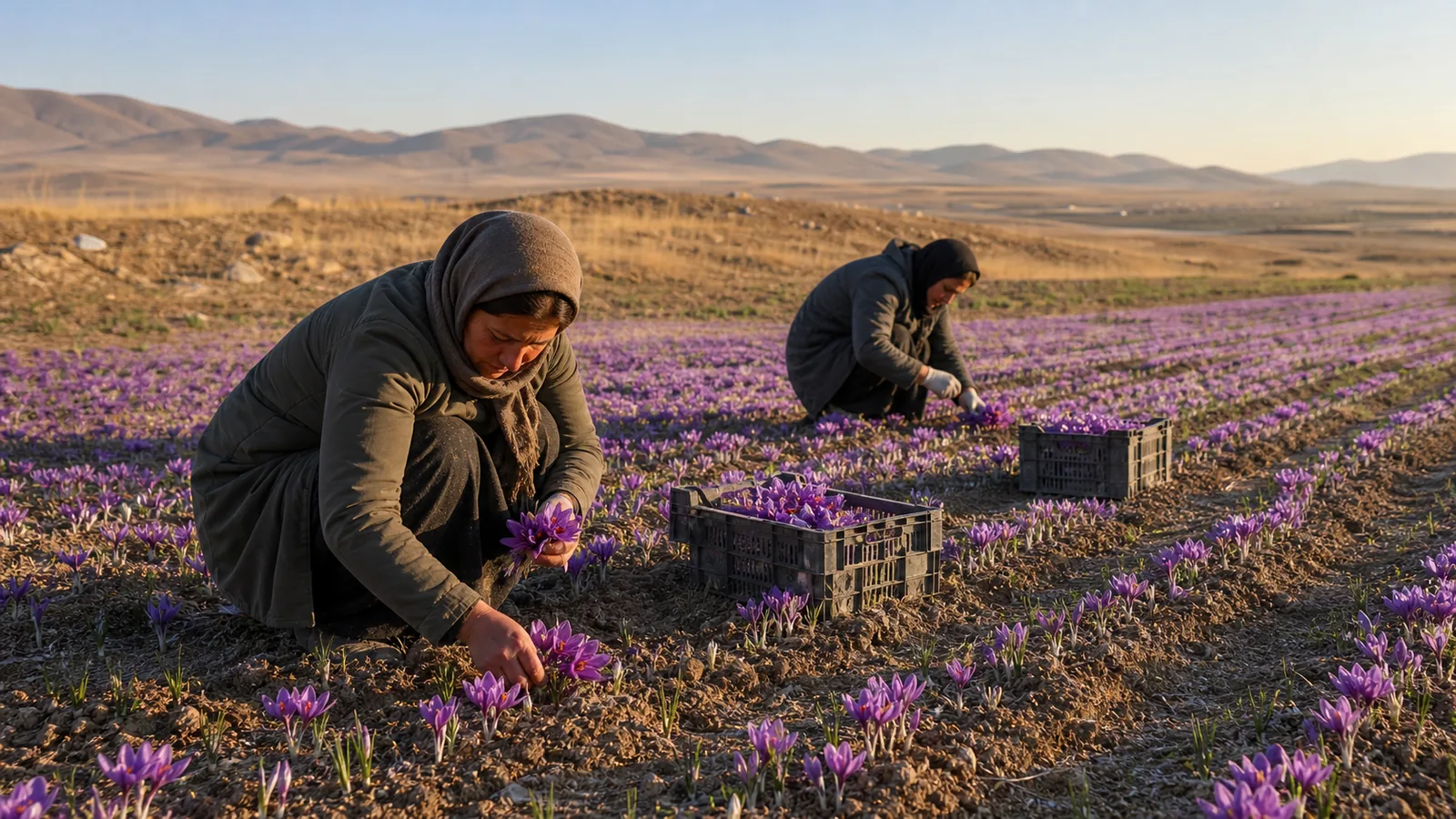
Saffron cultivation in Zanjan grew in stages. One contemporary report put the province at about 30 hectares. A later report recorded more than 46 hectares already planted and described another 25 hectares planned, which would bring the programme to 71 hectares. Read together, the figures show an expansion effort shaped by water pressure, the cost and quality of planting corms, farmer training, and access to credit.
These are historical figures from reports published in the 2010s, not a current acreage estimate. Keeping the dates and the speakers attached to each number matters: without that context, 30, 46, 60, and 71 hectares can look contradictory when they are actually snapshots and targets from different points in the programme.
From 30 hectares to a larger provincial programme
In an earlier Tasnim report, Fardin Moradian, then director of crop affairs for Zanjan Agricultural Jihad, said that 146 growers were cultivating saffron on roughly 30 hectares. He linked interest in the crop to falling groundwater levels and described saffron as suitable for land with limited water. The same report also stressed that expansion without local research could expose farmers to avoidable losses.
A second account attributed to Moradian described a plan to double the planted area to 60 hectares in the following year. It also recorded the practical obstacle behind that ambition: growers had knowledge of saffron cultivation, but credit and equipment were limited. Moradian presented large-scale saffron planting as a response to Zanjan’s water crisis. That was an official’s forceful case for changing the cropping pattern, not proof that one crop could solve the province’s water problems by itself.
The original Tasnim report remains available in Persian: 30 hectares of agricultural land in Zanjan planted with saffron.
What the later 46- and 71-hectare figures mean
A later ISNA account quoted Behnam Ojaghloo, director of horticultural affairs at the provincial Agricultural Jihad organisation. It said that more than 46 hectares of Zanjan land were under saffron. The headline figure of 71 hectares represented that base plus an expected 25 hectares of additional planting, described as 100 new plots. It should therefore be read as the programme’s next total, not as a second estimate for the same moment.
The report counted 344 saffron plots across the province. Of the planted area, 23 hectares had reached bearing age in the previous season and produced 50 kilograms. Many fields were still young, so Ojaghloo put their average yield at about 2 kilograms per hectare and expected it to rise towards 3 kilograms as they matured.
Why field age changes the yield picture
Saffron is a perennial crop grown from corms. A newly planted field does not immediately behave like an established one, which is why a provincial average based on young farms can be lower than figures quoted for mature fields elsewhere. The Zanjan report said production generally peaked around the third year. It described an economically useful field life of eight to nine years, while noting that a stand might remain in place for as long as 15 years.
Those are reported local expectations, not a guarantee for every farm. Yield and field life depend on the condition and density of the corms, soil, irrigation, nutrition, disease pressure, weather, and field management. The important point in the Zanjan figures is that much of the province’s acreage was still at an early stage.
Corm quality was a central constraint
Expanding acreage required a reliable supply of healthy saffron corms. The later report said Zanjan sourced planting material from northern provinces and from Razavi and South Khorasan. It also acknowledged the risk of bringing pests and diseases into new fields. A supporting company was said to trace healthy farms, purchase suitable corms, and distribute them within the province.
The reported planting requirement was four to five tonnes of corms per hectare. At the prices quoted at the time, corms alone cost about 250 million rials per hectare, while the total establishment cost rose to around 300 million rials. Those amounts are part of the historical record and should not be used as today’s budget: inflation, labour, transport, input prices, planting density, and exchange rates have changed substantially.
Training and finance had to grow with the acreage
The provincial programme did more than distribute planting material. The later report recorded cultivation classes for 52 operators and three specialists. This training was important because moving a high-value crop into a newer production area requires decisions about field selection, corm health, planting depth, irrigation timing, weed control, flower collection, and drying.
Finance was another constraint. Ojaghloo said an agreement with Omid Entrepreneurship Bank was expected by September to provide lower-cost facilities for saffron growers. The earlier Moradian account made the same underlying point from the other direction: knowledge alone could not expand cultivation when farmers lacked credit and equipment. Because these were planned facilities at the time of reporting, they should not be read as a current loan offer.
The reported Zanjan harvest window
The later account placed saffron harvest between 15 Mehr and 15 Aban in the Iranian calendar, roughly from early October to early November. Exact flowering dates move with altitude, temperature, irrigation, and the season. Flowers also do not wait: once blooming begins, farms need enough labour to collect them promptly and separate the stigmas before quality declines.
This timing was one reason officials considered saffron useful within the local farm calendar. Its main autumn workload can fall outside the peak labour and irrigation periods of some summer crops. That advantage still has to be tested against the water, soil, climate, labour, and market conditions of each farm.
Water scarcity was the reason for expansion, not a complete solution
Both reports placed water at the centre of the policy. Zanjan was dealing with a severe water crisis and declining groundwater, while saffron was presented as a lower-water alternative to some established crops. Moradian went so far as to describe saffron cultivation as the province’s route out of the crisis.
That wording should be understood as advocacy for crop substitution. A lower-water crop can help reduce pressure only when the full production system is managed well. Acreage decisions also depend on sustainable water allocation, suitable land, clean planting stock, agronomic support, labour at harvest, processing capacity, and a dependable market. Saffron can be one part of that response; it cannot replace province-wide water management.
The figures in one chronological view
- About 30 hectares: the early cultivated-area estimate associated with Moradian’s report.
- 60 hectares: an early target described as roughly doubling the planted area.
- More than 46 hectares: the planted base in the later Ojaghloo report.
- Another 25 hectares: the later report’s expected new planting, covering about 100 plots.
- 71 hectares: the resulting programme total if the planned 25 hectares were added to the 46-hectare base.
- 23 bearing hectares and 50 kilograms: the previous season’s productive area and output reported in the later account.
What this history tells us
The increase in saffron planting in Zanjan was not simply a story about adding hectares. The reports show a province trying to match a lower-water crop with local conditions while working through corm supply, plant health, farm maturity, training, finance, and harvest labour.
They also show why agricultural statistics need dates and definitions. A planted hectare is not necessarily a bearing hectare; a target is not the same as completed cultivation; and a young-field yield is not directly comparable with the output of an established farm. With those distinctions in place, the early 30-hectare report and the later 46-to-71-hectare programme form one coherent account of Zanjan’s expansion.

![Exporting Saffron to Turkey + Price Guide [Complete 0 to 100]](https://img.rowhanisaffron.com/20260827003933/saffron-export-turkey-quality-inspection.webp)



