


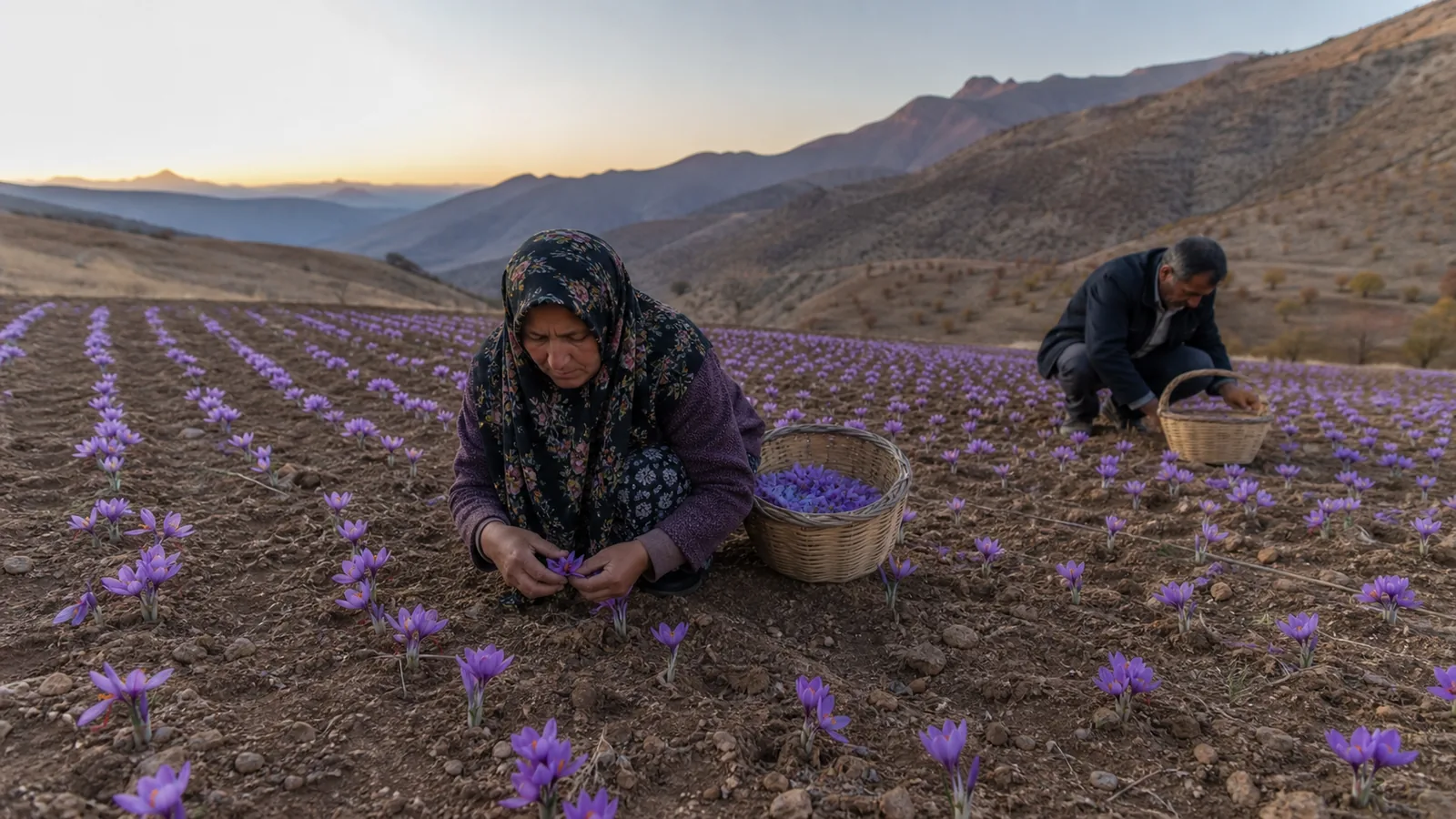
Saffron cultivation in Chahar Mahal and Bakhtiari has grown from a small diversification programme into an established provincial crop. An early agricultural report recorded 133 hectares under saffron, concentrated particularly in Ben County. By November 2025, provincial agriculture officials were reporting about 300 hectares, an average yield near five kilograms per hectare and expected annual production of roughly 1.5 tonnes.
The increase reflects a practical concern: farmers in a drought-affected province need crops that can create value without the summer irrigation demand of many conventional choices. Saffron can fit that role, but “low water use” should not be mistaken for “no water needed.” Its irrigation is seasonal and must be timed well, while the suitability and economics of each farm still depend on soil, climate, yield and access to workers.
How cultivation expanded in Chaharmahal and Bakhtiari
The earlier report came from the provincial Agricultural Jihad organization and quoted Hamid Reza Danesh, then an official responsible for crop-production improvement. He said saffron area had increased by 35 percent as part of a move away from more water-intensive crops. During that programme, 110 tonnes of saffron corms were distributed and 133 hectares of farmland were allocated to the crop, especially in Ben County.
Officials at the time gave an average yield of about four kilograms of dried saffron per hectare and forecast a provincial harvest of 450 kilograms. These are historical figures, not current production estimates. They are useful because they show the scale and purpose of the programme at that stage.
A 2025 report from Iran’s Agricultural News Agency provides a later checkpoint. Ebrahim Shirani, the provincial director of horticulture, put the planted area at approximately 300 hectares and the average harvest at around five kilograms per hectare. The same report said four processing and packaging units for medicinal plants and saffron were active in the province.
Why saffron appealed to local farms
Saffron grows through the cooler part of the year and becomes dormant in summer. That cycle can reduce summer irrigation pressure and make it a candidate for a water-conscious cropping plan. It also produces a high-value material from a relatively small area, which can suit the small, fragmented holdings common in rural Chaharmahal and Bakhtiari.
There is an important qualification. A scientific review of saffron water requirements describes the crop as drought-tolerant and water-productive, but also explains that satisfactory yields in dry regions depend on appropriate irrigation quantity and timing. Saffron is therefore a lower-water alternative in the right system, not a crop that succeeds through neglect.
Value also depends on what happens after flowering. Clean picking, quick stigma separation, controlled drying, grading and credible packaging all influence what a grower can sell. Expansion of planted area is only one part of a viable local industry.
What the reported yields do and do not mean
The move from the early reported average of four kilograms per hectare to about five kilograms in the 2025 provincial account is encouraging. It does not establish a yield guarantee. A new field may produce little in its establishment phase, and two farms in the same county can perform differently because of corm size, planting density, field age, irrigation, nutrition or disease.
Before judging the economics of a planting, a grower needs a farm-specific budget that includes:
- healthy, graded corms and the quantity required for the chosen spacing;
- soil preparation, testing and any necessary drainage work;
- irrigation at the correct stages rather than a simple annual water total;
- short-notice labour during the flowering period;
- clean separation, drying, storage and packaging; and
- the price and route to market for the grade actually produced.
A headline value per kilogram tells only part of the story. Establishment costs arrive before the field reaches mature production, and market returns vary with quality and sales channel.
Where saffron fits the province’s cropping pattern
Ben County was prominent in the first expansion report, but a provincial total does not make every parcel suitable. Saffron needs soil that drains freely around its corms, a climate compatible with autumn flowering and a management plan that avoids poorly timed water. Local frost exposure, slope, soil texture and previous crop history should all be checked before planting.
The original article also referred to “Zagros saffron” as though it were a cultivated variety and treated Chaharmahal and Bakhtiari as its primary habitat. Wild crocuses and cultivated saffron are not interchangeable. Commercial saffron is Crocus sativus; a local wild flower should not be used to identify corms, predict yield or market a crop without a verified botanical identification.
A measured view of continued growth
The rise from 133 reported hectares to around 300 hectares shows genuine adoption of saffron cultivation in Chahar Mahal and Bakhtiari. The strongest case for further growth is not simply that saffron is valuable. It is that selected local farms can combine appropriate land, carefully timed water, healthy corms, trained harvest labour and dependable processing.
For growers considering the crop, a small planned start is more informative than a province-wide promise. Compare the proposed field with successful nearby farms, seek local agricultural advice, document water use and yield, and expand only after the field has demonstrated that it can produce clean saffron at a sustainable cost.

![Exporting Saffron to Turkey + Price Guide [Complete 0 to 100]](https://img.rowhanisaffron.com/20260827003933/saffron-export-turkey-quality-inspection.webp)



