


Saffron flower processing technology can shorten the labour-intensive work between picking a crocus flower and drying its three red stigmas. A useful machine does not replace the entire harvest, however. Growers need to know whether equipment picks flowers, opens them, separates stigmas, dries saffron or grades the finished spice—and then test its results against careful manual work.
What happens after saffron flowers are picked
Fresh Crocus sativus flowers contain purple tepals, yellow stamens and the red stigmas that become saffron. Once flowers arrive from the field, workers open them and separate the stigmas from the other plant material. The stigmas are then dried under controlled conditions, cooled and protected from moisture and light.
These steps are time-sensitive because a large volume of delicate flowers arrives during a short flowering season. Crowded, warm or dirty holding conditions can damage material before separation begins. That is why processing capacity must be planned around the busiest harvest day, not an average day.
What a saffron processing machine actually does
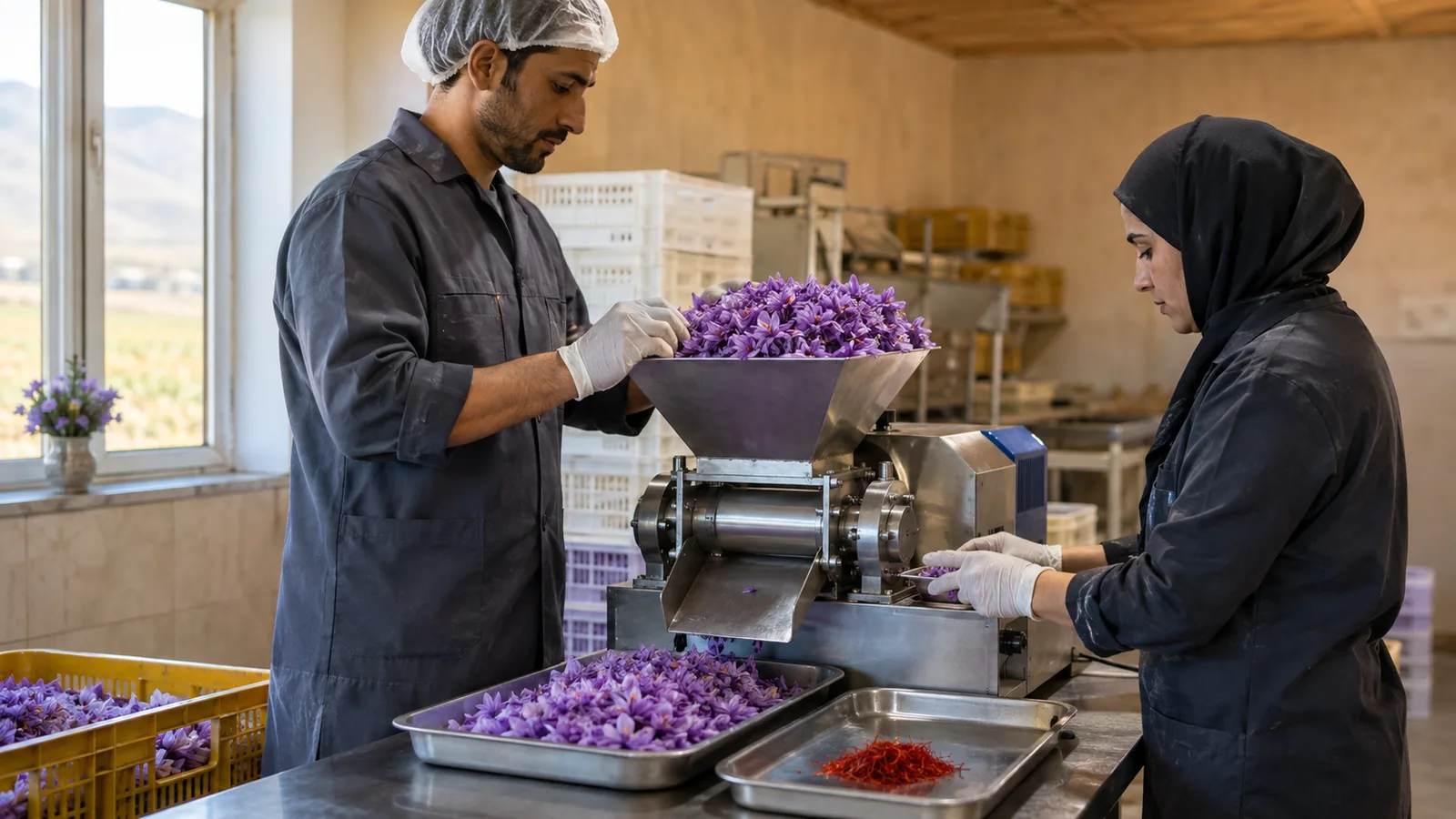
The machine described in the original article was intended to separate red saffron threads from the rest of the flower close to the farm. The stored report did not name its manufacturer, model, test protocol or commercial availability, so it cannot support claims that one particular device will eliminate losses or guarantee a higher grade.
In practice, “saffron processing machine” can refer to several pieces of equipment:
- a flower-opening or cutting unit;
- a separator that uses airflow, screens or movement to divide flower parts;
- a drying cabinet or controlled hot-air dryer;
- a cleaner that removes foreign material; or
- an optical system that sorts or grades dried threads.
A processing line may combine some of these operations. Buyers should ask exactly what enters the machine, what leaves each outlet and which steps still need trained operators.
A processing machine is not always a harvesting machine
A saffron harvesting machine works in the field and attempts to collect flowers. A post-harvest separator receives flowers that have already been picked. The distinction matters because field harvesting, stigma separation and drying create different engineering problems.
Search results and product descriptions sometimes use the terms interchangeably. Before comparing equipment, identify the operation first. Our separate review of a saffron harvesting machine explains the questions to ask about field picking and why a portable harvester should not be assumed to prepare sale-ready saffron.
What official field tests in Khorasan Razavi found
A useful example comes from a 2021 report by Iran’s Agricultural News Agency. The provincial horticulture director said a saffron flower-cleaning machine designed by Sharif University of Technology specialists was taken to Zaveh and tested with growers, mechanisation staff and researchers.
According to the dated field-test report, that unit handled 15 kilograms of flowers per hour with error below 6% during the reported trial. It said six operators could process 150 kilograms in ten hours, compared with 50 workers for the same amount by hand.
The report also described a second system in Torbat-e Jam with separate cutting and separating sections. Its cutting unit still had defects, while the separator reportedly handled seven kilograms per hour with error below 3% when workers cut the flowers first. These are test results from named conditions, not universal specifications. Flower condition, operator skill, feed rate and the definition of “error” all affect a fair comparison.
Why faster separation can protect value
The original article said flowers needed processing within two days. A fixed deadline is too blunt: safe holding time changes with temperature, ventilation, cleanliness, moisture and how densely flowers are piled. The sound principle is to keep the delay short and the flowers cool, clean and loosely handled while separation is organised.
A peer-reviewed review of saffron post-harvest processing confirms that flower collection and stigma separation require substantial labour. It also explains that separation is followed by drying, where time, temperature, airflow and humidity influence colour, aroma and other quality characteristics.
Equipment can help by matching separation capacity to the daily flower intake. That may reduce delays and avoid distressed sales of fresh flowers when a farm lacks enough labour. It does not automatically increase profit; the calculation also needs purchase and maintenance costs, staffing, energy, rejected material and the price actually received for the dried saffron.
Quality checks that matter during separation
Throughput is easy to advertise, but the output needs inspection. A grower comparing manual and machine separation should use flowers from the same field and harvest time, then record:
- kilograms of flowers processed per hour;
- number of trained operators required;
- intact red stigmas recovered;
- red threads left in the discarded flower material;
- yellow style, petal and stamen material mixed into the saffron;
- crushed, heated or contaminated material;
- cleaning time between lots; and
- downtime, adjustment and maintenance needs.
A machine that reports high speed but loses valuable stigmas or leaves excessive floral matter may cost more than it saves. The trial should weigh saleable dried output, not merely count the fresh flowers that entered the hopper.
Drying remains a separate quality decision
Removing stigmas quickly does not protect the crop if drying is uncontrolled. Fresh stigmas do not yet have the stable form, aroma and handling characteristics of the finished spice. Drying conditions change their chemistry, and the best settings depend on equipment design, layer depth, airflow, load and the intended specification.
Research comparing drying methods shows that temperature and exposure time interact; there is no responsible single setting for every dryer. Operators should validate a repeatable process, measure the final product and avoid treating a fast separator as proof of good drying.
Hygiene and lot control cannot be automated away
On-farm processing can reduce transport and waiting, but it also moves food-handling responsibility to the farm. Food-contact surfaces should be cleanable, materials should not shed or contaminate the crop, and operators need a routine for hand hygiene, foreign-material control and separation of damaged flowers.
Each lot should remain traceable to its field and harvest date. If flowers from several farms are combined before problems are noticed, neither the cause nor the affected material is easy to isolate. A processing line is most useful when it supports that discipline instead of creating one unrecorded bulk pile.
How to assess a saffron flower processing line
A sensible evaluation begins with a trial using the buyer’s own flowers. Ask the supplier to state capacity as a range, identify the required flower condition and operator count, and demonstrate cleaning, adjustment and safe shutdown. Inspect the discarded petals for lost stigmas and the recovered threads for unwanted yellow or floral material.
Then compare the complete cost per kilogram of acceptable dried saffron with the farm’s manual process. Include labour saved, extra operators, electricity, consumables, servicing, seasonal storage and the chance that parts will not be available during harvest. A machine that cannot be repaired during the flowering window may offer little practical protection.
Where innovative technology provides real value
Improving saffron processing with innovative technology is most valuable where flower volume exceeds the available skilled labour and where equipment can be cleaned, maintained and measured properly. Portable separation can help rural growers retain more processing work locally, but only if the output meets the buyer’s quality requirements.
The goal is not machinery for its own sake. It is a reliable path from freshly picked flower to clean, correctly dried, traceable saffron. The strongest system combines appropriate equipment with trained people, documented trials and quality checks at every hand-off.

![Exporting Saffron to Turkey + Price Guide [Complete 0 to 100]](https://img.rowhanisaffron.com/20260827003933/saffron-export-turkey-quality-inspection.webp)



