


This 2013 interview with the president of the Khorasan Razavi saffron sellers’ union was about quality control, labour and export readiness. Its translated headline sounds like advice to travellers, but the intended message was different: the union said packaged saffron handled by its member exporters should not leave the country without being checked.
The original report also called for better stigma-separation equipment. It argued that careful mechanisation could ease a labour bottleneck while protecting the quality of a spice still processed largely by hand. The interview remains a useful picture of the industry at that time, although its acreage and price lines contain translation problems and must not be treated as current statistics.
What the Khorasan Razavi union president said
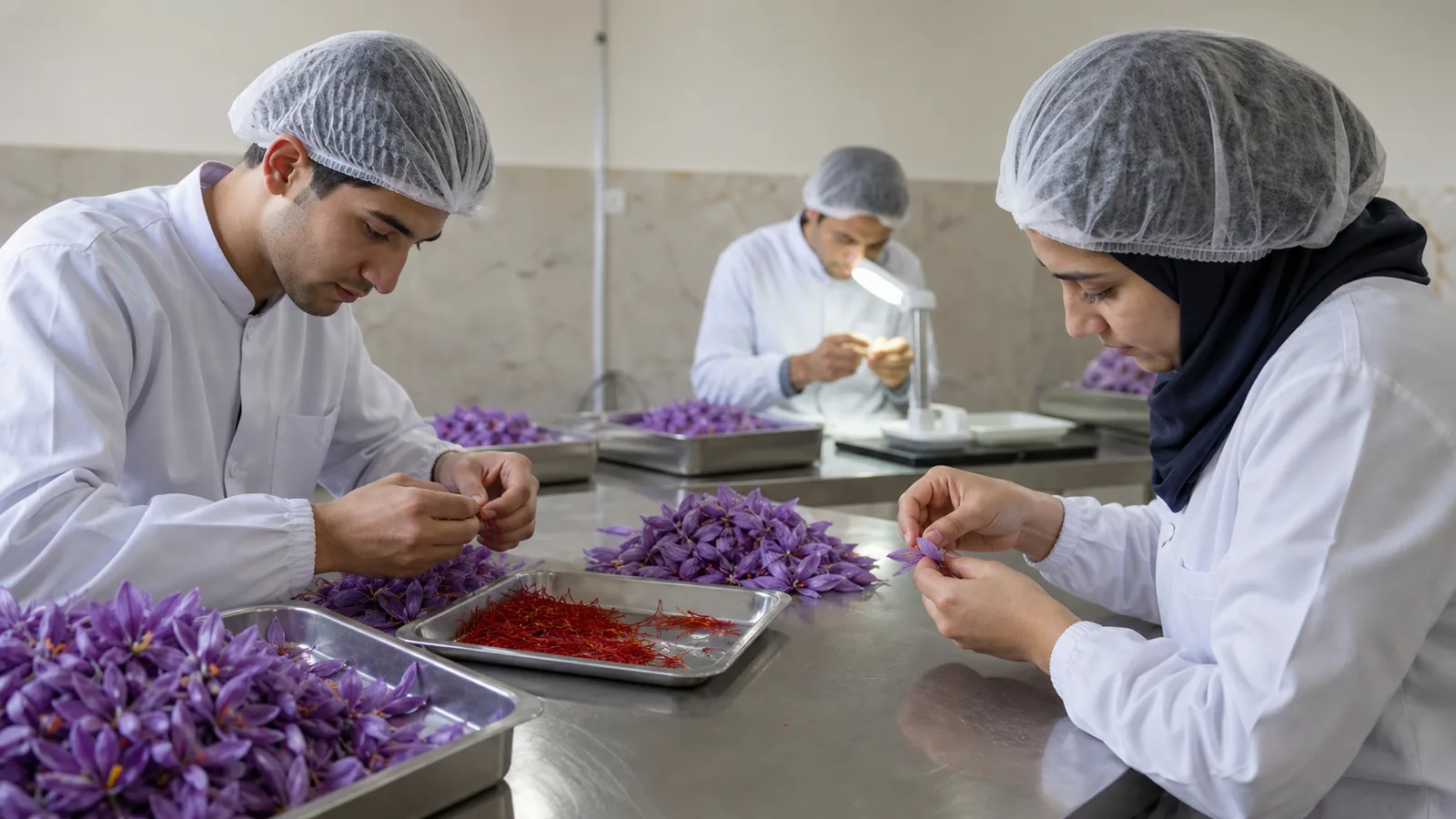
The speaker is identified in the translated report as Miri, president of the Khorasan Razavi saffron sellers’ union. He described a large production base, an annual harvest of about 250 tonnes of dried saffron and a separation process dependent on human labour.
The acreage line is not reliable as printed. It says “830 hectares” beside the 250-tonne figure, a combination that is not agronomically credible and probably lost one or more zeros during translation or transcription. Without the original Persian report, we will not silently replace it with a guessed number.
Miri’s broader point is clear. Removing stigmas from large numbers of flowers placed pressure on producers during the short harvest period. He wanted the agricultural authorities to support a coordinated programme for production, mechanised separation and better export quality.
Why saffron stigma separation is difficult
Each Crocus sativus flower carries three red stigmas. Flowers are picked during a brief autumn harvest, then opened so the stigmas can be separated before drying. Delay, rough handling, excess moisture or contamination can reduce the value of a batch.
Hand separation gives experienced workers direct control, but it requires many people at the same time. A machine can help only if it separates the useful red material consistently without crushing it, mixing in too much yellow style, introducing foreign matter or slowing the next drying step.
Mechanisation is therefore not automatically a quality improvement. Equipment needs a clearly defined output, food-contact-safe materials, effective cleaning between lots and a comparison with properly handled manual work. The useful question is not simply whether a machine is faster, but whether the resulting saffron still meets the buyer’s specification.
What “no saffron leaves without quality control” meant
The union said it worked with the exporters’ association and relevant authorities on saffron quality. The report referred to hygiene brochures, sanitary supplies and plastic bags being distributed to producers, and said a quality-control unit covered about 40 union members.
It also claimed that packaged saffron supplied by member export firms passed through their quality-control process before reaching domestic or foreign markets. That is an industry statement about participating businesses. It should not be expanded into a guarantee that every parcel crossing every Iranian border in 2013 was tested, or that the same arrangement operates today.
The value of the statement lies in the principle: export quality is built across harvest, separation, drying, sorting, storage, testing and packaging. A final laboratory result cannot repair saffron that was mishandled earlier.
What modern saffron quality control should cover
The current ISO 3632-1:2025 specification sets requirements for dried saffron from Crocus sativus pistils. It applies to filaments, cut filaments and powder. A commercial specification should name the relevant edition and test method rather than merely say “ISO quality.”
Depending on the product, destination and contract, a practical control plan can include:
- confirmation that the material is true saffron and the stated form or grade is accurate;
- visual checks for excess yellow style, foreign matter, damaged material and inconsistent colour;
- moisture and drying control so the batch remains stable in storage;
- appropriate measurement of the characteristics associated with colour, taste and aroma;
- food-safety testing required by the destination market or buyer;
- clean, food-contact-suitable packaging that protects against moisture, light and contamination;
- batch identification, supplier and harvest records, test results and a traceable packing date; and
- a retained sample and a documented process for handling a complaint or non-conforming lot.
The FAO/WHO Codex Alimentarius codes of practice include CXC 42-1995 for spices and dried aromatic herbs. Its hygiene framework is relevant to cleaning, processing, packing, storage and transport. ISO product specifications and food-hygiene controls complement one another; neither is a substitute for the destination country’s law.
Our guide to identifying pure saffron explains why appearance alone is not enough when authenticity matters.
Why Pushal, Negin and Dasteh were priced differently
The closing paragraph of the old report compared three common commercial forms. Dasteh, sometimes called bunch saffron, keeps more of the style attached and bundles the strands. Pushal retains some yellow or pale style. Negin is selected for longer, predominantly red stigmas with less attached style. Their appearance, labour requirements and usable red content differ, so they do not command the same price.
The translation records amounts resembling “2 million 630” for Dasteh, “3 million 350” for Pushal and “3 million 600” for Negin, but it also inserts the word “dollars” where the scale and context indicate a damaged currency translation. We cannot determine from this copy whether the original figures were rials, tomans or another quoted unit. They are preserved as historical fragments, not converted into a modern price.
For the physical differences between these forms, see our overview of the types of saffron.
A sensible export-quality workflow
A buyer or exporter should agree on the specification before packing, not after a dispute. The sequence normally needs to be explicit:
- identify the saffron form, intended market and contract requirements;
- record the supplier, harvest lot and initial condition;
- separate, dry and sort under controlled hygienic conditions;
- sample the lot using a method appropriate to its size and form;
- test against the named specification and destination requirements;
- release only the accepted lot for packing;
- use packaging suited to the shipment length and sales channel; and
- keep the certificate, batch record and retained sample connected to the final units.
A machine may assist several stages, but responsibility does not move to the machine. The producer and exporter still need validated settings, cleaning records, trained staff and a way to isolate material when something goes wrong.
Reading the 2013 report today
The interview captured a real industry concern: Iranian saffron could not rely on production volume alone. Export value also depended on consistent separation, hygienic handling, defensible grades and trustworthy testing. The union’s proposed mechanisation was meant to support those goals, not replace skilled judgement.
Its numbers now need context. The 250-tonne output estimate, the corrupted acreage line, the 40-member quality unit and the three old price fragments describe the report published on 19 October 2013. None should be read as a current Khorasan Razavi production total, membership count or farm-gate price.
Source and review note
We reviewed this article on 28 August 2026. The historical account and quotations come from the original translated union report preserved on this page. Current quality context uses the official ISO 3632-1:2025 page and the FAO/WHO Codex codes-of-practice collection linked above. Where the translation does not support a reliable acreage, currency or legal conclusion, the uncertainty is stated rather than filled with an invented correction.

![Exporting Saffron to Turkey + Price Guide [Complete 0 to 100]](https://img.rowhanisaffron.com/20260827003933/saffron-export-turkey-quality-inspection.webp)



