


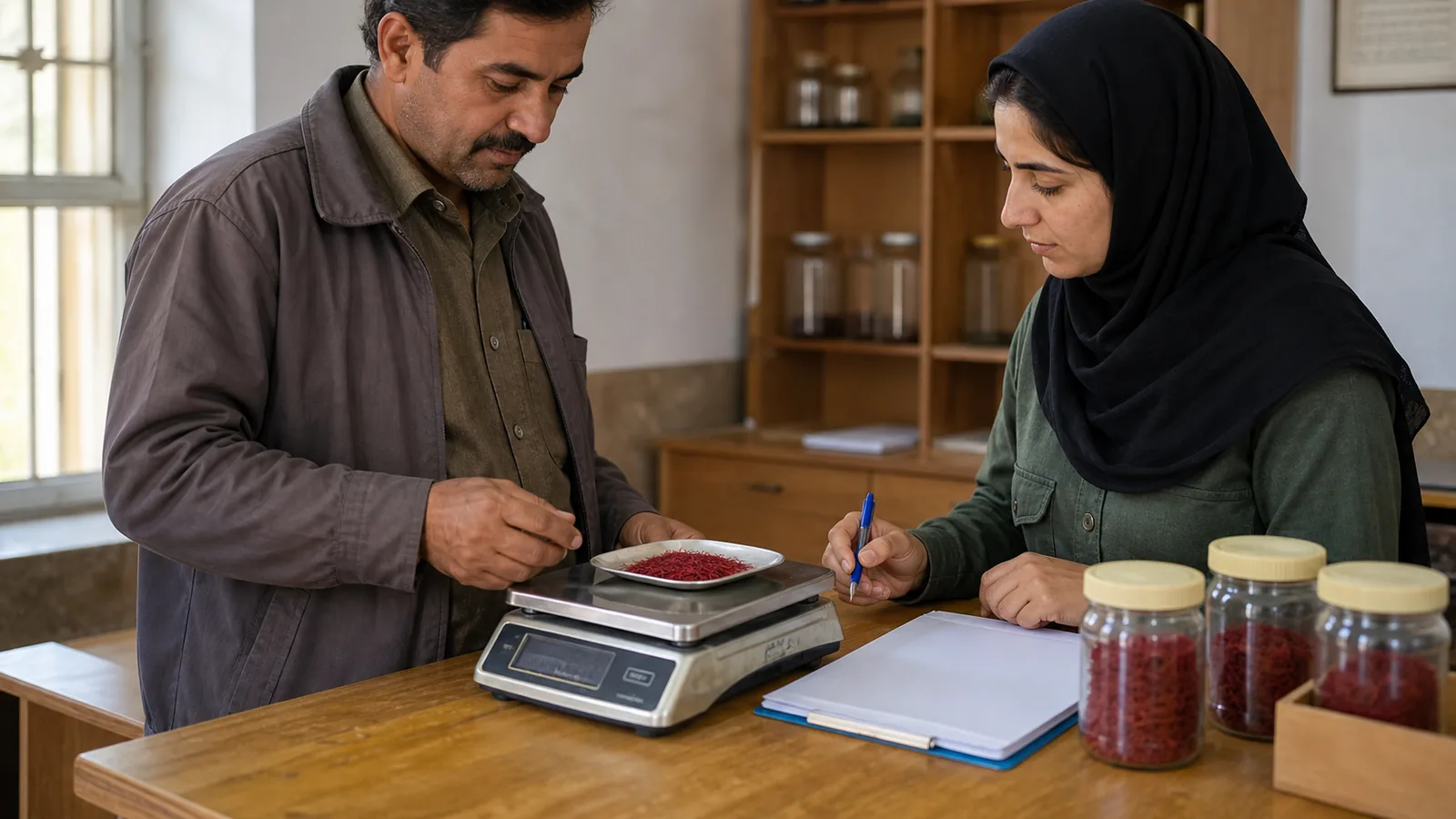
The “safe shopping guarantee” in this 2013 report referred to a proposed saffron purchasing fund for farmers, not a blanket guarantee offered to online shoppers. Mahmoud Salami argued that a locally organised fund could shorten the chain between growers and dealers, reduce pressure to sell at the wrong moment and support more transparent marketing.
The original translation is rough, but its central concern is still recognisable: when farmers need cash during harvest and a small number of intermediaries control immediate buying, the price paid at the farm can move very differently from the later wholesale price. A fund or producer organisation may help, provided that its buying rules, grades, finance and governance are clear.
What Mahmoud Salami proposed in 2013
Speaking to the Iranian Students News Agency in Khorasan, Salami described a working or operating fund as one of the basic needs of saffron farmers. The report said a fund was being set up for the Torbat, Khaf and Rashtkhar area so that the number of dealers between producers and the market could be reduced.
The place names are damaged in translation. The production passage appears to refer to Torbat, Zaveh, Mahvelat, Khaf and Rashtkhar, and puts their combined annual saffron output at roughly 80 tonnes. We retain that as the report’s historical estimate rather than a current regional total.
Salami also connected saffron with non-oil exports and the wider regional economy. He called for a comprehensive research centre serving Khaf and Rashtkhar, with work spanning production, processing, economics and marketing instead of treating those subjects as separate problems.
Why farmers can be vulnerable at harvest
Saffron flowers arrive within a short season. Growers suddenly need labour for picking and stigma separation, space for drying, suitable containers and cash to pay immediate costs. The dried spice stores better than the flower, but only after it has been handled correctly.
A farmer who cannot finance those few critical weeks may have little choice but to accept the price available that day. A dealer with storage and working capital can wait for a different market. That difference in timing does not make every intermediary harmful; traders also aggregate lots, find buyers and carry risk. It does explain why access to finance and transparent purchasing terms matters.
What a saffron purchasing fund can do
A properly designed fund or cooperative purchasing system can give growers another route to market. Its practical functions may include:
- publishing the grades it will buy and the method used to determine each grade;
- posting an offer price or a clear pricing formula before delivery;
- weighing and sampling each lot consistently;
- paying within a stated period rather than leaving farmers uncertain;
- pooling suitable lots for larger commercial orders;
- arranging controlled storage and retaining traceability records; and
- selling when a real buyer is available rather than relying on an unsupported price promise.
The FAO publication “Agricultural cooperatives: paving the way for food security and rural development” describes how cooperatives can improve producers’ access to markets, information, inputs and bargaining power. That is a general model, not proof that the fund proposed in this interview was launched or succeeded.
What a fund cannot safely guarantee
No organisation can remove market risk by changing its name. A fund that promises a price needs enough capital, storage, quality control, buyers and authority to honour that promise. If the rules are hidden, grading is inconsistent or payment is delayed, the organisation can reproduce the same imbalance it was meant to solve.
The old article says brokers bought at selected times and later sold at higher prices. It does not provide transaction records that would let us measure the margin or decide whether it was excessive. The safe conclusion is that Salami wanted a shorter and more transparent channel, not that every private dealer behaved improperly.
Quality has to be part of any purchase guarantee
A guaranteed price without a product specification creates another dispute: which saffron qualifies? Whole red stigmas, Pushal with some style attached, broken material and powder do not have identical characteristics or values.
The current ISO 3632-1:2025 specification covers requirements for dried saffron in filament, cut-filament and powder forms. A fund or buyer should name the standard and edition it uses, explain any additional contract tests, and make the sampling process visible to the seller.
Useful intake records include the farmer or supplier, harvest area, lot number, gross and net weight, product form, sampling date, test result, accepted grade, deductions and final payable amount. Those records protect both sides when a later buyer questions the lot.
Safe saffron shopping for a commercial buyer
A modern buyer needs more than the word “guaranteed” on a website. Before paying for a sample or shipment, check:
- the legal name and contact details of the seller;
- the exact saffron form, grade, origin and harvest or packing information;
- whether the offer is for a sample, retail pack or wholesale lot;
- the net weight, unit price, currency, Incoterm and included costs;
- the laboratory report and whether it belongs to the same batch;
- the packaging, shelf-life and storage requirements;
- the payment route, shipping method and import responsibilities; and
- what happens if the delivered lot does not match the agreed specification.
A useful first step is our guide to identifying pure saffron and checking documentation. For wholesale orders, a representative sample and written specification are more meaningful than an absolute quality slogan.
Why price comparisons often fail
Saffron prices can refer to farm-gate material, a trader’s bulk lot, an export-ready package or a retail jar. Grade, red-stigma content, moisture, test results, package size, currency and delivery terms all affect the number. Two offers that look far apart may not cover the same product or stage of the supply chain.
The 80-tonne regional figure in the 2013 interview does not establish the quantity available to one buyer. Production can be spread among growers and grades, consumed domestically, stored, sold through different channels or committed under earlier contracts.
Why the proposed research centre mattered
Salami’s call for a saffron research centre joined four questions that belong together. Production research affects yield and harvesting. Processing affects stability and grade. Economics affects whether growers can finance the season. Marketing affects which specifications buyers will pay for.
A centre cannot set a fair price by research alone, but it can make decisions less dependent on rumour. Comparable field records, processing trials, transparent grades and documented market requirements give farmers, funds and exporters a shared basis for negotiation.
Reading the old “safe shopping” headline correctly
The report was advocating a safer purchasing structure for saffron producers in parts of Khorasan. It was not announcing that every purchase was insured, that prices would stay stable, or that a named consumer guarantee remains open today.
Its useful lesson is narrower and stronger: a trustworthy saffron market needs finance, published buying terms, consistent grading, traceable lots and buyers who understand what the quoted price includes.
Source and review note
This article preserves the Mahmoud Salami interview first published here on 22 October 2013. We reviewed it on 28 August 2026. Historical place names, the 80-tonne estimate and the proposed fund and research centre are presented as claims from that report. Current context comes from the official FAO cooperative publication and ISO specification linked above; we found no evidence in the source material that supports presenting the proposed fund as a current programme.

![Exporting Saffron to Turkey + Price Guide [Complete 0 to 100]](https://img.rowhanisaffron.com/20260827003933/saffron-export-turkey-quality-inspection.webp)



