Saffron will not soon replace medicines. It contains compounds worth studying, and clinical trials have reported possible benefits for a few specific outcomes. That is very different from proving that a spice or supplement can replace a tested drug for depression, heart disease, cancer, Alzheimer’s disease or another condition.
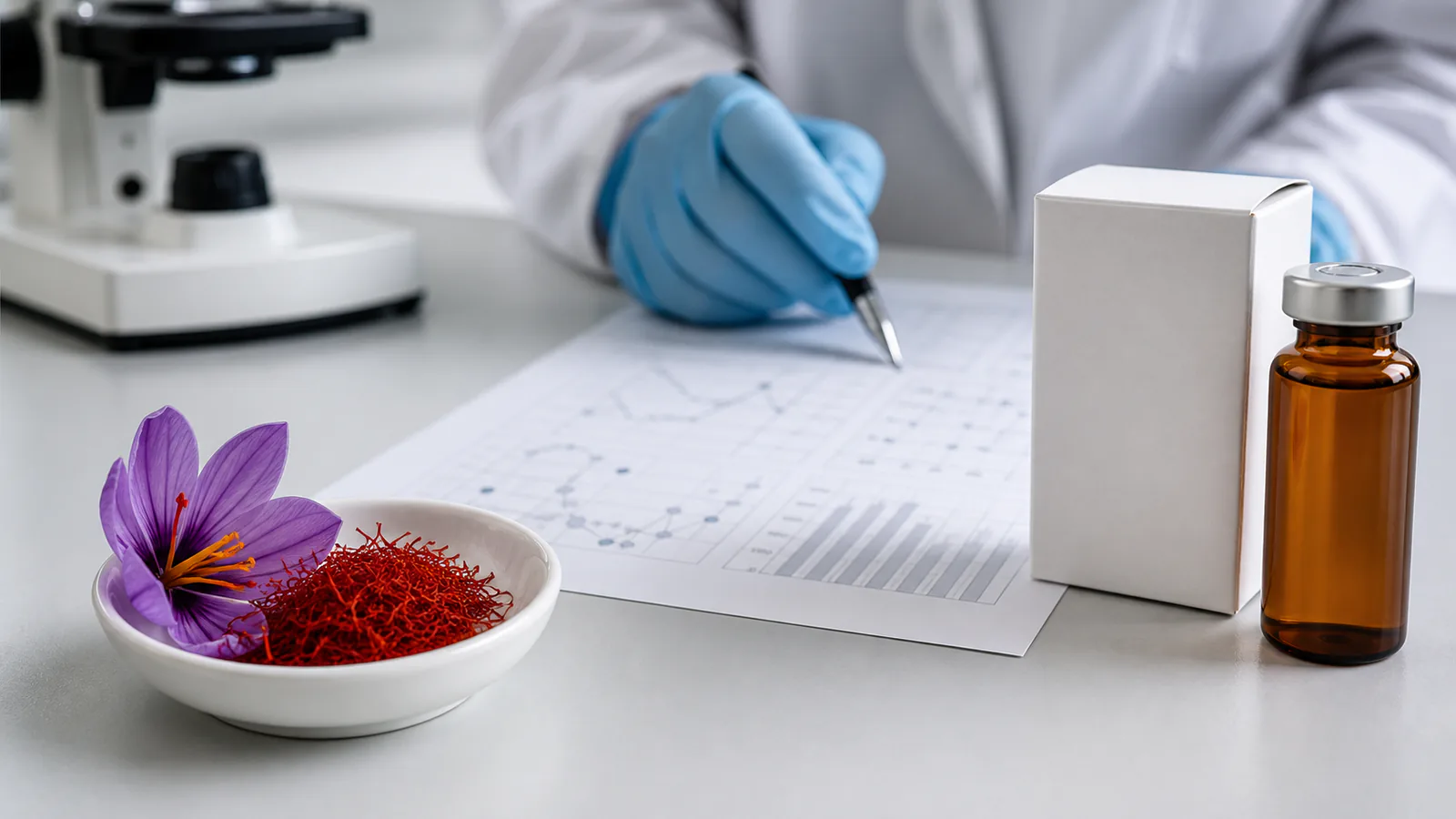
The original claim on this page treated “natural” and “chemical” as opposites. In reality, saffron is made of chemicals too: crocin, crocetin, picrocrocin and safranal are among its naturally occurring constituents. The useful comparison is not natural versus chemical. It is reliable evidence, known composition, appropriate use and a benefit that outweighs the risk.
Why plants can inspire medicines
Plants make a vast range of biologically active molecules. Researchers can isolate one, study how it behaves, modify it, or use it as a starting point for a medicine. The final product may have a precisely controlled composition and a carefully tested use.
That history does not mean every medicinal plant is already a medicine. A whole spice contains many compounds whose amounts vary with variety, harvest, drying and storage. A tea, culinary dish, extract and purified constituent can expose the body to very different amounts.
What saffron research has actually found
Saffron has been investigated in clinical trials involving mood, sleep, cognition, sexual function and metabolic measures. Cell and animal studies have explored many more conditions, including cancer and neurodegenerative disease.
A meta-research review of 19 saffron meta-analyses found signals across several clinical outcomes, but it also identified weaknesses in the quality and reporting of the reviews. The authors called for larger, high-quality randomised trials in multiple countries.
A 2026 review of 34 randomised trials in mood disorders illustrates why the detail matters. It found improvements on some self-reported depression and anxiety scales, but not on several clinician-rated scales, with substantial variation between studies. That is evidence to refine and test—not a reason to stop an effective antidepressant.
A research signal is not a replacement claim
Before a treatment can replace an established medicine, researchers need to answer much more than “did one score improve?” They need to know:
- which preparation and amount produce a reproducible effect;
- whether the effect is clinically meaningful, not merely statistically detectable;
- how it compares directly with current treatment;
- which patients benefit and which are at risk;
- what happens with long-term use and other medicines;
- how every manufactured batch will maintain identity, strength and purity.
A small short-term trial may be an important step. It is not the end of that process.
How a promising compound becomes a drug
The US Food and Drug Administration describes a sequence that begins with discovery, moves through laboratory and animal studies, then proceeds to human clinical research, regulatory review and post-market safety monitoring.
Preclinical work answers basic questions and determines whether human testing may be reasonable. Clinical trials then examine safety, dosage, effectiveness and uncommon adverse effects in progressively larger groups. Regulators also review manufacturing, stability, impurities and labelling.
A saffron constituent could one day contribute to an approved product for a defined use. If that happens, the claim will belong to that tested formulation, amount and indication—not automatically to every pinch of spice or bottle of extract.
Why “chemical-free” is misleading
Water, oxygen, crocin and every component of food are chemicals. “Chemical” does not mean artificial or dangerous, just as “natural” does not mean safe or effective. Safety depends on the substance, exposure and person.
This language can also hide a serious comparison. A prescribed medicine usually has a known active ingredient, controlled strength, studied interactions and a defined indication. A supplement may have different regulatory requirements and less evidence for the disease claim attached to it.
What saffron can reasonably be today
Saffron is first a valued culinary ingredient. It can also be a standardised research material and a source of compounds for pharmacological investigation. Under clinical supervision, a defined supplement may be studied as an adjunct for a specific condition.
“Adjunct” means used alongside established care, not instead of it. Even then, the evidence must match the product and patient. A trial in adults with mild symptoms cannot establish safety in pregnancy, childhood, severe illness or complex treatment.
Do not replace prescribed treatment yourself
Stopping a medicine suddenly can cause relapse, withdrawal effects or loss of disease control. This is especially important with medicines for mood disorders, seizures, blood pressure, blood clotting and chronic respiratory disease.
Tell your clinician or pharmacist about saffron capsules, extracts and other supplements. They can consider possible overlapping effects, interactions, surgery and the reason you want to use the product. A seller’s health claim is not a substitute for that review.
How to evaluate the next saffron headline
- Identify whether the evidence came from cells, animals or people.
- Check the exact saffron preparation and outcome.
- Look for an appropriate control and enough participants.
- Ask whether the change mattered clinically.
- Check adverse effects, interactions and study duration.
- See whether an independent team reproduced the result.
Saffron research can be promising without being oversold. Its most credible future lies in careful experiments and defined products—not in the prediction that saffron will replace medicines wholesale.