Saffron and liver cancer are being studied together, but the evidence does not show that eating saffron prevents liver cancer or that a saffron supplement treats it. The most direct published studies have used human cancer cells and rats with chemically induced liver tumours. Those experiments can identify biological signals worth investigating; they cannot establish a benefit for a person with cancer.
This distinction corrects the claim previously made on this page. Anyone with liver cancer should follow an oncology team’s treatment plan and discuss every supplement with that team. Saffron must not replace screening, surgery, ablation, immunotherapy, targeted treatment or any other care selected for the individual patient.
What the liver-cancer studies actually tested
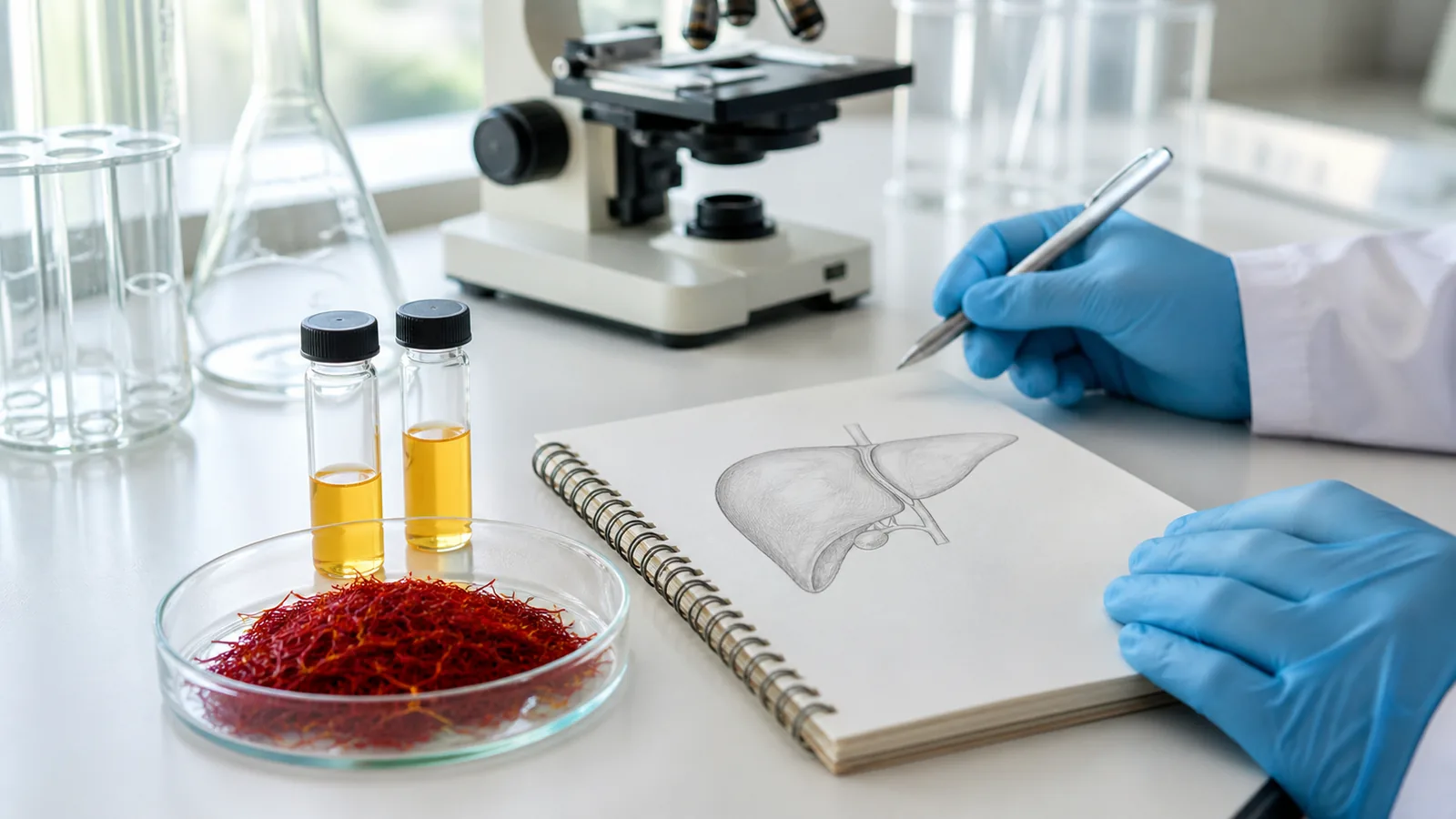
A widely cited 2011 study investigated saffron in rats given diethylnitrosamine, a chemical used to create an experimental model of liver cancer. The rats received 75, 150 or 300 milligrams of saffron per kilogram of body weight each day, beginning before exposure to the chemical and continuing for 22 weeks. Researchers reported fewer early liver lesions and changes in markers related to oxidative stress, inflammation, cell proliferation and apoptosis. They also ran experiments in HepG2 liver-cancer cells. The full design is described in the peer-reviewed study record on PubMed.
Those doses, that induced-cancer model and the timing of treatment are not equivalent to using saffron as a culinary spice. Because treatment began before the carcinogen, the experiment also does not show that saffron can treat an established human tumour.
A later study isolated crocin, one of saffron’s carotenoid compounds. It again combined a chemically induced rat model with HepG2 cell experiments. The researchers observed effects on inflammation, the cell cycle and programmed cell death, and described crocin as a candidate for further research. This crocin liver-cancer study was still preclinical: no patient outcomes were measured.
Has saffron been tested in people with liver cancer?
A small human study has been registered, but the public record does not provide results. The ClinicalTrials.gov record NCT06464380, last updated in September 2024, listed a planned single-blind trial of safranal versus placebo in 40 people with hepatocellular carcinoma and showed the study as not yet recruiting. A registration explains what researchers intend to test. It is not evidence that an intervention works, and a trial with no posted results cannot support a prevention or treatment claim.
Why cell and animal mechanisms are not clinical proof
The source articles named several possible mechanisms: antioxidant activity, changes in superoxide dismutase, lower inflammatory signalling, interference with cancer-cell growth and an interaction with topoisomerase II. These are laboratory hypotheses and observations, not a list of health effects a consumer can expect.
“Antioxidant” is especially easy to overinterpret. Oxidative stress is part of many disease pathways, but changing an antioxidant marker does not automatically prevent a cancer, heart attack or stroke. Cancer treatments may themselves depend on particular cellular pathways, which is one reason patients should not add concentrated botanical products without clinical advice.
The original text also grouped crocin, crocetin and safranal together as if they were chemically interchangeable. They are different saffron constituents, and studies may use a whole extract, purified compound or branded supplement at different concentrations. A result for one preparation cannot simply be transferred to another.
What research says about liver protection
Experiments have explored saffron or crocin in other models of liver injury. For example, researchers reported changes in liver enzymes and tissue appearance in rats fed a high-fat diet, while another rat study examined liver damage after radiation. These projects can help scientists select mechanisms and future trials. They do not show that culinary saffron prevents fatty liver disease, radiation injury or liver cancer in people.
The safe conclusion is that saffron’s compounds have produced interesting antioxidant and anti-inflammatory findings under controlled laboratory conditions. Human studies would still need to establish an appropriate preparation and dose, identify interactions, compare it with usual care and measure outcomes that matter to patients.
The wider research picture: mood and anxiety
One of the source articles quoted Mehdi Ebrahimi of the Medicinal Herbs Research Center at South Khorasan University Jihad. He discussed saffron extract in relation to anxiety, depression, cardiovascular protection and liver protection, while also calling for more toxicology work. Clinical research has since developed further in some of those areas, but it remains important to separate symptoms measured in trials from claims of treating a disease.
A 2026 systematic review and meta-analysis of 34 randomised trials, involving 1,769 adults, found reductions in self-reported Beck Depression Inventory and Beck Anxiety Inventory scores. It did not find significant effects on the clinician-rated Hamilton depression or anxiety scales or on the Profile of Mood States. The authors rated the certainty as moderate and noted substantial differences among studies.
That finding is more informative than saying saffron simply “relaxes” a person, but it still does not make a retail spice a substitute for mental-health care. Trials used defined interventions for at least four weeks, whereas culinary use varies widely. Someone with persistent anxiety, low mood, thoughts of self-harm or a medication question needs professional help, not an instruction to self-treat with saffron.
Cardiovascular and lipid claims need the same restraint
The source material proposed that crocin could inhibit platelet aggregation, slow arterial smooth-muscle growth and inhibit pancreatic lipase, thereby improving cholesterol and triglycerides. Much of that mechanistic discussion came from non-human research. Human trial reviews offer a more measured picture.
A 2022 meta-analysis of 32 randomised studies reported small average changes in several risk markers, including triglycerides, total and LDL cholesterol, fasting glucose and systolic blood pressure. A 2025 review of 25 trials in people with metabolic conditions found small changes in glucose, total cholesterol and blood pressure but no significant change in triglycerides, LDL, HDL, body-mass index or waist circumference.
Different inclusion criteria and populations can produce different pooled results. Neither review shows that saffron prevents heart attacks, strokes or cardiovascular death. Changes in laboratory risk markers should not be presented as proven disease prevention, and saffron should not replace prescribed blood-pressure, cholesterol or diabetes treatment.
Claims about the brain and inflammation
The inherited article also said crocin reduced brain swelling and protected the blood-brain barrier after cerebral ischaemia. Those findings came from animal models, not treatment trials in people who had suffered a stroke. They may guide research into neuroprotection, but they do not justify taking saffron during a stroke emergency. Sudden facial droop, arm weakness or speech difficulty requires emergency medical care.
Inflammatory enzymes and cytokines appear throughout preclinical saffron research. Measuring a change in one of these markers helps explore a mechanism; it does not prove a general “anti-inflammatory” treatment effect in every condition. The disease, preparation, dose and clinical endpoint all matter.
Safety: spice use and concentrated supplements are different
The amount of saffron used to flavour food is not the same as a capsule or purified crocin or safranal. Supplements can vary in composition, and the dose used in one trial should not be copied into another setting. A recent systematic review of human safety reports found that adverse events were reported in many trials, although reporting quality and preparations varied. Across clinical evidence reviews, complaints such as nausea, dry mouth, reduced appetite and headache have been described.
Pregnant or breastfeeding people, children, people preparing for surgery, and anyone taking prescription medicine should ask an appropriate clinician before using concentrated saffron products. The same applies to people with cancer, liver disease, mood disorders, blood-pressure problems, diabetes or bleeding concerns. Product purity is another issue: an extract used in research is not automatically equivalent to an unverified supplement bought online.
How to read a saffron health claim
Before acting on a headline, ask four questions:
- Was the research in people? A cell line or rat model cannot establish a human treatment.
- What was tested? Whole saffron, an extract, crocin and safranal are not the same intervention.
- What outcome changed? A biomarker is not automatically a reduction in symptoms, cancer recurrence or death.
- Was the study completed and published? A registered plan without posted results is not positive evidence.
Our broader guide to saffron’s health research applies this evidence ladder across more topics. For liver cancer specifically, the honest position is clear: crocin and saffron have generated preclinical findings that justify further research, but there is not yet clinical evidence that saffron prevents or treats the disease. It remains a valued culinary spice, not an established cancer therapy.