


Saffron cultivation in Gonabad is more than a valuable harvest in an arid corner of Razavi Khorasan. It is part of a farming system built around qanats, local knowledge and the careful use of scarce water. That combination earned international recognition and still shapes the work of families who pick, separate and dry the crop each autumn.
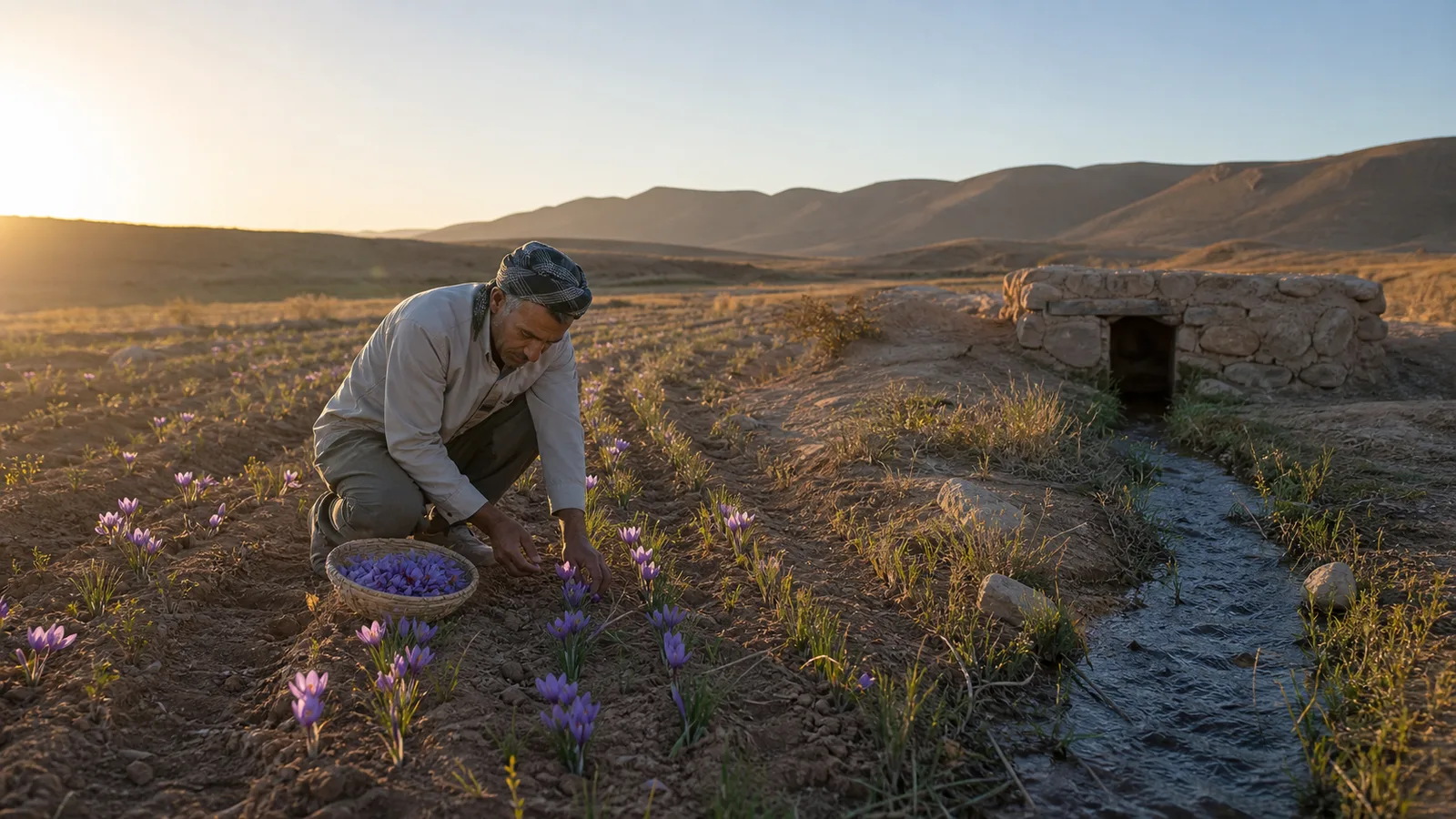
The spice is often called “red gold,” but the nickname can hide the harder story. Gonabad’s saffron depends on functioning water infrastructure, skilled seasonal labour, healthy corms, sound drying and a market that rewards quality. Its future cannot be measured by price alone.
Why Gonabad is closely associated with saffron
Gonabad lies on Iran’s central plateau, where the climate is arid to semi-arid and surface water is limited. Saffron suits this setting better than many thirsty field crops because its irrigation schedule and growing cycle can work with relatively modest water supplies. It is not water-free, however, and poor timing or prolonged drought can still reduce flowering and yield.
Knowledge passes through families: selecting and lifting corms, preparing the soil, deciding when to irrigate, gathering flowers before they deteriorate and drying the separated stigmas without losing their character. These linked decisions explain why origin is not simply a name on a package.
The qanat-based saffron farming system
A qanat carries groundwater through a gently sloping underground channel, using gravity rather than a pump along most of its route. Vertical shafts provide access during construction and maintenance. In a dry landscape, this shared infrastructure has supported settlements and farming over long periods.
For saffron growers, the system connects water management with community rules and inherited practical knowledge. Maintenance matters: blocked passages, declining groundwater or damaged channels affect everyone downstream. Efficient use at field level cannot compensate indefinitely for a neglected source.
The Food and Agriculture Organization of the United Nations designated the Qanat-based Saffron Farming System in Gonabad as a Globally Important Agricultural Heritage System in 2018. FAO highlights its role in livelihoods, food security, biodiversity, traditional knowledge and the cultural landscape. This is a recognition of a living system, not merely an award for producing a famous spice.
From flower to dried saffron
Harvest is concentrated into a short season. Flowers are commonly collected early so they reach the separation area in good condition. The red stigmas must then be removed carefully and dried under controlled, hygienic conditions. Delays, excess heat or moisture can affect aroma, appearance and storage stability.
Several commercial forms can come from the same flower depending on how much style remains and how the stigmas are separated. A buyer comparing Gonabad saffron still needs a clear grade, batch identity and test information; geography alone does not make every lot identical.
How saffron supports local livelihoods
The crop creates work across cultivation, harvest, separation, drying, grading, packaging and trade. Much of the most time-sensitive work happens within households and local labour networks. Women have an important role throughout the harvest and processing period, a point also noted in FAO’s description of the heritage system.
Saffron’s high value per unit of weight makes it suited to a region where land and water are constrained. Income is not guaranteed. A household’s result depends on yield, quality, labour costs, the price offered at sale and whether it can store the crop safely rather than sell under immediate pressure.
Water scarcity and climate pressure
The old article reported a severe production decline during a particular drought year. Without a clearly dated official dataset, that percentage should not be treated as the current condition. The underlying risk is real: hotter conditions, irregular precipitation and pressure on groundwater can weaken a saffron system even when the crop uses less water than alternatives.
Adaptation starts with monitoring, not slogans. Farmers need to know the condition of the qanat, soil moisture, corm health and the timing of irrigation. Field levelling, appropriate organic matter, careful bed preparation and locally suitable irrigation improvements may reduce waste. Any new method has to respect water rights and the shared structure of the qanat system.
Protecting the heritage does not mean freezing every practice. It means keeping the knowledge and community relationships that make the landscape resilient while testing improvements against local evidence.
Quality, packaging and market access
Weak packaging was identified in the original local account as a barrier to capturing more value. Packaging can protect dried saffron from moisture, light, contamination and handling damage, but it must be paired with traceability. A polished box cannot substitute for a trustworthy lot code, net weight and quality report.
Local grading and testing services can help growers compare offers on a clearer basis. Cooperatives or responsible aggregators may reduce the fixed cost of testing and export preparation for small lots. Transparent fees and records are essential so that aggregation does not erase the grower’s identity or bargaining position.
International buyers also need consistent documentation, lawful payment and dependable delivery. For an overview of how organised trading can affect small producers, see saffron market development and commodity-exchange access.
Tourism and the cultural landscape
Flowering fields, qanat engineering and harvest knowledge give Gonabad potential for carefully managed agricultural tourism. Visits can create income beyond the crop and help explain why genuine saffron requires so much work. They must not interfere with harvest, damage fields or turn private community practices into a performance for visitors.
FAO’s heritage designation includes biodiversity and landscape values alongside production. Fruit trees, other crops and wildlife around the farming system are part of that broader setting. Preserving them makes the story of Gonabad more complete than a single export statistic.
A practical future for Gonabad saffron
Long-term support should begin with qanat maintenance, responsible groundwater management and services farmers can actually reach. Training in drying, storage and lot documentation can protect quality after the flower leaves the field. Market information and fair access to testing can improve decisions without promising a particular price.
That is the real strength of Saffron cultivation in Gonabad: a valuable crop joined to a community-managed water system and generations of practical knowledge. Protecting all three gives the region a stronger future than relying on the “red gold” label alone.

![Exporting Saffron to Turkey + Price Guide [Complete 0 to 100]](https://img.rowhanisaffron.com/20260827003933/saffron-export-turkey-quality-inspection.webp)



