


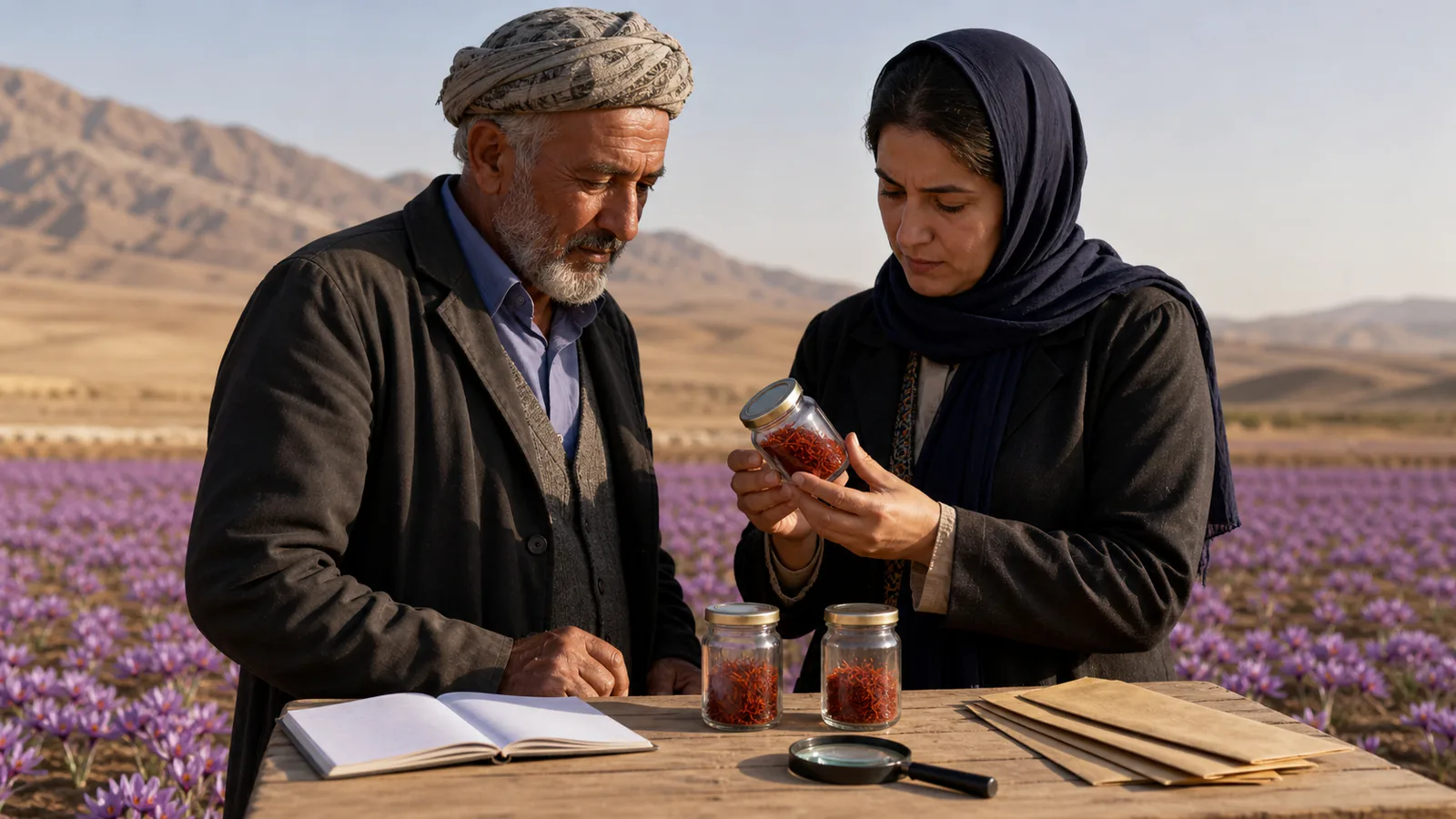
Saffron production in Afghanistan is a competitive challenge for Iranian saffron, but competition itself is not the real threat. The greater risk is losing origin, quality and value when saffron crosses a border without reliable traceability. A buyer should be able to tell where a batch was grown, where it was processed and packed, and which evidence supports the name on the package.
This concern was raised in an earlier interview with the head of South Khorasan’s Agricultural Jihad Organization. He warned about Iranian saffron being exported in bulk or bags and then packaged in Afghanistan. The statement reflects its reporting period; it does not prove that every Afghan-labelled product contains Iranian saffron, nor does it diminish Afghanistan’s legitimate saffron farms.
Afghanistan has a genuine saffron industry
Afghan saffron is not merely a packaging story. The FAO identifies Herat-Bastan saffron as an origin-linked Afghan product grown in several districts of Herat Province. It describes quality through the physical and chemical characteristics of Crocus sativus threads and their connection to local environment and production practice.
FAO has also supported processing, hygiene, certification and market access in Herat. A 2020 account reported that saffron production and export brought Afghanistan USD 27 million in 2019, while a 2026 FAO–World Bank programme includes a Herat saffron enterprise among agribusiness grant recipients. These facts show an industry developing its own skills and market identity.
That development can increase competition for premium buyers. It can also encourage clearer origin protection and better quality systems on both sides of the border.
Where the real risk lies
Problems arise when product origin changes in the paperwork or marketing without a transparent chain of custody. Bulk saffron may pass through traders, processors and packing companies before retail. Repacking in another country is not automatically deceptive, but the label must not imply that the growing origin changed with the package.
For Iranian suppliers, the answer is not a slogan. It is a batch record that connects:
- the farm or producing area and harvest year;
- the processor and drying method;
- the weight received, separated, dried and packed;
- test results and a retained sample;
- each transfer of ownership; and
- the final pack and export documents.
FAO and Iran’s Ministry of Agriculture Jahad began a two-year authenticity and traceability project in 2024. Its focus on testing, enforcement capacity and a transparent supply chain is more useful than treating all foreign production as suspect.
Darmian: a border district producing its own saffron
Darmian in South Khorasan makes the issue local. An archived agricultural report recorded 480 kilograms of dried saffron from 202 hectares in the county. Dividing those two reported figures gives about 2.38 kg/ha, but that is only a simple county-level average for the stated season. It does not reveal differences among farms or establish today’s yield.
The same report recorded 341 hectares of rain-fed gardens and 2,919 hectares of irrigated gardens. It placed the county centre at Asadieh and named Central, Derakhsh and Gazik as its three sections. Its estimate of a 50-kilometre Afghan border differs from the current Visit Iran description of a 70-kilometre border; the safe conclusion is that Darmian directly borders Afghanistan, while published boundary lengths are not consistent.
That geography helps explain why regional officials discussed Afghan competition alongside farm policy. Growers and traders near the border see both production systems at close range. The constructive response is to make South Khorasan origin verifiable and to raise the saleable quality of what Darmian already produces.
What the 480-kilogram figure can and cannot tell us
The figure establishes scale for one reported crop, not farm profitability. To evaluate Darmian saffron properly, we would also need field age, corm density, irrigation water and soil tests, weather, labour, dry-down method, grade distribution, production cost and farm-gate price. None is supplied by the short source report.
Its insurance paragraph is also incomplete. It lists 705 hectares of wheat, 118 hectares of barley and 190 hectares of barberry while discussing agricultural insurance, but the sentence ends before saying whether those areas were insured, eligible or merely cultivated. Those numbers therefore should not be presented as verified insurance coverage.
Water management needs field evidence
The South Khorasan interview promoted pressurised irrigation for higher average yield, lower water use and more timely production. It also said systems could operate on land with higher electrical conductivity if pipes were flushed or replaced more frequently. Those remarks are historical local guidance, not a universal salinity threshold.
Electrical conductivity can refer to irrigation water or the soil saturated extract, and the units and sampling method matter. A peer-reviewed field study of saffron under saline irrigation found that increasing salinity reduced yield components and described saffron as salt-sensitive. Later long-term research likewise shows that irrigation depth, salinity, rainfall and planting method interact. A grower should test water and soil, assess drainage and obtain local agronomic advice before selecting or operating a system.
Modern equipment saves water only when it is designed, maintained and scheduled correctly. Blocked emitters, salt accumulation or irrigation at the wrong stage can erase the intended benefit.
Crop diversity in a dry province
The original provincial interview set saffron within a broader adaptation plan. It named barberry, jujube, pomegranate, pistachio and medicinal plants among horticultural crops suited to parts of South Khorasan. It also discussed fodder sorghum, millet, maize and triticale as lower-water or seasonal forage options.
The Darmian report repeats several of those choices, including fodder sorghum, millet, fodder maize and autumn triticale. This does not mean one crop should replace another across the county. Water quality, market access, livestock demand, frost risk, machinery and labour determine which rotation makes sense.
Diversification matters because a saffron household may need food, forage and income at different times of year. It can reduce dependence on one harvest, but only if each crop has a viable buyer and its water requirement is calculated rather than assumed.
Branding should prove origin, not just announce it
The earlier interview contrasted the global visibility of Spanish saffron branding with efforts in Iran and Afghanistan. South Khorasan organisations had submitted production forms for a branding initiative in 2016. A brand can help recognition, but it cannot substitute for consistent product and evidence.
Strong Iranian saffron positioning should include accurate origin labelling, documented harvest and processing, appropriate laboratory testing, tamper-aware packaging and a way for buyers to verify the batch. The same standards should apply to claims made for Afghan saffron. Competition then moves toward documented quality rather than disputed labels.
Buyers comparing offers should request origin, harvest year, grade, test method, batch size and packing location. Our saffron processing guide explains how handling affects the finished spice, and the current price guide shows why a quotation must be tied to a defined product.
From “threat” to a defensible market advantage
Afghanistan’s growth gives buyers another origin and gives Iranian producers another reason to protect their own. The defensible advantage is not bulk volume alone. It is saffron whose farm, processing, quality and ownership trail remain clear from field to package.
For Darmian and the wider South Khorasan border region, that work begins with better field records and continues through careful drying, testing and honest labelling. When the evidence travels with the saffron, competition does not erase origin; it makes origin worth proving.

![Exporting Saffron to Turkey + Price Guide [Complete 0 to 100]](https://img.rowhanisaffron.com/20260827003933/saffron-export-turkey-quality-inspection.webp)



