


Khorramdareh city is one of the areas prone to saffron cultivation, according to a local agricultural assessment that described years of small-plot growing in this part of Zanjan province. Its case for expansion centred on groundwater pressure, but the old report is most useful when its promise is separated from what still needed to be measured.
What the Khorramdareh report established
Alireza Asadollahi, identified in the stored account as the head of Khorramdareh Agricultural Jihad, said studies had found the city potentially suitable for saffron. He noted that growers had already cultivated the crop for years in small plots and gardens, rather than presenting it as an entirely new arrival.
Asadollahi linked the proposal to falling groundwater levels and concern about farmers’ preference for crops that require plentiful water. Changing the cultivation pattern, he said, would also require public understanding and farmer participation. That is a more realistic starting point than assuming growers will switch crops because an official recommends it.
The archived page was published on 13 December 2021, but it does not give the original Persian report’s date. Its cultivation area, local sales and expansion forecast should therefore be read as a historical account, not a description of Khorramdareh’s current saffron sector.
The old area figure needs careful reading
The English text says the area under saffron was “1.2 tenths of a hectare.” That phrase is not a valid, unambiguous translation. It may represent a Persian decimal written with a slash, but the source text is not available here to confirm whether the intended area was 1.2 hectares or another value.
The official also predicted that cultivation could increase by as much as five times. If the starting point was 1.2 hectares, five times that area would be 6 hectares. This is conditional arithmetic, not a corrected official figure or evidence that the forecast occurred.
A trustworthy follow-up would provide the exact baseline unit, the harvest year and the area actually in production rather than merely planted. That distinction matters because a newly planted saffron field does not necessarily produce a representative harvest in its first season.
What makes land suitable for saffron
“Prone to cultivation” is awkward English for agronomic suitability. A suitable district can still contain unsuitable individual fields, so growers need a field-level assessment before planting.
The FAO Ecocrop profile for Crocus sativus lists well-drained medium or light soils and low salinity among the crop’s relevant environmental characteristics. Those broad requirements are useful for screening, but they do not replace a soil test, drainage check or local record of winter and spring conditions.
Field history matters as well. A grower should know whether water stands after irrigation, whether the soil compacts, how saline the water and root zone are, and which diseases or weeds affected the previous crop. Healthy corms cannot compensate indefinitely for a poorly drained or unsuitable site.
Saffron is not a no-water crop
The stored translation calls saffron a “water short-term” product. Its likely meaning is a crop with a different or lower irrigation burden than some alternatives. It should not be read as a claim that saffron needs no planned water management.
A 2024 study indexed by FAO’s AGRIS database assessed saffron water footprints in three production areas using field, meteorological and agricultural records. The study’s method is the useful point for Khorramdareh: water performance has to be calculated from local irrigation, rainfall, evapotranspiration and yield data, not inferred from the crop name.
Before changing a cultivation pattern, planners should compare realistic water use and income over several seasons. A high-value crop can improve the return on scarce water, but revenue still depends on yield, labour, quality, price and access to buyers.
Small plots can be a sensible test
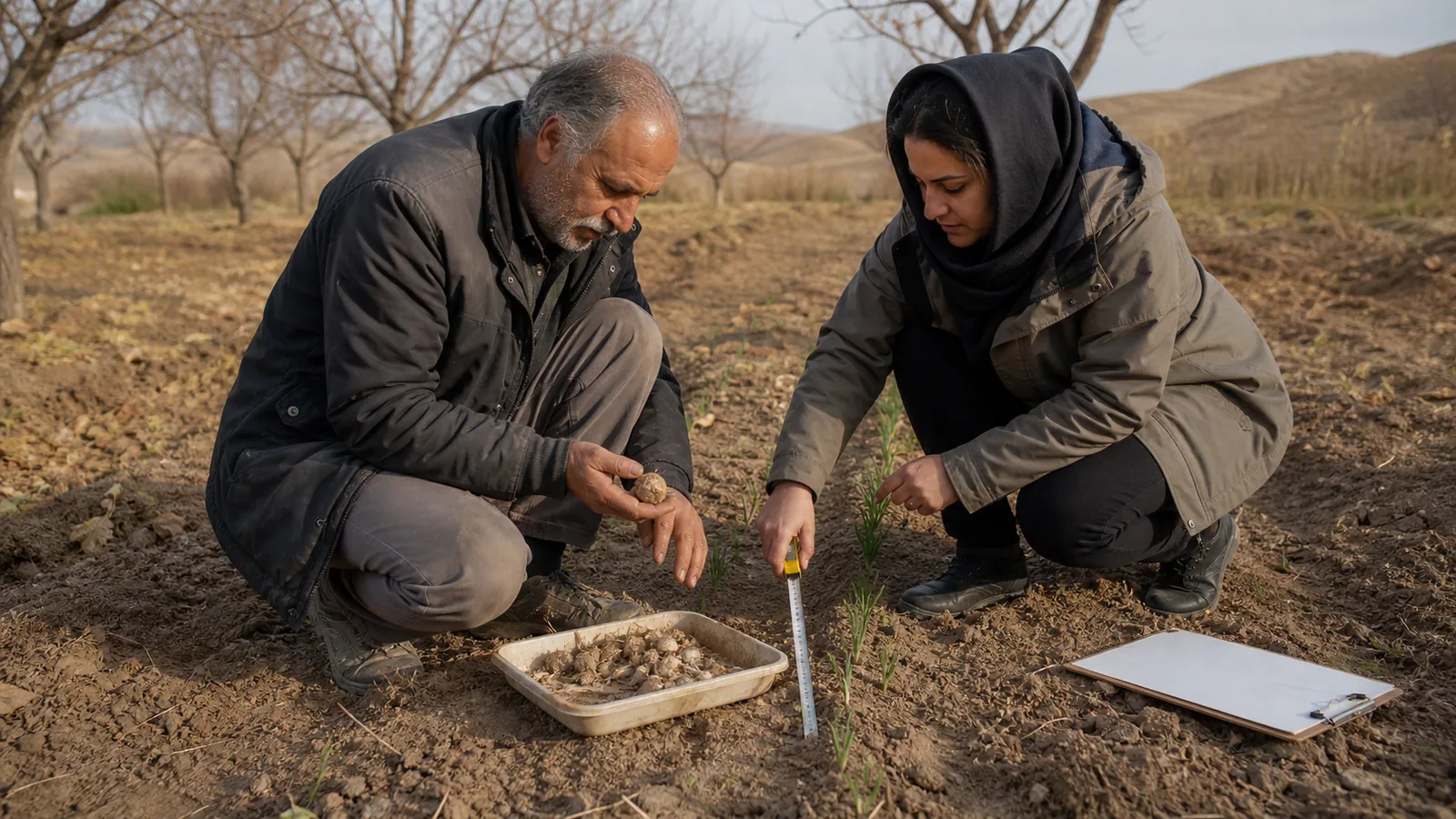
Khorramdareh’s history of saffron in gardens and small plots is valuable because it offers local experience. A limited trial lets a grower learn irrigation timing, flower picking, stigma separation and drying without committing a large area at once.
The trial should still be recorded properly. At minimum, the grower needs the planted area, corm weight and source, planting date, irrigation events, fresh flower weight, dry saffron yield, labour hours and sale price. Without those records, “good quality” and “profitable” remain impressions rather than information another farmer can use.
Several seasons are more informative than one. Saffron is perennial, and field age can change corm density, flowering and management needs. Expansion decisions made from a single attractive harvest may miss later congestion or declining performance.
Extension support should continue from planting to sale
Asadollahi said extension classes were being held for city farmers and that participants received course certificates. Agricultural Jihad also offered expert advice from planting through harvest and help obtaining suitable planting material, described as “seeds” in the old translation but more accurately understood as saffron corms.
That support is strongest when it goes beyond a classroom. A field visit can check planting depth, spacing, drainage and crop condition. Harvest guidance can cover picking time and hygienic separation. Post-harvest advice can address controlled drying, moisture protection, clean storage and batch identification.
A certificate records attendance; it does not by itself establish field competence or crop quality. Simple follow-up measurements would show which advice growers used and where the programme needs to change.
Local sales are useful but not a complete market plan
The official said Khorramdareh’s saffron was considered good quality and was usually sold within the city. Local sales can reduce transport and give producers direct contact with buyers. They can also be difficult to scale if the cultivated area grows faster than local demand.
Before a fivefold expansion, growers need to know who will buy the additional crop, in what grade and package, with which test or traceability requirement, and on what payment terms. Increasing planted area without a credible route to market can turn a water-saving intention into a financial problem.
Quality language should be specific. Rather than relying on colour or aroma alone, a saleable batch should have a known origin, clean processing history, protected storage and representative testing where the buyer requires it.
What responsible expansion would look like
Khorramdareh had three useful foundations in the original account: local experience on small plots, extension support and a recognised need to protect groundwater. The next step was not simply to multiply the area. It was to test whether suitable fields, growers and buyers could support that growth.
A measured programme would begin with verified baseline acreage and water data, select fields by soil and drainage evidence, document corm health, and follow each trial through harvest and sale. Results should include unsuccessful plots as well as strong ones.
The historical report makes a credible case for investigating saffron cultivation in Khorramdareh. It does not prove that every local field is suitable, that fivefold growth happened or that saffron alone can solve the city’s groundwater problem. Preserving that distinction makes the account more useful to growers and more honest about what the evidence can support.

![Exporting Saffron to Turkey + Price Guide [Complete 0 to 100]](https://img.rowhanisaffron.com/20260827003933/saffron-export-turkey-quality-inspection.webp)



