


The negotiable purchase of 88 kg of saffron in Sarayan was a government-backed attempt to support growers during a weak harvest market. “Agreed purchase” is the clearer translation: designated centres bought eligible grades at stated minimum prices and paid farmers in two stages.
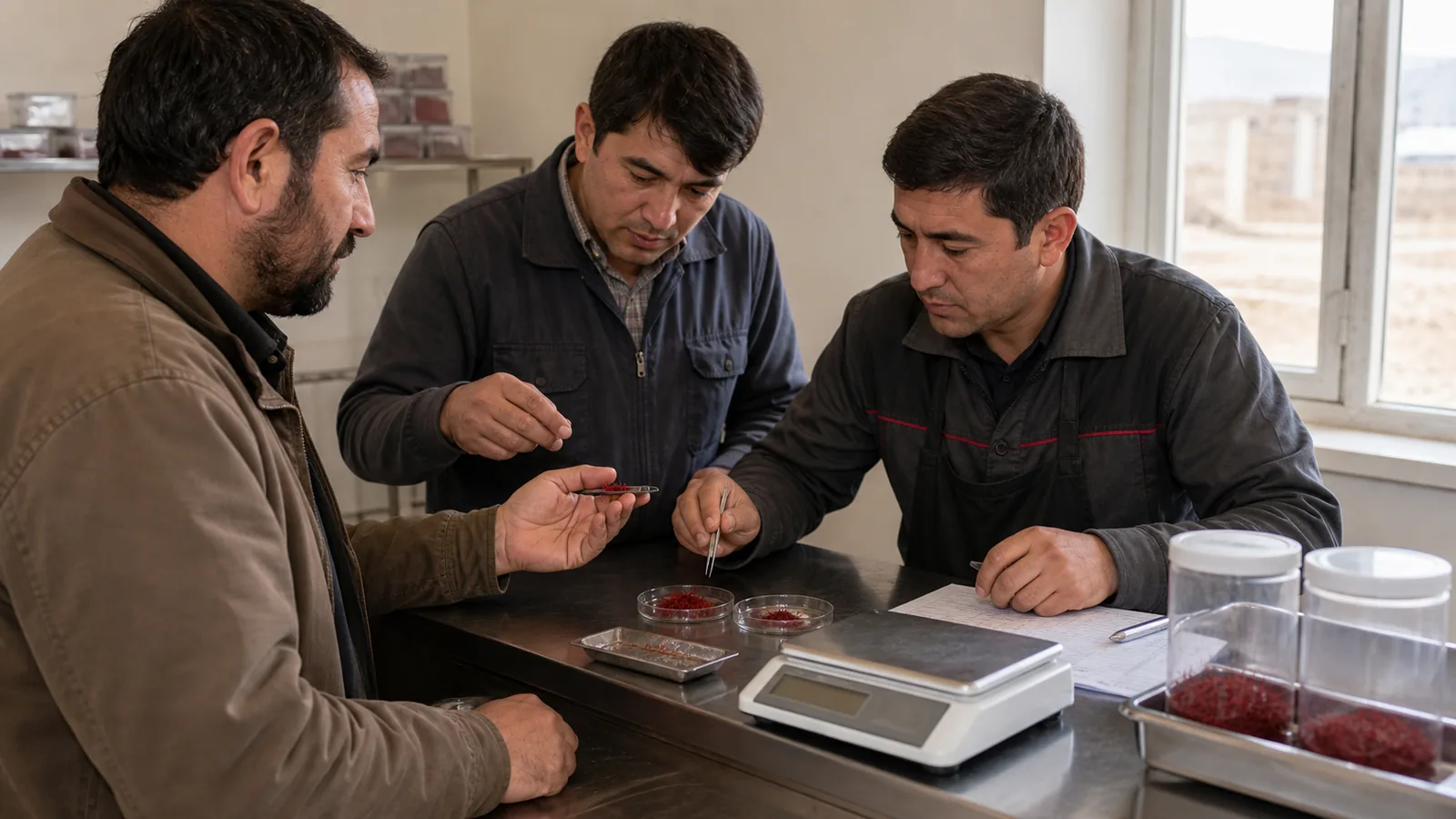
What happened in the Sarayan purchase programme
Musa Soleimani, then director of Agricultural Jihad in Sarayan, said 88 kilograms of saffron had been accepted through the programme. The scheme was introduced by the Ministry of Agriculture Jihad after growers repeatedly faced falling prices and difficulty selling during the concentrated harvest season.
Soleimani described the intervention as a way to support farmers and reduce their dependence on intermediaries. That purpose should not be read as proof that every private trader was harmful. Intermediaries can aggregate, finance, grade and market a crop; the policy question is whether farmers have enough information and alternatives to negotiate fairly.
The stored account does not identify its original publication date. It says purchasing began in mid-November and was to continue until the end of December, but gives no year in the body. Its quantities, prices and deadlines are historical and must not be used as current purchase terms.
Why “agreed purchase” is more accurate than negotiable purchase
The headline’s word “negotiable” can suggest that each grower bargained independently. The reported process was closer to an agreed or negotiated-purchase programme: authorities announced minimum rates and designated centres assessed whether the product met the covered grades.
A minimum purchase price gives a farmer an alternative when private bids fall below the programme rate. It does not necessarily fix the price of every transaction. Quality, eligibility, quantity limits, delivery dates and sampling rules determine whether a particular lot can enter the scheme.
For the programme to be credible, farmers need the written instructions before delivery. They should know which documents to bring, how the lot will be sampled, what happens after a failed grade, whether a second test is possible and exactly when each payment becomes due.
The four historical purchase prices
The translated report lists four minimum prices per kilogram of dried saffron: 55 million, 52 million, 49 million and 44 million rials. Its grade wording is damaged, but the sequence appears to correspond to Negin, Sargol, premium Pushal and ordinary Pushal.
These are not current saffron prices. They belong to the old programme, and the article does not provide the exchange rate, testing standard or exact date needed to compare them with today’s market.
The order of the rates reflects visible product form and grade, but appearance alone should not decide quality. Representative testing, cleanliness, moisture, foreign matter, storage condition and the integrity of the lot all matter. A named grade needs a written specification so the same term is not applied differently at two centres.
How the 40% cash payment worked
Soleimani said farmers received 40 percent of the product value in cash when saffron was purchased, with the balance to be settled within two months. A deferred payment can ease immediate harvest pressure, but it also leaves the grower financing most of the transaction until final settlement.
Using the reported minimum rates, the initial 40-percent payment would have ranged from 17.6 million rials per kilogram at the 44-million-rial grade to 22 million rials at the 55-million-rial grade. The remaining 60 percent would have ranged from 26.4 million to 33 million rials. These are arithmetic examples based on the old terms, not evidence that every payment arrived as scheduled.
A complete evaluation needs the acceptance date, grade, weight, initial payment date and settlement date for each lot. It should also record any fees or deductions. Without that information, the promise of payment within two months cannot be compared with actual farmer experience.
The most important mismatch: bunch saffron was excluded
Soleimani said many Sarayan farmers prepared saffron in the bunch form, while the purchase instruction did not allow the centres to buy that form. He said the issue was being followed up.
Bunch saffron, also called Dasteh or Dokhtar-pich, keeps the red stigmas attached to part of the pale style and traditionally ties them into a small bundle. It is a real commercial form, not automatically waste or adulterated saffron. Its composition and value differ from fully separated red-thread grades.
The exclusion created a practical problem. A support programme meant for local growers did not accept the form many of them actually produced. Farmers then had to separate or reprocess their saffron, find another buyer or remain outside the scheme.
Changing product after drying can add labour and may not create the same appearance as saffron prepared in the required form from the start. Instructions therefore need to be published before harvest, when growers can decide how to separate and dry their crop.
What the 88 kg figure tells us
Soleimani reported 88 kilograms purchased at the time of his statement. He also put Sarayan’s saffron production at ten tons from 2,600 hectares and said the county ranked second in the province.
On those figures, 88 kilograms would equal 0.88 percent of a ten-ton crop. That is only a scale comparison. The production estimate may refer to a different reporting period, not all output would have been offered, and bunch saffron was not eligible.
The 2,600-hectare and ten-ton figures imply an average near 3.85 kilograms per hectare. Again, this is a calculation, not a measured value supplied by the report. Planted area may include fields of different ages or fields that did not contribute a full crop.
Why farmers may need support at harvest
Saffron flowers arrive during a short period, and picking, stigma separation and drying cannot be postponed for long. Growers face concentrated labour costs while a large portion of the season’s supply reaches buyers at roughly the same time.
A farmer who needs cash may accept the first available offer even when clean storage could preserve the lot. A purchase programme can add another buyer and set a visible floor for eligible grades. Storage finance, warehouse receipts and transparent market information can offer alternatives without requiring the state to buy every kilogram.
Support is strongest when it preserves choice. A grower should be able to compare a private cash offer with the programme’s grade, delayed balance, transport cost and acceptance risk. The highest announced price is not necessarily the best net result if the lot is graded differently or payment is late.
Quality rules should be transparent and local production considered
Modern saffron programmes increasingly focus on authenticity, traceability and consistent quality. FAO’s 2025 work with Iranian partners emphasizes validated testing and field-ready post-harvest guidance, alongside the limits of relying on routine grades alone.
That principle applies to a purchase centre. A small sample should represent the delivered container, and its identity must remain linked to that lot. Results should be explained in language the grower understands, with a documented route for disputes.
Local production forms also need attention. If bunch saffron is common in Sarayan, the programme can either define an eligible bunch specification and price or give growers sufficient notice and training to prepare accepted grades. Quietly excluding the dominant form after harvest weakens the policy’s reach.
What a proper programme report would disclose
The announcement recorded a useful start, but 88 kilograms alone cannot show whether the intervention succeeded. A final report should provide:
- total quantity offered, accepted and rejected for each grade and product form;
- the number of participating farmers and any per-farm limit;
- initial and final payment dates, including overdue balances;
- sampling, testing, appeals and rejection reasons;
- storage losses, programme costs and the later sale of purchased saffron; and
- private-market prices for comparable grades during the same dates.
These figures would show whether the purchase reached the farmers it was designed to support, whether exclusion of bunch saffron materially limited participation and whether delayed settlement was honoured.
The lasting lesson from Sarayan
The negotiable purchase of 88 kg of saffron in Sarayan responded to a genuine harvest-season problem: many sellers, limited immediate cash and weak prices. The minimum-rate structure gave eligible growers another route to market.
Its main weakness was the gap between the instruction and local practice. A programme cannot fully support Sarayan growers when it excludes the saffron form many of them prepare. Product rules, sampling and payment terms must be settled and communicated before flowers are picked.
The best measure is not the announced minimum price. It is how many growers received a fair, understandable grade and the full payment on time, while retaining a genuine choice among buyers.

![Exporting Saffron to Turkey + Price Guide [Complete 0 to 100]](https://img.rowhanisaffron.com/20260827003933/saffron-export-turkey-quality-inspection.webp)



