


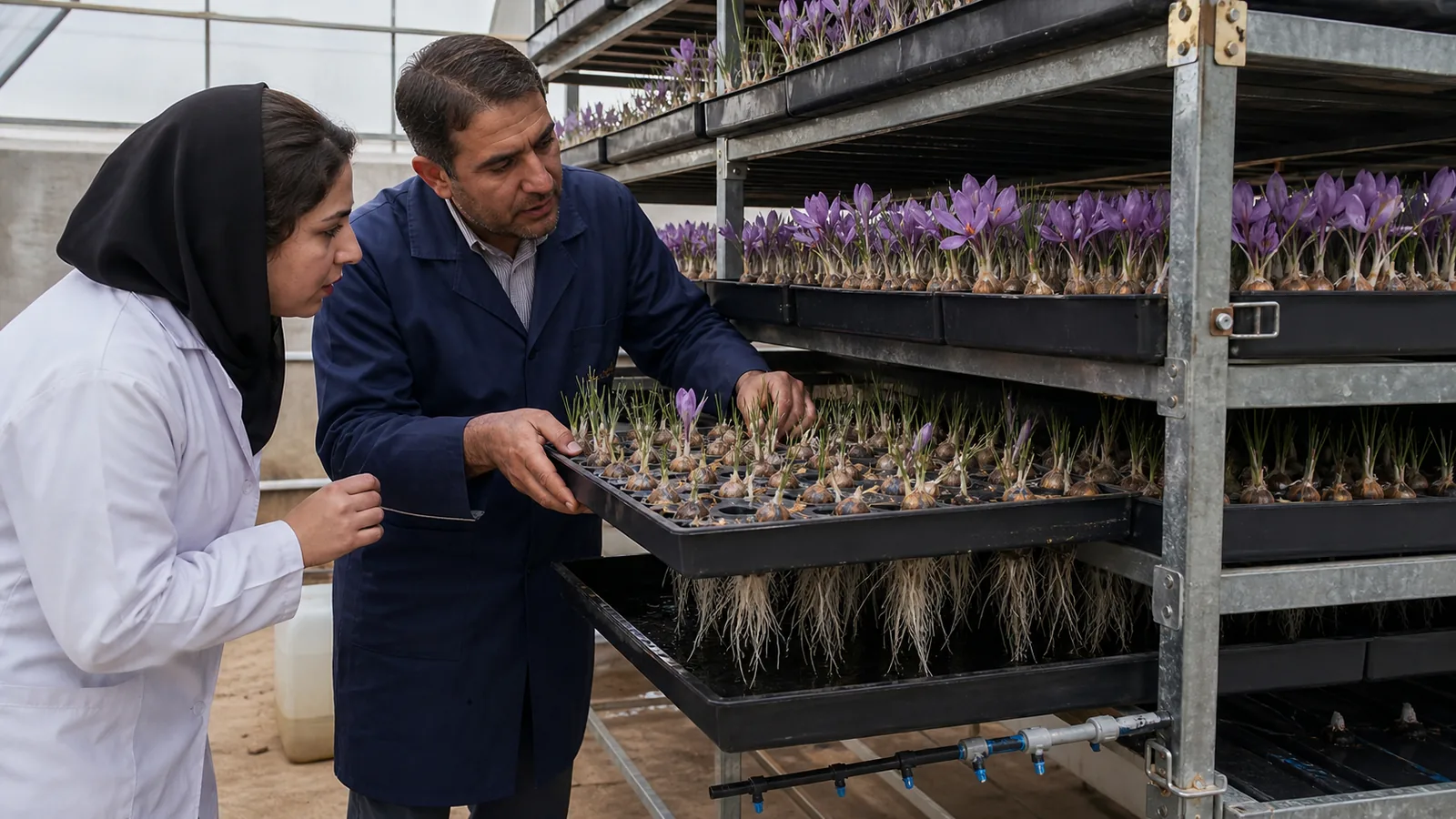
Aeroponic saffron in Kashmar began as a 100-square-metre, eight-tier greenhouse pilot intended to test whether controlled, vertical production could work economically for local growers. The 2021 announcement did not publish a harvest, water meter, energy bill, or profitability result. Its value is as a documented experiment beside Kashmar’s much larger field system: 7,200 hectares, 12,300 grower families, and a historical forecast of 25.2 tonnes.
What the Kashmar aeroponic pilot installed
Seyyed Abolghasem Mousavi, director of Kashmar Agriculture Jihad, said a grower in the central district began the city’s first aeroponic saffron project in September 2021. The greenhouse covered 100 square metres and used eight vertical tiers to make greater use of floor area.
Mousavi described the unit as an operational trial that could give other applicants practical experience. Its stated purpose was to test economic feasibility for the region, not to declare the method profitable before results existed. The announcement listed possible benefits including lower water use, more production space, frost protection, a cleaner product, and home-based employment.
Vertical racks do not by themselves prove aeroponics
In a true aeroponic system, plant roots are suspended without soil and receive water and nutrients as a mist or fine spray. A stack of corm trays can be vertical and soil-free without documenting that root-zone system. The Kashmar article calls the method both “aeroponic” and an “aeration system,” but it does not describe nozzles, nutrient solution, root exposure, temperature, humidity, light, or what happened to the corms after flowering.
That missing detail matters. A controlled 2022 saffron aeroponics experiment reported its corm selection, pretreatments, temperature of 20–22°C, humidity of 75–80%, darkness, and replication. Those specifications allow someone to understand and test the method. The Kashmar pilot may have used a valid local design, but the saved news page is not a technical protocol.
What research says about controlled saffron cultivation
Saffron can flower in controlled aeroponic and hydroponic environments, but performance depends on corm size and condition, pre-flowering treatment, temperature, humidity, light, root management, and the later corm-replacement cycle. An earlier experiment comparing aeroponics, hydroponics, and soil cultivation found poor flowering across all three systems when small corms were used. That result is a useful warning against crediting the structure alone.
Vertical tiers can increase corms per square metre of greenhouse floor, but they also add costs for the building, racks, environmental control, sanitation, labour, energy, monitoring, and corm handling. A fair comparison should measure dried stigma output and quality per corm, square metre, litre of water, labour hour, and unit of energy—not simply count tiers.
Claims the pilot had not yet proved
Water saving
A closed or recirculating controlled system may reduce some water losses, but the Kashmar announcement published no water baseline. The comparison also needs to include cleaning, humidity control, discarded solution, and the field phase if corms are returned to soil. “Water-saving” was a project objective, not a measured result in the article.
Organic and healthy saffron
Aeroponics does not automatically make saffron organic. Organic status depends on the applicable standard, permitted inputs, records, inspection, and certification. Likewise, a greenhouse can reduce some exposure while creating other sanitation or humidity risks. Product safety and quality require controlled handling and testing.
The current ISO 3632-1:2025 specification covers dried saffron in filament, cut-filament, and powder forms. It provides a product framework, while the grower still has to document sampling, drying, storage, and test results for each batch.
Profit and household employment
A 100-square-metre pilot can reveal labour and operating problems before a larger investment, but it cannot establish regional profitability without revenue and cost data. Home-based or small-enterprise work is possible only if the system has safe premises, reliable corms, defined responsibilities, a buyer, and a margin after energy and equipment costs.
Kashmar’s 7,200-hectare field context
The related field-harvest report divided Kashmar’s historical saffron area into 4,700 hectares in the central district and 2,500 hectares in the colder Kuhsorkh district. At a forecast average of 3.5 kilograms per hectare, the expected total was 25,200 kilograms. Here the arithmetic is internally consistent.
The report said Kuhsorkh had completed its harvest as flower picking began in the central area. It also warned that frost, lower rainfall, and rising temperatures had pushed central-district performance below the long-term average. These were local observations for that season, not proof that every Kashmar field experienced the same loss.
Families, prices, and the historical income estimate
Mousavi said 12,300 families were involved in Kashmar saffron and that the county ranked third in the province by planted area. The aeroponic article gave a historical price range of about 8.5 to 12.5 million tomans per kilogram and put field income near 253 billion tomans.
The 253-billion figure is plausible at roughly 25.2 tonnes and a midpoint near 10 million tomans per kilogram. It remains a period estimate, not current revenue: yield, grade, sale timing, and price vary, and the archived field article’s price typography is corrupted by right-to-left number ordering.
Field training remains central
Kashmar Agriculture Jihad’s training programme addressed healthy corm selection, irrigation, weed control, plant nutrition, hygienic harvesting, and drying. Those topics matter in both field and controlled systems. The greenhouse may protect flowering from some weather, but it does not remove the need for clean separation, controlled drying, traceability, and honest grading.
Our guide to saffron cultivation and growing conditions explains the conventional crop cycle. The aeroponic pilot should be compared with that full cycle, including what happens to daughter corms and how the next season is established.
What a useful pilot report should publish next
To decide whether the Kashmar system deserves expansion, a follow-up needs the actual system design, number and weight of corms, flowering rate, dry stigma yield, water and energy use, labour, losses, corm survival, laboratory quality, capital cost, operating cost, sale price, and results over more than one cycle.
The original project remains interesting precisely because it was a test. Kashmar’s field crop shows the economic scale and climate risks growers already face; the eight-tier greenhouse offers a possible tool. Evidence from the completed pilot—not the word “aeroponic” by itself—must decide whether that tool improves water use, quality, and farmer income.

![Exporting Saffron to Turkey + Price Guide [Complete 0 to 100]](https://img.rowhanisaffron.com/20260827003933/saffron-export-turkey-quality-inspection.webp)



