


The production forecast of 400 kg of saffron in Kermanshah marked an early stage in the province’s expansion of the crop. The number becomes much easier to understand when the age of the new fields, the area already flowering and the wide variation in saffron yield are kept in view.
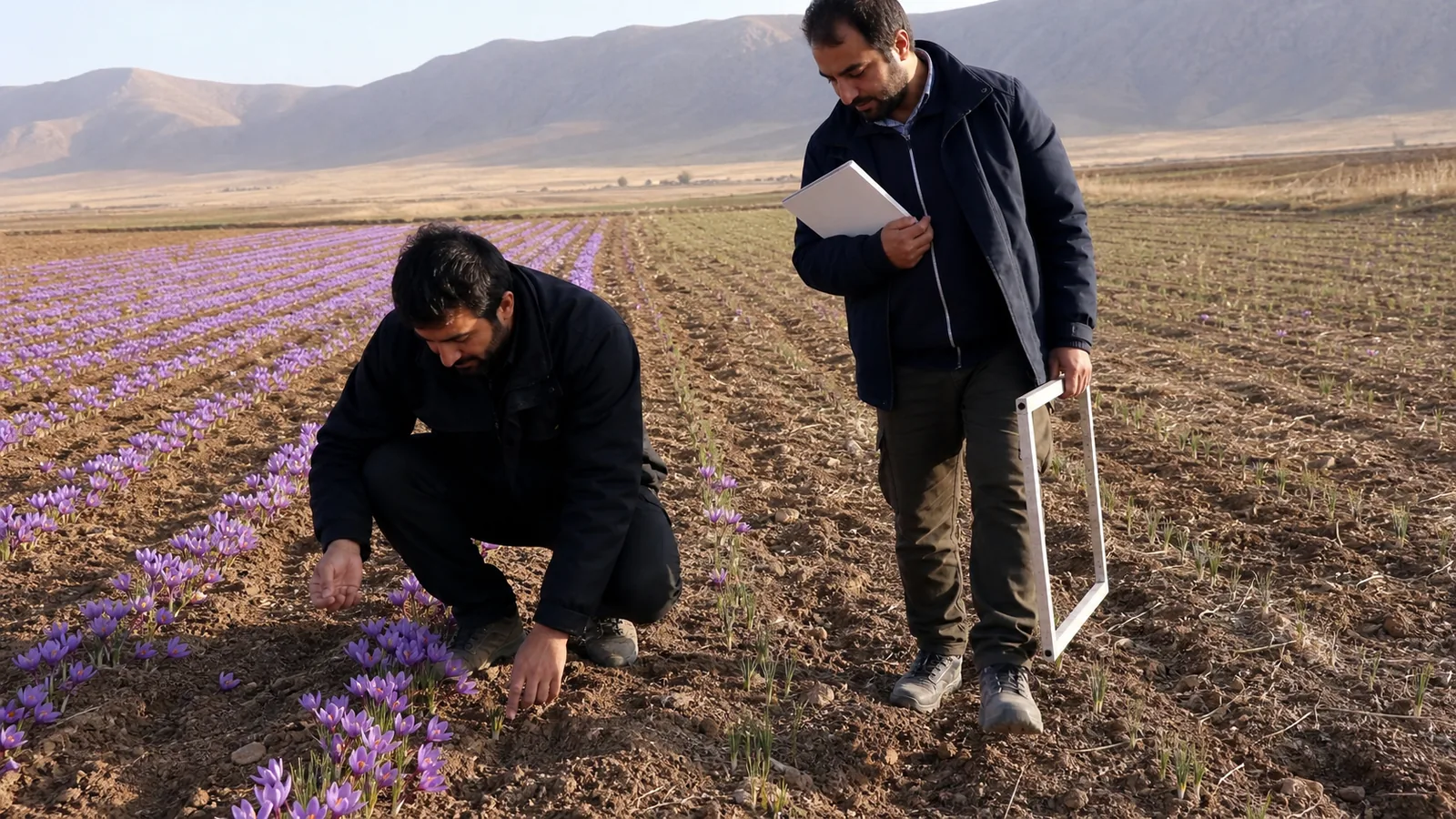
The Kermanshah saffron forecast in context
The forecast was announced during a visit to saffron farms by Ayatollah Mostafa Ulama. He called for greater attention to agriculture and said Kermanshah had land, water and climatic conditions that could support further development.
Khosrow Shahbazi, then head of the province’s Agricultural Jihad organization, supplied the figures behind the projection. He said saffron cultivation in Kermanshah had gathered momentum since the Iranian year 1390, roughly 2011–12. The cultivated area had stood at 105 hectares, and 106 newly planted hectares had taken the reported total to 211 hectares.
Shahbazi put the average dry-saffron yield at four kilograms per hectare. Because the new fields had not yet entered production, he forecast about 400 kilograms for that season rather than multiplying four kilograms by the full 211 hectares.
Why 211 hectares did not imply an 844 kg harvest
A simple multiplication of 211 hectares by four kilograms gives 844 kilograms, more than twice the headline forecast. The missing detail is field maturity. The additional 106 hectares were new and were not expected to contribute a normal crop in the forecast year.
Applying the reported average to the earlier 105 hectares gives 420 kilograms, which is close to the rounded 400-kilogram projection. That makes the forecast internally consistent. It does not prove the final harvested amount, because the archived report gives no post-season result.
Saffron is a perennial crop grown from corms. A newly established plot does not behave like a mature field, and its output can change as the corm population develops. Weather, corm size and density, soil, irrigation timing, weed control, field age and harvest labour can all affect the number of flowers and the dry stigma recovered.
Four kilograms per hectare was a planning average
The four-kilogram figure should be read as Kermanshah’s reported provincial average for that period, not as a guaranteed return for every farm. An average can contain young plots with very little output and established fields that perform much better.
Published evidence shows how widely saffron yield can vary. A six-year experiment indexed by FAO AGRIS in nearby western Iran reported only 0.4 kilograms per hectare in the first year. The same trial reached 12.8 and 12.2 kilograms in its fourth and fifth years, with six-year means of 7.5 kilograms under irrigation and 7.1 under rain-fed conditions.
Those results came from a controlled trial in Khorramabad, not from Kermanshah’s commercial farms. They cannot be copied directly into a farm budget. They do support the main caution behind the old forecast: planted area and productive area are not the same thing, and field age must be recorded before yield is compared.
What about the claim of 30 kg per hectare?
Shahbazi said Kermanshah had the potential to produce as much as 30 kilograms of saffron per hectare. That was an upper-potential claim, not the average used in the 400-kilogram forecast. The archived statement does not identify a farm, trial design, season or measurement that achieved it.
For comparison, the FAO Ecocrop profile for saffron gives a broad average of about ten kilograms of dried saffron per hectare. An FAO technical account of saffron development in Afghanistan reported an average of seven kilograms and a maximum around 24 kilograms per hectare in that context. These are general reference points, not ceilings for every region.
A 30-kilogram target may be useful for discussing biological potential under exceptional conditions, but it is too optimistic for an ordinary revenue forecast without local replicated evidence. A grower deciding whether to plant should model a conservative range based on neighbouring fields of similar age and management, then test how the budget changes if yield or sale price falls.
Does Kermanshah have suitable conditions for saffron?
Saffron is often associated with dry and semi-dry areas, yet low water demand does not mean the crop succeeds without careful site selection. The plant needs well-drained soil, healthy corms and moisture at the right stages. Poor drainage and unsuitable irrigation can damage corms, while rain during flowering can interfere with harvest and quality.
The FAO description of Iran’s qanat-based saffron system notes the crop’s value in a water-scarce setting and its relatively modest water requirement. That is one reason saffron can interest areas looking for a high-value crop, but water use is only one part of suitability.
Kermanshah contains varied elevations and local climates. A province-wide statement cannot replace a field assessment. Soil drainage, winter cold, access to timely irrigation, corm health and the availability of workers during the short flowering window all need to be checked at farm level.
Quality cannot be judged by province name alone
Both Ulama and Shahbazi praised the saffron produced in Kermanshah. Shahbazi said its quality was equal to saffron from the Khorasan provinces. That comparison was not accompanied by a blind sensory panel, laboratory report, sample size or grade breakdown.
Good Kermanshah saffron can certainly meet a strong specification, but origin alone does not prove the condition of a lot. Buyers need to assess the threads themselves and review representative test results. Colour strength, aroma-related measures, moisture, floral waste, cleanliness and storage history are more useful than a broad regional claim.
Post-harvest handling can change those results quickly. Flowers need to be collected at the right time, the stigmas separated cleanly and drying started without avoidable delay. Excess moisture during storage can shorten useful life, while poor containers expose the threads to humidity, light and foreign odours.
Income depends on more than saffron’s unit price
Ulama linked saffron’s high price with the possibility of better farm income. The crop’s price per kilogram is striking, but dried saffron is produced in small quantities and requires intensive work at harvest. Gross price should never be mistaken for profit.
A realistic budget includes corms, land preparation, irrigation, nutrition, weed control, flower picking, stigma separation, drying, testing, packaging, storage and finance. It also accounts for the establishment period before a new field contributes a mature crop and for the risk that flowering coincides with a labour shortage.
Farmers also need a credible route to market. A high laboratory grade does not automatically secure a premium if the lot is too small, records are incomplete or the seller has only one buyer. Cooperatives or local service centres may help with shared drying, testing, aggregation and traceability, provided individual lots remain identifiable and payment rules are clear.
How later performance should be measured
The old report predicted substantial growth in Kermanshah’s saffron production over the following years. It did not provide a target date, later harvest total or evidence that all 211 hectares remained in productive use. The forecast should therefore remain a dated baseline, not be presented as Kermanshah’s current output.
A meaningful follow-up would separate planted hectares from flowering hectares and record the age of each field. It would publish dry stigma output, yield per productive hectare, the number of active growers and the portion of lots meeting defined quality grades. Reporting farm-gate prices and production costs would show whether expansion actually improved livelihoods.
It would also distinguish experimental peaks from repeatable commercial yield. A result achieved on one carefully managed plot is useful research, but a province’s production plan must work across different soils, growers and seasons.
What the 400 kg forecast still tells us
The production forecast of 400 kg of saffron in Kermanshah was mathematically plausible for about 105 productive hectares at the reported average of four kilograms. The newly planted area explained why the full 211-hectare total was not expected to yield at that rate immediately.
The announcement also captured the real opportunity and the real caution. Kermanshah could diversify with saffron where field conditions, labour and market access suited the crop. Success, however, could not be guaranteed by planted area, a high retail price or a 30-kilogram potential figure.
For growers and planners, the sound measure is repeatable dry-saffron yield from mature fields, sold at a documented grade after all costs. That evidence would show whether the early expansion developed into a durable part of Kermanshah agriculture.

![Exporting Saffron to Turkey + Price Guide [Complete 0 to 100]](https://img.rowhanisaffron.com/20260827003933/saffron-export-turkey-quality-inspection.webp)



