


Golbaf becomes the center of saffron in the southeast of Iran was the ambition announced when a research farm opened with support from Torbat Heydariyeh University. The project gave Golbaf a place to train growers and test methods, but becoming a regional centre would require much more than an inauguration.
Why the Golbaf saffron project was launched
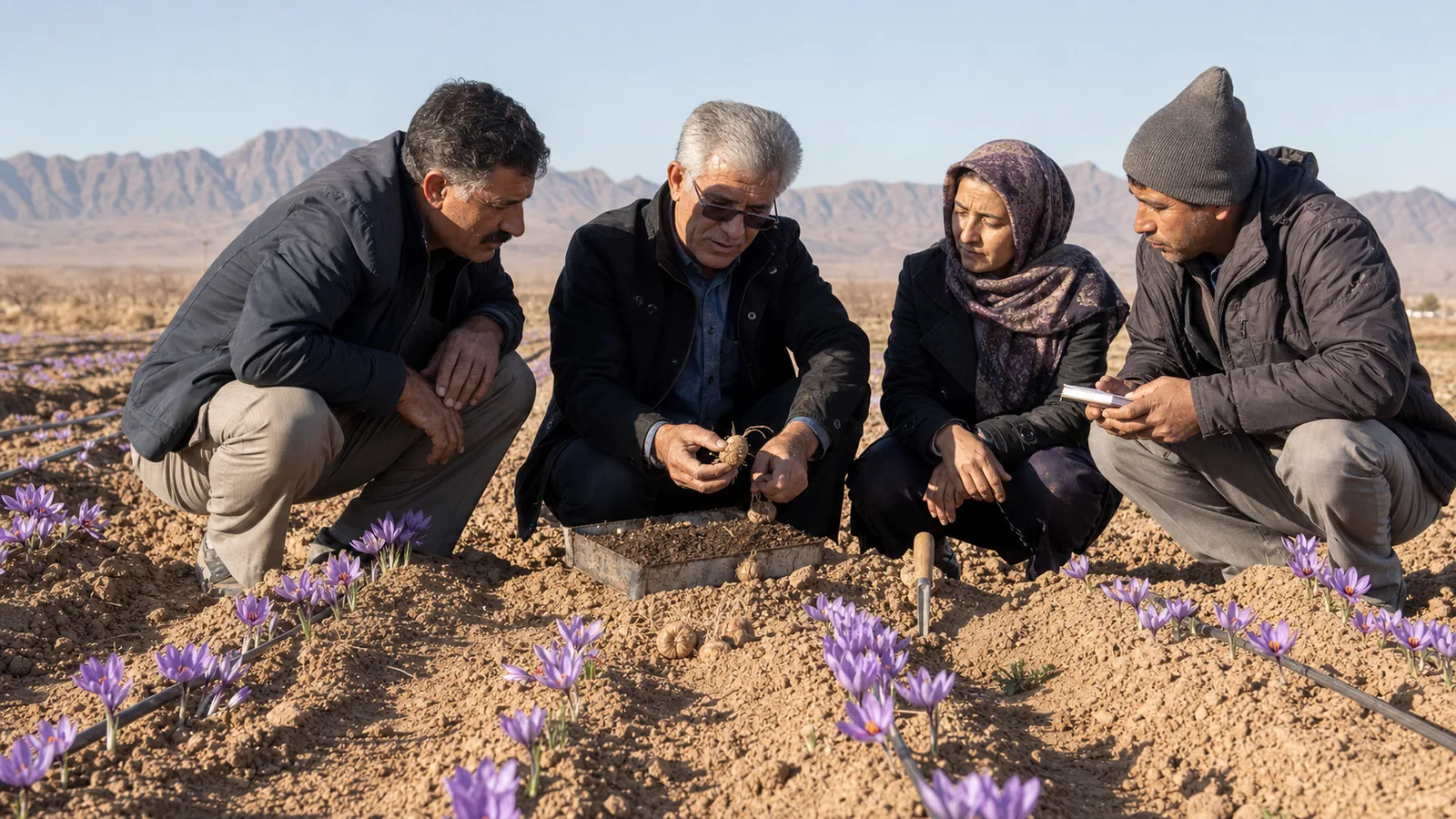
The Golbaf saffron research farm was opened in Kerman Province with the participation of Torbat Heydariyeh University. The original account described it as a base for theoretical and practical instruction in principled and organic saffron cultivation.
Mohammad Mehdi Zahedi, then a representative for Kerman and Ravar in Iran’s Islamic Consultative Assembly, welcomed the project. He said 2.5 billion rials had been allocated to saffron specialists so they could teach growers in Golbaf. He linked the courses and research farm with opportunities for young people and local business.
Zahedi’s larger goal was for Golbaf to become the saffron centre of southeast Iran. That statement expressed an aspiration rather than a completed change in the region’s agricultural hierarchy. The archived report provides no opening date, planted area, grower count, research plan or later results by which the claim can be confirmed.
What Torbat Heydariyeh could contribute
Torbat Heydariyeh is closely associated with saffron production and applied research. Bringing its specialists to Golbaf could help a newer growing area avoid costly mistakes, especially in corm selection, field establishment, irrigation, pest and disease observation, harvest timing and drying.
Modern saffron support has to span more than cultivation. FAO and Iran’s 2024 saffron project brought producers, researchers, associations and private businesses together around authenticity, traceability, food safety and supply-chain management. A local research farm can make that broad work practical for its own growers.
A Golbaf saffron project would be incomplete if it taught only how to put corms in the ground. Growers also need to know how to keep lots clean and traceable, dry the stigmas consistently, judge whether a buyer’s quality claim is measurable and calculate the real cost of production.
A research farm must answer local questions
Methods developed in Khorasan cannot simply be copied into Golbaf without testing. Soil, elevation, water timing, winter conditions, flowering dates and access to harvest labour can differ. The purpose of a local research farm is to learn which practices remain dependable under Golbaf conditions.
Useful trials would compare a limited number of clearly recorded variables. Corm size and health, planting depth and density, irrigation timing, soil preparation and field age are all relevant. Each trial should keep enough comparable plots to separate a real effect from an unusually good strip of land.
The results need to extend beyond flower counts. Dry stigma yield, quality measurements, corm multiplication, labour hours, input costs and losses after harvest are what determine whether a method is practical for a grower. Publishing those results would allow the research farm to benefit people who could not attend a course in person.
“Principled cultivation” needs practical content
The translated announcement repeatedly referred to principled saffron cultivation. For a farmer, that phrase is useful only when it becomes a set of decisions that can be checked in the field.
- Choose sound corms from a traceable source and reject visibly damaged material.
- Assess soil drainage and field history before deciding where and how densely to plant.
- Plan irrigation around local soil and weather rather than following a calendar copied from another province.
- Keep field records so yield and problems can be linked to a plot, season and treatment.
- Organize enough labour to pick flowers promptly and separate stigmas hygienically.
- Dry and store each lot under controlled conditions, then use representative tests to describe its quality.
These steps do not guarantee a profitable crop. They make causes and outcomes visible, which is the starting point for improving them.
What “organic saffron” should mean in Golbaf
The project also promoted organic cultivation. In everyday speech, “organic” is sometimes used to mean natural, traditional or grown with fewer synthetic inputs. In a commercial claim, it should mean production under a defined standard, with required records, inspections and certification for the target market.
A training course should make that distinction clear before a grower spends money. Organic management does not remove the need for healthy planting material, soil fertility planning, weed control, pest monitoring or hygienic post-harvest work. It changes which inputs and practices may be used and how compliance is documented.
Certification can be worthwhile when a buyer recognizes it and pays enough to cover the extra work. Without a market plan, it can become an expense rather than an advantage. A research and training farm is well placed to calculate those costs honestly and compare them with conventional production under the same local conditions.
Low starting capital and high profit are not guarantees
Zahedi described saffron as a crop that could be started with little capital and produce high profitability. The plant uses less water than many alternatives and dried saffron has a high unit value, but those features do not make every planting inexpensive or profitable.
Establishment requires corms, land preparation and labour. Income is delayed while the field develops, and the short flowering period creates an intense demand for pickers and stigma separators. Drying, testing, packaging and storage add further costs. Yield, quality and sale price can all vary.
A responsible Golbaf training programme would give growers a range of possible outcomes rather than one optimistic number. A farm budget should include the establishment years, labour at peak harvest, rejected or lower-grade material, finance costs and the price available to that grower—not the highest retail price seen in another market.
Quality is where training becomes market value
The research farm’s long-term value depends on whether better decisions survive from the field to the buyer. Clean harvesting and prompt, controlled drying help preserve the characteristics customers expect, but quality cannot be protected without suitable storage and lot records.
In 2025, FAO and Iran’s national saffron quality workshop brought growers, processors, cooperatives, traders and researchers together around production, post-harvest handling, safety, traceability and marketing. That wider value-chain approach is relevant to Golbaf: a strong crop has limited commercial advantage if identity or quality is lost after harvest.
A regional centre should therefore provide, or connect growers with, representative sampling and credible laboratory services. It should teach what each result means and avoid implying that a certificate from one sample proves every container in a mixed lot.
How Golbaf could become a genuine regional centre
A centre is created by repeatable services and trusted results, not by a title. Growers from outside Golbaf would need a reason to seek its advice, planting material, field data, training, testing or market connections.
The research farm could start by publishing an annual record: active trial area, field age, dry yield, quality results, courses delivered, participating growers and methods that failed as well as those that worked. Clear records would let farmers see whether recommendations were based on local evidence.
It could also support shared services that small producers struggle to fund alone. Clean separation areas, controlled drying, lot coding, testing and aggregation can reduce per-farm costs when governance is transparent. Each grower’s product and payment must remain traceable through the shared process.
Market development is the final test. Buyers must know what Golbaf saffron specification they are purchasing and receive the same standard repeatedly. Branding should follow that reliability, not substitute for it.
How to judge the original promise now
The announcement established a clear starting point: a Golbaf research farm, Torbat Heydariyeh participation, 2.5 billion rials for expert training and an ambition to build youth employment and local enterprise. It did not report outcomes.
Evidence of progress would include continued field trials, published local recommendations, trained growers who remained in production, stable quality results, functioning post-harvest services and repeat buyers. Without those measures, it is safer to describe Golbaf as pursuing a regional saffron role rather than to state that the role has already been achieved.
Golbaf becomes the center of saffron in the southeast of Iran remains a useful vision. The research farm can move that vision forward when it turns outside expertise into local evidence, realistic farm decisions and saffron that buyers can identify and trust.

![Exporting Saffron to Turkey + Price Guide [Complete 0 to 100]](https://img.rowhanisaffron.com/20260827003933/saffron-export-turkey-quality-inspection.webp)



