


Iran should be the reference price for saffron, but production volume alone cannot make a price trustworthy. A useful benchmark also needs verified grades, transparent trades, dependable settlement and enough participation for buyers and growers to believe what the number represents.
Why Iran was proposed as the saffron price reference
Ali Akbar Mehrfard, then a deputy minister at Iran’s Ministry of Agriculture, made the case at the launch of saffron transactions on the Iran Mercantile Exchange. He said the country had produced 336 tonnes in the previous year and exported 236 tonnes. On that scale, he argued, Iran should help establish the price by which the world’s saffron trade is judged.
The export figure is consistent with public trade records for 2017. World Bank WITS data based on UN Comtrade records 235,900 kilograms of Iranian saffron exports under HS 091020, valued at about US$325.65 million. That does not independently verify the 336-tonne production estimate, but it gives the reported export quantity a firm reference point.
Mehrfard also said Iran produced about 90 percent of the world’s saffron. That percentage was common in industry statements from the period, although production estimates depend on the year and source. The broader point remains reasonable: a country responsible for most supply has a strong claim to host an influential market. It still has to build the mechanism that makes its quoted price usable.
What a reference price actually means
A reference price is not simply the highest price a producer wants or the average of a few private sales. It is a visible point that market participants can use when negotiating physical contracts, valuing stock or managing exposure to later price changes.
The US Commodity Futures Trading Commission’s glossary defines price discovery as determining a commodity’s price level through the interaction of buyers and sellers under supply-and-demand conditions. In practice, the reference becomes more credible when many independent participants can see comparable bids, offers and completed transactions.
This distinction matters for saffron because two lots can carry the same weight while differing in colour strength, moisture, floral waste, age, origin documentation and laboratory results. A public price for an undefined “kilogram of saffron” may look precise without describing a product a buyer could reliably accept.
What Iran would need for a credible saffron benchmark
A durable Iran saffron reference price would need a market structure around the number. At minimum, participants would have to understand:
- the deliverable grade and the test methods used to confirm it;
- the form of saffron, lot size, packaging and permitted tolerances;
- the approved warehouses and rules for sampling stored lots;
- the delivery location, timing, fees and settlement currency;
- how rejected, disputed or deteriorated stock is handled; and
- the daily trading volume behind the published price.
Standardization does not mean forcing all saffron into one commercial grade. Premium whole-thread lots, processing grades and other specifications may need different price points. The important step is to make each contract specific enough that a buyer knows what will be delivered and a grower knows which quality earned the quoted value.
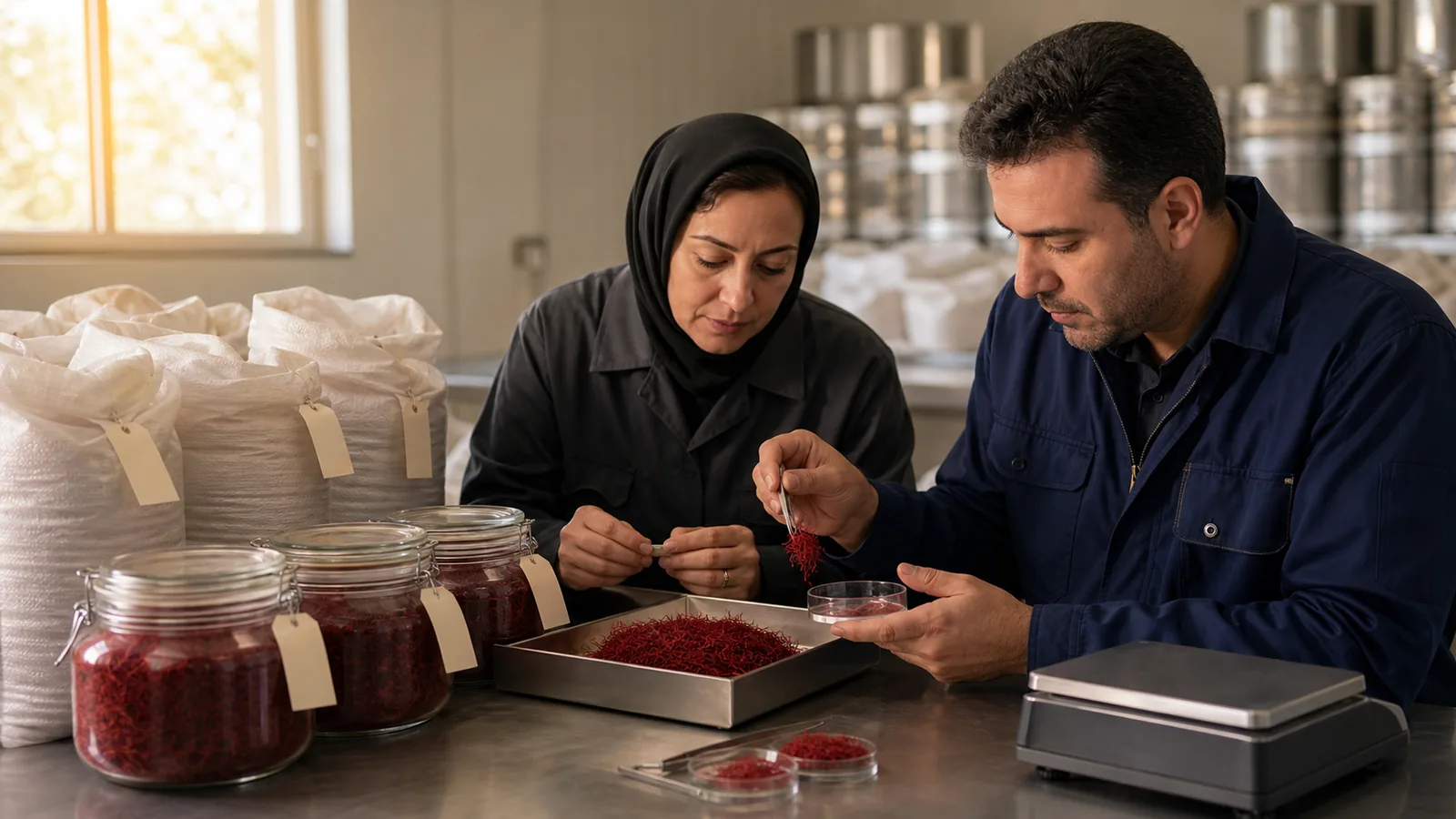
Independent laboratory work and representative sampling are central to that confidence. Testing an unrepresentative pinch from a large lot cannot prove the condition of the whole consignment. Records also need to connect the sampled lot with the warehouse receipt so that an approved product is not exchanged for a different one before delivery.
Why futures trading was welcomed
Mehrfard described the start of saffron futures transactions as a promising development. Futures can let market participants express expectations about a later price in a public venue. They can also help a producer or buyer reduce exposure to an adverse price move, provided the contract reflects the physical market closely enough to be useful.
The CFTC’s explanation of agricultural futures notes that exchanges specify contract size, delivery months, locations and acceptable qualities or grades. It also explains that standardization can improve liquidity because many participants are able to trade the same instrument.
A futures market does not dictate a correct price, and a contract with little trading can give a weak signal. A handful of transactions may reflect the immediate needs of those traders rather than the wider saffron economy. Cash-market information, warehouse stocks, crop estimates, export demand and actual quality premiums are still needed to interpret the quotation.
The smallholder liquidity problem behind harvest-time sales
The original speech identified a practical obstacle: many saffron growers operate on a small scale and need cash soon after harvest. That can lead them to sell together when supply is most visible, even if holding a properly dried and stored lot might offer a better opportunity later.
Mehrfard said the Rural Cooperative Organization had purchased 67 tonnes of saffron that year. The archived report does not give the purchase dates, grades, prices or final disposition, so the figure cannot tell us whether the programme improved growers’ net returns. It does show the scale of the attempt to relieve immediate selling pressure.
A market-based solution would give small growers several practical choices. They might sell at harvest, place an eligible lot in an approved warehouse, finance part of its value against a warehouse receipt, or combine their crop through a cooperative that can afford testing and negotiate by grade. Each option has costs and risks, but access matters more than a trading screen that small producers cannot use.
Quality work begins before saffron reaches the exchange
Mehrfard called for better technology and stronger farmer organizations. He specifically mentioned workshops for flower picking and hygienic separation of the stigmas, saying 205 workshops and sites existed and another 22 were under construction. No public inventory or completion report accompanied the translated statement, so those numbers should be treated as a historical programme claim rather than a current facility count.
The underlying need is clear. Timing during harvest, clean working surfaces, careful separation, controlled drying and moisture-resistant storage all affect the condition of the finished saffron. Training is useful when it is paired with equipment, testable procedures and a buyer willing to pay for the resulting grade.
Farmer organizations can also reduce the cost of those systems. Shared drying equipment, lot records, sampling and laboratory access may be more realistic than asking every small farm to reproduce the same facilities. The organization must keep members’ lots traceable, however; pooling without records can hide good work instead of rewarding it.
Competition abroad and the effect of exchange rates
The second challenge in Mehrfard’s account was overseas competition. He said prices were being pushed down and noted that foreign buyers purchased saffron in rials. When the rial weakened against the dollar, the same foreign-currency payment could buy more saffron unless domestic prices adjusted.
That exchange-rate effect can make an export price look stable in dollars while the return received by different participants changes sharply in local currency. It can also separate the farm-gate price from the amount visible in customs statistics, since exporters face testing, packing, finance, transport and sales costs after buying the crop.
A useful benchmark therefore needs clarity about currency and location. A warehouse price in Iran is not automatically the same as a delivered price in Europe, the Gulf or East Asia. Freight, insurance, import requirements, distributor margins and local demand sit between the two.
The corm-smuggling concern needs careful wording
Mehrfard also alleged that saffron corms were being smuggled from Iran into Afghanistan and then to other countries. The stored report does not provide customs cases, volumes or destinations, so it is not evidence that every transfer followed that route or that legal plant trade did not occur.
The concern had two possible dimensions. Uncontrolled movement of planting material can bypass plant-health checks, while the spread of production knowledge may increase future competition. These are different issues and should not be blurred. Protecting crop health calls for traceable, lawful movement and phytosanitary controls; maintaining commercial strength calls for better quality, productivity, customer relationships and market institutions.
Saffron is more than a medicinal commodity
The speech contrasted saffron’s use as food in Iran with its use as medicine elsewhere. That is too broad. Saffron is used as a spice, colour and aroma ingredient in many countries, while its compounds are also researched and used in some traditional practices and commercial products.
Research interest does not turn every saffron product into a medicine or establish that it treats a condition. Medical claims depend on the exact preparation, dose, evidence and rules of the market where the product is sold. A commodity price should not assume a medicinal premium unless the traded specification and buyer’s application actually justify it.
Can Iran become the saffron reference price?
Iran’s production and export scale gave Mehrfard’s argument real weight. The 2017 export record also shows why an Iranian trading venue could matter internationally. Supply leadership creates the opportunity, but transparent participation and trusted specifications are what turn that opportunity into a benchmark.
The strongest reference would connect farms, approved testing, warehouse receipts, physical buyers and an active exchange. It would publish enough information for people to see which grade traded, where it could be delivered and how much volume supported the price. Farmers would need a practical route into that system rather than remaining price takers outside it.
Iran should be the reference price for saffron only if its quotation describes real, verifiable saffron and earns voluntary use beyond the exchange itself. A price becomes influential when traders trust it in contracts, not when a production statistic declares it so.

![Exporting Saffron to Turkey + Price Guide [Complete 0 to 100]](https://img.rowhanisaffron.com/20260827003933/saffron-export-turkey-quality-inspection.webp)



