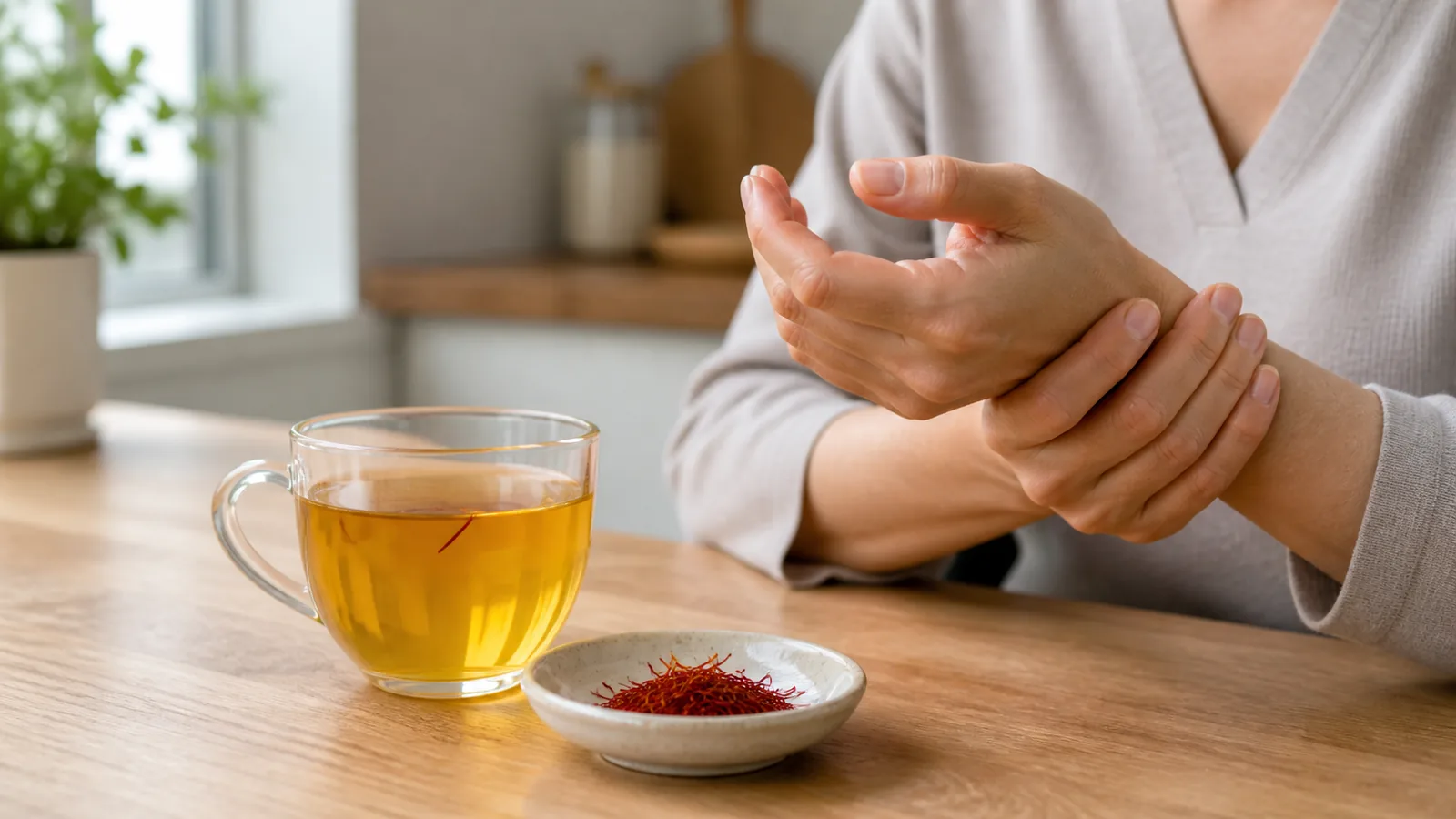
Saffron has been studied for depressive symptoms, but the evidence does not make it a miraculous remedy or a substitute for professional care. The most accurate way to discuss saffron for depression treatment is as a promising research subject: several small trials and later reviews report benefits, while important questions about product consistency, long-term safety and who is most likely to respond remain open.
This article explains what the clinical studies actually tested, where early comparisons with fluoxetine are often overstated, and what someone should consider before using a concentrated saffron product.
What the research on saffron and depression found
The early studies were not tests of ordinary saffron added to food. They generally used a measured capsule containing saffron stigma, petals or a standardized extract, and followed people for a limited number of weeks. That distinction matters because two supplements carrying the word “saffron” may not contain the same plant part, dose or concentration.
A 2020 meta-analysis combined 12 studies of mild-to-moderate depression. It found a larger improvement in symptoms with saffron than with placebo and no clear efficacy difference between saffron and the antidepressants used as comparators. The authors also called for larger, longer and more geographically diverse trials. A separate 2019 review of 23 studies found encouraging effects but detected publication bias and limited regional diversity. Those limitations make the findings promising, not definitive.
A newer review of 34 randomized trials reported improvement on self-rated depression and anxiety scales, but not on the clinician-rated depression and anxiety scales it assessed. It rated the certainty of the evidence as moderate. Different scales, preparations and study populations can produce different answers, which is one reason a headline such as “saffron cures depression” goes beyond the evidence.
The six-week saffron and fluoxetine trial
One frequently repeated claim comes from a 2005 pilot trial. It was a double-blind, randomized, single-center study of 40 adults with mild-to-moderate major depression. For six weeks, participants received either a saffron stigma extract at 30 mg per day or fluoxetine at 20 mg per day. Symptoms improved in both groups, and the researchers found no statistically significant difference between them.
That result needs careful wording. A small pilot study finding no difference is not proof that every saffron product is equivalent to fluoxetine. The study was brief, involved only 40 people and tested one defined preparation under research conditions. Its abstract also reports no significant difference between the groups in observed side effects.
The older source article described 38 participants aged 18 to 55 and said the saffron group avoided sexual dysfunction, tremor and sweating. Those details do not match the study abstract’s primary description: 40 adults entered the trial, and the reported between-group side-effect difference was not significant. They should not be presented as proof that saffron avoids antidepressant adverse effects.
Does saffron work by increasing serotonin?
Saffron contains compounds including crocin, crocetin, picrocrocin and safranal. Laboratory and animal research has proposed serotonergic, antioxidant, anti-inflammatory and neuroprotective pathways. These are possible mechanisms, not a confirmed explanation of how saffron changes depression in people.
It is therefore too simple to say that saffron “raises serotonin” in the same way as a selective serotonin reuptake inhibitor. Clinical trials measure symptoms; they do not automatically prove a particular brain mechanism. Crocin and safranal may be relevant to the research, while picrocrocin is best known for saffron’s bitter taste. For a broader introduction to the spice and its compounds, see our guide to saffron beyond its culinary role.
Saffron versus conventional depression care
Depression is not one uniform condition. Severity, other health problems, pregnancy, bipolar symptoms, current medication and risk of self-harm all affect what care is appropriate. Established options include psychotherapy, medication and, in some circumstances, other clinician-supervised treatments. Response and side effects vary from person to person.
Saffron research should not be read as a reason to stop an antidepressant, change its dose or delay an assessment. The U.S. National Institute of Mental Health advises people not to stop prescribed medication without help from a healthcare provider. The National Center for Complementary and Integrative Health similarly warns against replacing conventional depression care with a complementary approach.
If someone is in immediate danger or is thinking about suicide, an article about supplements is not the right level of help. Contact the local emergency service or crisis service now; in the United States, call or text 988.
What about anxiety, sleep and mood in healthy people?
Depression can occur alongside anxiety and disturbed sleep, and saffron has been examined for both. Some reviews report improvements, but results vary by population and outcome scale. Evidence from a group with diagnosed depression cannot automatically be extended to everyone with insomnia, everyday stress or a temporary low mood.
The same caution applies to claims about healthy people. A positive result from a particular extract does not establish that culinary saffron will raise serotonin or dopamine, improve memory or create a general mood boost. Those broad promises were removed here because they were not supported by the cited depression trials.
Dose, product quality and safety
The 30 mg amount in the fluoxetine comparison describes the study’s daily saffron preparation; it is not a personal dosing recommendation. Extracts can differ in plant part, concentration and chemical profile, and milligrams of an extract cannot be treated as interchangeable with milligrams of loose spice. A product considered for clinical use should clearly identify its ingredients, serving size, manufacturer and quality testing.
“Natural” does not mean free of adverse effects. Reviews have reported effects such as nausea, dry mouth, appetite changes and headache, while long-term and high-dose evidence remains limited. Herbal products can also interact with medicines, and the interaction evidence for many combinations is incomplete.
Before taking a concentrated saffron supplement, speak with a doctor or pharmacist if you use an antidepressant, anticoagulant or other regular medication; have bipolar disorder or another psychiatric condition; are pregnant or breastfeeding; or are considering it for a child. Do not combine products or increase a dose to reproduce a research result.
Questions worth taking to a healthcare professional
- Does the research apply to my diagnosis and symptom severity?
- Could this preparation interact with my medicines or medical conditions?
- Is the product comparable to the standardized extract used in a cited trial?
- How will benefit, side effects and worsening symptoms be monitored?
- What should I do if my mood deteriorates or I develop suicidal thoughts?
A measured conclusion
Research on saffron for depression treatment is encouraging enough to justify continued clinical study. Small trials have reported symptom improvement, and pooled analyses often favor saffron over placebo. At the same time, short follow-up, small samples, variable preparations, publication bias and inconsistent outcome measures prevent a claim that saffron is a proven replacement for antidepressants.
For a reader, the useful conclusion is modest: saffron may be worth discussing as a complementary option with a qualified healthcare professional. It should not be sold as a cure, used to self-treat serious symptoms or used as a reason to stop established care.
Research and official guidance
- Noorbala et al.: six-week saffron-versus-fluoxetine pilot trial
- Dai et al.: 2020 systematic review and meta-analysis
- Marx et al.: 2019 systematic review and meta-analysis
- Mahmoudi et al.: GRADE-assessed review of 34 trials
- National Institute of Mental Health: depression and treatment
- NCCIH: depression and complementary health approaches