


Saffron farming in North Khorasan has repeatedly been reported above Iran’s national average yield. The claim is plausible for the season described, but it only becomes useful when the year, productive area and unit—fresh flowers or dried saffron—are kept clear.
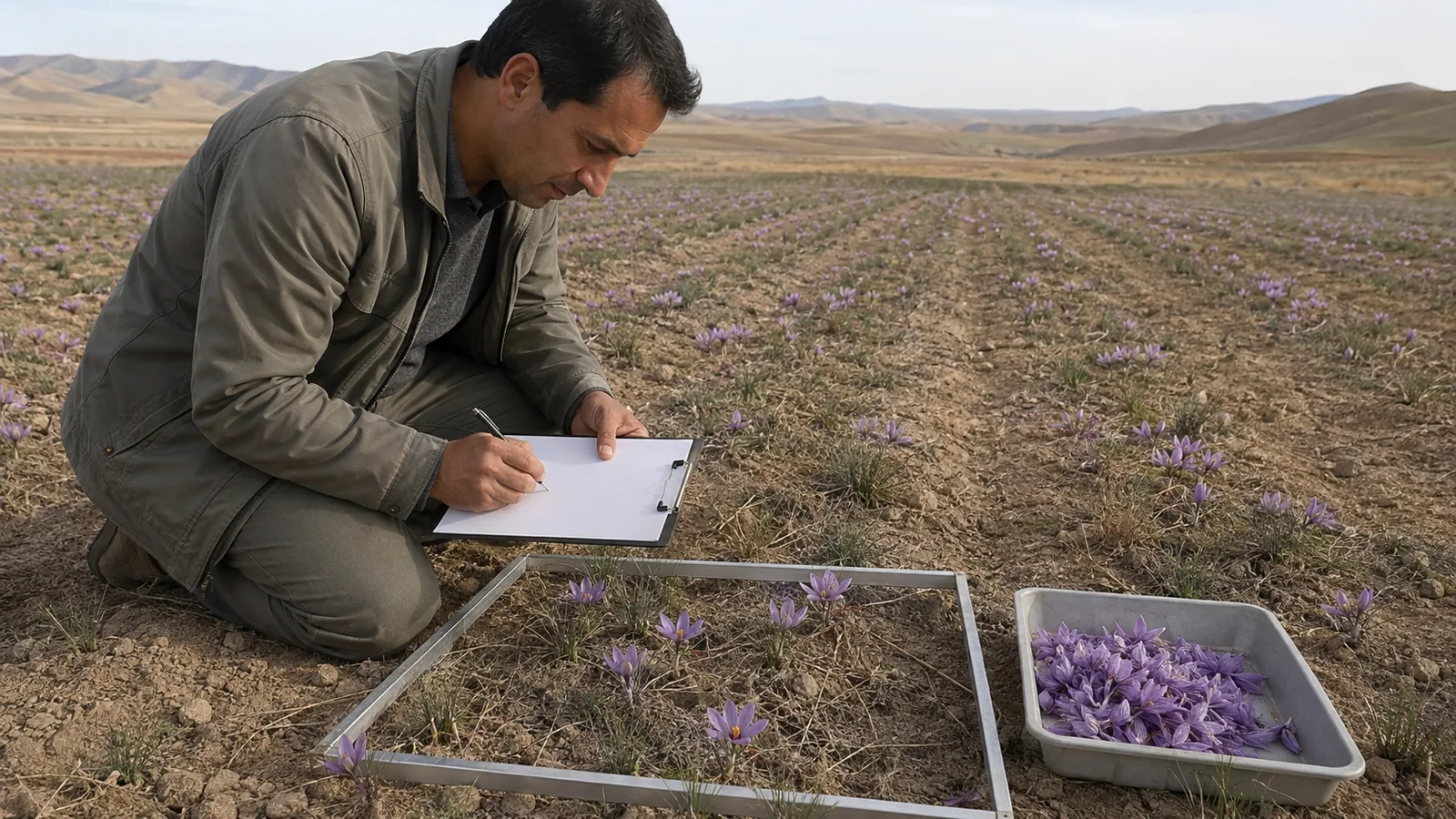
The reported North Khorasan yield
The original article attributed its figures to Mohamad Eftekhari, described as a horticulture director at the North Khorasan Agricultural Jihad Organization. It reported an average dried-saffron yield of 6 to 7 kg per hectare in the province, compared with a national average of 4 kg/ha.
A dated report from Iran’s Agricultural News Agency (IANA) provides useful support. On 28 October 2021, the provincial horticulture director said North Khorasan averaged more than 6.2 kg/ha, roughly twice the national comparison used in that report. It also placed the province third by saffron cultivation area and production for that season.
Neither figure should be treated as a guaranteed yield for a new field or as a live 2026 average. Weather, field age, corm stock and which hectares are included can change the result from one report to the next.
Correcting the “27 tonnes of saffron flowers” claim
The old copy said North Khorasan was expected to produce 27 tonnes of saffron flowers from more than 4,350 hectares. That wording conflicts with the yield figures in the same article.
If 4,350 hectares produced 6 kg of dried saffron per hectare, the result would be 26.1 tonnes of dried stigma. At 7 kg/ha, it would be 30.45 tonnes. A 27-tonne forecast therefore fits the article’s dried-saffron arithmetic, not a province-wide fresh-flower total. Fresh flowers weigh far more than the dried red stigmas separated from them.
Because the original source document is not linked, the safest conclusion is that “flowers” was a translation or unit error. The 27-tonne number is retained as a historical forecast, but it should be described as saffron production unless the original Persian statement confirms otherwise.
Area, productive fields and average yield
The report used three related figures:
- more than 4,350 hectares under saffron cultivation across North Khorasan;
- about 4,000 hectares described as actively producing;
- 3,600 hectares attributed to Faruj County.
These categories need not be identical. Newly planted fields may not yet contribute a normal harvest, while old or stressed plots can remain within the cultivated area but produce little. An average calculated over productive hectares will be higher than one calculated over every planted hectare.
That denominator may explain why the 2021 IANA report could quote both a 22-tonne provincial forecast and an average above 6.2 kg/ha. Dividing 22 tonnes by all 4,350 hectares gives about 5.1 kg/ha; applying the higher yield only to productive fields gives a different total. Good reporting should state which land base was used.
Faruj’s contribution to Khorasan saffron
Faruj—also written Farouj—was named as North Khorasan’s leading saffron area in both the original post and the dated IANA report. The source article assigned 3,600 hectares to the county, said the province produced more than 21 tonnes in the previous season and forecast a 10% increase.
Those numbers should not be combined without checking their scope. A 10% rise from 21 tonnes would be about 23.1 tonnes, not 27 tonnes. The difference may reflect “more than 21,” a revised area, a different baseline or a copied forecast from another year. It is evidence that every production comparison needs its original season and definition.
What can raise saffron yield per hectare?
Corm size, health and planting density
Saffron’s stored reserves begin in the corm. Healthy planting material, an appropriate size mix and careful storage support establishment. Density also changes flower and daughter-corm production.
A three-season experiment conducted about 10 kilometres from Shirvan compared 50, 100 and 150 corms per square metre under different nutrient treatments. The study, indexed by FAO AGRIS, found that density and manure treatment affected flower and corm results under Northern Khorasan conditions. It offers local evidence, not a universal recipe for every soil or field age.
Field age and stand condition
A saffron plot changes as daughter corms multiply. Early fields, mature productive stands and crowded declining plots should not be compared as though they are the same. Keeping each plot’s planting year and harvest history makes a provincial average more informative.
Irrigation and soil management
Saffron can fit semi-arid farming systems, yet “low water” does not mean that shortage is harmless. Moisture at establishment, flowering and the winter-spring leaf period affects the crop. Soil texture, drainage and rainfall determine how a schedule performs.
Nutrient decisions should begin with soil evidence. Applying more fertilizer or raw manure without knowing the field can waste money, introduce contamination and make comparisons less reliable.
Harvest and post-harvest control
A high flower yield can lose value if crews cannot pick and separate the crop promptly. Clean containers, timely separation and controlled drying protect the weight and quality that will be measured as saleable saffron.
Employment behind the production number
The source article said more than 20,000 rural workers participated in the provincial harvest. It did not provide a year, employment definition or method, so this remains an attributed historical estimate rather than a current workforce total.
Harvest participation is mostly seasonal. It includes picking, moving flowers and separating stigmas; longer-lived jobs may also exist in drying, grading, testing, packaging and sales. Our article on saffron farming and local employment in North Khorasan explains why worker counts and person-days are not interchangeable.
Is saffron a sustainable crop for an arid region?
Saffron’s seasonal pattern and relatively modest water demand can make it a useful option in dry and semi-dry areas. The original article went too far by implying that it faces few water-scarcity problems or automatically guarantees profit.
A crop is only locally sustainable if withdrawals match available water, soil remains productive, planting material stays healthy and the market covers labour and handling costs. Warm winters, irregular rain, poor irrigation timing and weak prices can still affect the result.
North Khorasan’s broader agricultural context
The old report placed saffron within more than 344,000 hectares of agricultural land, including 47,000 hectares of orchards. Those totals are retained as the source official’s historical context, not a current land census, because no statistical year was supplied.
The important comparison is not simply saffron area versus all farmland. It is the value and employment produced per unit of scarce land and water, balanced against risk, labour availability and what else the same resources could support.
How to compare production claims responsibly
- Record the agricultural year and publication date.
- Separate planted area from productive area.
- State whether output means fresh flowers or dried stigma.
- Use the same area and output definitions when calculating kg/ha.
- Distinguish forecasts from final measured harvests.
- Compare Faruj, North Khorasan and national figures at the same geographic level.
- Keep field age, corm density and weather in view before assigning a cause.
What “above the national average” really means
For the season documented by IANA, North Khorasan’s reported average was indeed above the national comparison quoted by the provincial official. That is a meaningful regional result, not proof that every field is more productive or that the same gap persists every year.
The best lesson is practical: strong Khorasan saffron production comes from measurable field management and careful handling, and strong reporting uses dates, units and consistent denominators. Keeping those details together makes the province’s achievement more credible rather than less.

![Exporting Saffron to Turkey + Price Guide [Complete 0 to 100]](https://img.rowhanisaffron.com/20260827003933/saffron-export-turkey-quality-inspection.webp)



