


Saffron farming in North Khorasan creates a burst of seasonal work when flowers open across thousands of hectares. The crop supports more than field picking: stigma separation, drying, transport, grading, processing and packing all need people, but the type and duration of those jobs should be described accurately.
What the original employment report measured
The source report, attributed to the horticultural director of North Khorasan’s Agricultural Jihad Organization, said the saffron harvest covered 4,350 hectares and generated 31,800 person-days over two months. It converted that total into “daily jobs for 530 workers.”
Those two figures describe the same workload in different ways: 31,800 person-days divided across roughly 60 days equals an average of 530 working places per day. They do not mean that 31,800 people held permanent jobs, nor that exactly 530 people worked on every farm. Peak flowering can require larger crews for a shorter period.
The year was not stated in the original English copy, so these numbers remain historical report figures rather than a current 2026 employment count.
Why the harvest creates so much work
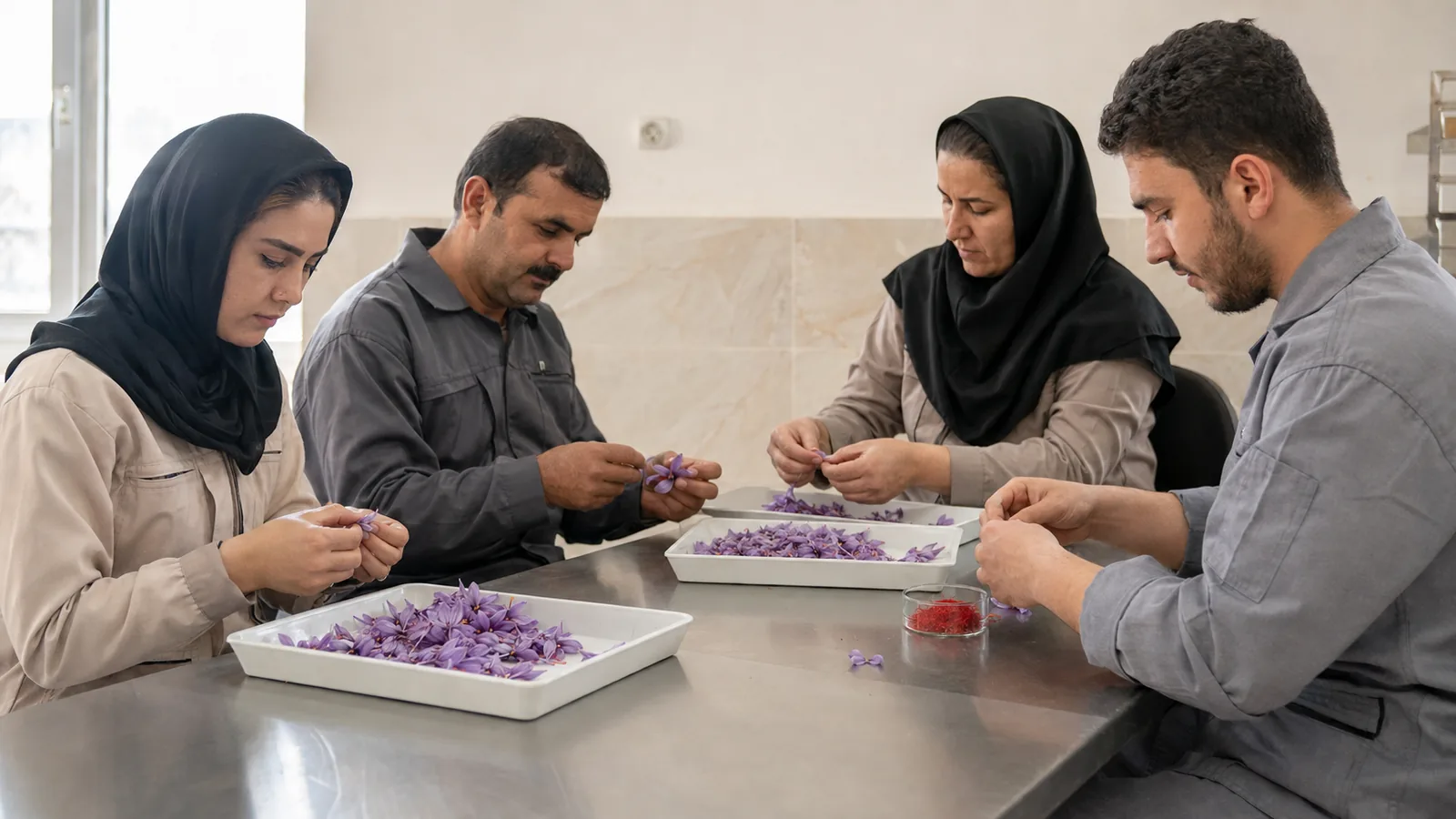
Across Iran, the saffron harvest season in Khorasan usually falls in October and November, although each locality and year can shift. Picking cannot be spread evenly through the season, and flowers need careful handling after they leave the field. A typical harvest workflow includes:
- checking fields and organizing crews before the morning’s picking;
- collecting flowers into clean, shallow containers;
- moving them without crushing or overheating the load;
- separating the red stigmas from petals and stamens;
- drying the stigmas under controlled, hygienic conditions;
- sorting, recording and packing each lot.
Some workers move between these tasks; others specialize. The North Khorasan harvest guide explains the sequence and why delays during peak bloom are difficult to recover later.
Seasonal work is valuable, but it is not year-round employment
The harvest brings cash income to rural households at an important point in the agricultural year. It may also create opportunities for family members and local residents who are not employed on the farm full time. That value should not be inflated into a claim that saffron alone guarantees permanent work.
Longer-lasting employment comes from activities around the crop: corm selection, field records, irrigation maintenance, drying, laboratory testing, warehouse management, product development, packaging, sales and export compliance. These roles extend the value chain beyond the weeks when flowers are visible.
In November 2025, the UN Food and Agriculture Organization and Iran’s Ministry of Agriculture-Jahad held a programme on saffron quality integrity and value-chain development. It brought together farmers, processors, cooperatives, traders and technical specialists, reflecting the range of work needed to turn stigmas into a trusted product.
North Khorasan’s reported cultivation and production
The original employment report also recorded 4,350 hectares under saffron, with about 4,000 hectares described as productive. It said the province had harvested more than 21 tonnes in the previous season and forecast 22 tonnes for the reporting year. Faruj—or Farouj—was identified as the leading county.
A dated IANA report from 28 October 2021 independently recorded the same 4,350-hectare area and a 22-tonne forecast. It described North Khorasan as third among Iranian provinces by saffron area and production and again named Farouj as the largest local production area.
Saffron yield per hectare
The source article gave an average North Khorasan yield of 6 to 7 kg of dried saffron per hectare, compared with a national figure of 4 kg/ha. The 2021 IANA report placed the provincial average above 6.2 kg/ha, providing dated support for the general comparison.
An average is not a promise for an individual field. Corm size and health, planting density, field age, soil, irrigation, nutrition, weeds, harvest timing and drying losses all affect the result. Yield should also be calculated from dried stigma weight, not fresh flower weight.
For employment planning, total hectares are not enough. A dense field at peak flowering may require more picking and separation hours than a younger or lower-yielding field of the same size.
How to read the old saffron prices
The original report listed four prices per kilogram:
- 41.35 million rials for a translated “premium” category;
- 36 million rials for “regular stigmas”;
- 33 million rials for “semi-premium” material;
- 32 million rials for what the copy called “high-quality threads.”
These values are retained as an archived market snapshot, not current prices. The category names are not clear commercial grades, the date is missing, and the final label appears inconsistent with the price order. They should not be used to value today’s crop without the original quotation sheet, grade definitions, date and currency context.
The report also said the Rural Cooperative Network was prepared to buy if prices fell. That records an intention at the time; it is not a standing guarantee for every later season. Farmers should confirm any active purchase programme, eligible grade, delivery point and payment terms directly.
Water use and the limits of a “drought crop”
Saffron’s growth cycle can suit dry and semi-dry regions, but the old claim that it faces few water-scarcity challenges was too broad. The crop still needs moisture at important stages, and leaves continue supporting replacement corms after flowering.
Water shortages, uneven irrigation and unusually warm or dry conditions can affect both the present harvest and future seasons. Calling saffron relatively low-water is useful only when it leads to careful scheduling, not neglect.
The wider agricultural setting
The source report placed saffron within 344,000 hectares of agricultural land in North Khorasan, including 47,000 hectares of orchards. Because the year and statistical publication were absent, those totals should be treated as the context used by the original official, not as a live land-use census.
Saffron’s small share of physical area can still create concentrated work because harvesting and stigma separation demand many hands at once. Its economic contribution depends on what happens after harvest as well: product sold anonymously in bulk supports a different mix of jobs from traceable saffron that is tested, packed and marketed locally.
What better local employment would look like
Planned and safe harvest work
Growers can estimate labour from field history, expected bloom and picking capacity, then organize transport and separation teams before the peak. Clean workspaces, reasonable shifts, drinking water, adequate light and safe tools matter just as much as the headcount.
Skills that remain useful after flowering
Training in drying control, lot records, moisture management, grading and food hygiene gives seasonal workers skills that can support processing and packing roles. Digital inventory, traceability and sales work can continue when fields are no longer flowering.
Transparent markets
Employment is more resilient when growers know how a lot was graded, what deductions apply and when payment will arrive. A clear market reduces the chance that a short-lived price claim is mistaken for dependable household income.
From a two-month harvest to a stronger local industry
The 530 daily jobs and 31,800 person-days in the original report help show the scale of seasonal effort. The stronger story is what those hands accomplish: they move a delicate crop from the soil through separation and drying while its quality can still be protected.
Saffron farming in North Khorasan can support broader local employment when field production connects to skilled processing, traceable packaging and credible market access. That is more durable than treating a harvest forecast or an old price list as proof that every part of the industry is already secure.

![Exporting Saffron to Turkey + Price Guide [Complete 0 to 100]](https://img.rowhanisaffron.com/20260827003933/saffron-export-turkey-quality-inspection.webp)



