Saffron extract has been studied for memory and cognitive symptoms, particularly in small trials involving people with Alzheimer’s disease. Some results are encouraging, but they do not show that saffron prevents neurodegeneration or works as a general memory enhancer. Most proposed mechanisms still come from cell and animal research, and clinical use should be discussed with the treating specialist.
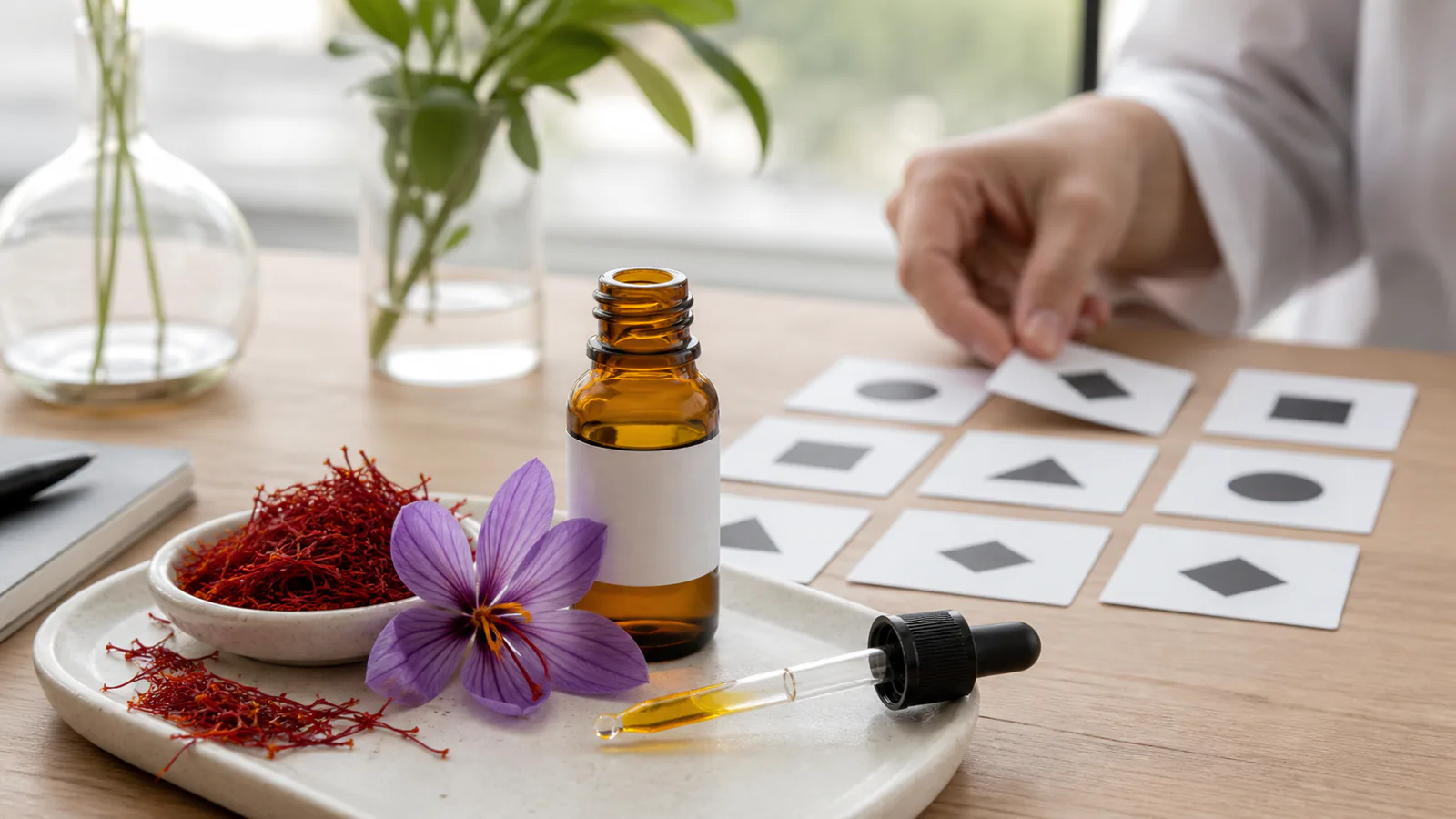
“Saffron extract” is also not one uniform substance. A trial preparation can differ substantially from a culinary spice, tea or retail supplement, so the result of one study cannot be assumed for every product.
What saffron extract contains
Saffron comes from the dried stigmas of Crocus sativus. Its best-known constituents include crocin and crocetin, which contribute to colour, and safranal, which contributes to aroma. Extracts use a solvent and a defined process to concentrate or standardise selected compounds.
That preparation matters. A study may specify the plant material, extraction method and amount of active constituents; a product sold online may disclose little more than total milligrams. Without a comparable composition, it is not possible to say that the two are equivalent.
What human studies have found
One often-cited 2010 randomised trial enrolled 46 people with probable mild-to-moderate Alzheimer’s disease. Over 16 weeks, the group receiving a defined saffron preparation had better results than placebo on two cognitive and clinical scales. The investigators called for larger confirmatory trials.
A 2024 systematic review of neurological and psychiatric trials reported a favourable pooled result for cognition. It also brought together studies with different populations, preparations, comparison treatments and durations. That breadth is useful for mapping the field, but it does not answer every practical question about long-term benefit, disease progression or the best formulation.
A separate 2024 review of neurodegenerative-disease research included 30 studies: only six were clinical trials, while 24 were preclinical. This balance explains why laboratory mechanisms are discussed more confidently than real-world treatment outcomes.
Alzheimer’s evidence is not a general memory claim
A change on a disease-specific cognitive scale in a supervised trial does not prove that saffron improves memory in healthy adults, prevents dementia or reverses established brain damage. These are different questions and need different studies.
Alzheimer’s disease is diagnosed through clinical assessment, and memory symptoms can have many causes. Depression, sleep problems, medication effects, thyroid disease, vitamin deficiencies, infections and other neurological conditions can all affect cognition. New or worsening memory problems deserve a medical evaluation rather than self-treatment.
For a broader discussion of healthy volunteers, ageing and different types of memory tests, see our guide to saffron’s effects on memory.
What about Parkinson’s disease?
Crocin, crocetin and safranal have been explored in models of oxidative stress, inflammation, protein aggregation and neuronal injury. Many Parkinson’s-related findings come from cultured cells or animals exposed to chemicals that reproduce selected features of the disease.
Those experiments can reveal a possible biological pathway. They do not establish that saffron improves movement, slows progression or changes quality of life in people with Parkinson’s disease. The human evidence is not strong enough to treat the spice or an extract as a Parkinson’s therapy.
Why antioxidant language can mislead
Calling crocin an antioxidant describes activity measured under certain experimental conditions. It does not tell us whether enough of the compound reaches the brain, how it is metabolised, or whether changing an oxidative marker improves a patient’s symptoms.
Neurodegenerative diseases involve overlapping processes and vary greatly between individuals. A plausible mechanism is the start of a research programme, not the final proof of treatment.
Safety and medicine interactions
Culinary use and concentrated supplementation should be considered separately. Trial participants receive a defined preparation and are screened and monitored; retail extracts can vary. Taking more than a study used does not make a result more likely and can increase risk.
People who are pregnant, preparing for surgery, using blood-thinning or blood-pressure medication, or managing several conditions should ask a clinician or pharmacist before taking a concentrated saffron product. Do not stop donepezil, memantine or another prescribed treatment to try saffron.
Questions to ask about an extract
- Is the product whole saffron, an extract or an isolated constituent?
- Is its composition standardised and independently tested?
- Was the relevant study conducted in people with the same condition?
- Did it measure symptoms, cognitive scores, daily function or disease progression?
- How long did the study last, and how many people completed it?
- Were adverse effects and medicine interactions monitored?
The careful conclusion is that saffron extract has an emerging clinical evidence base for cognition, with a few small Alzheimer’s trials and a much larger body of preclinical research. It remains a subject for rigorous study, not a replacement for diagnosis or established care.